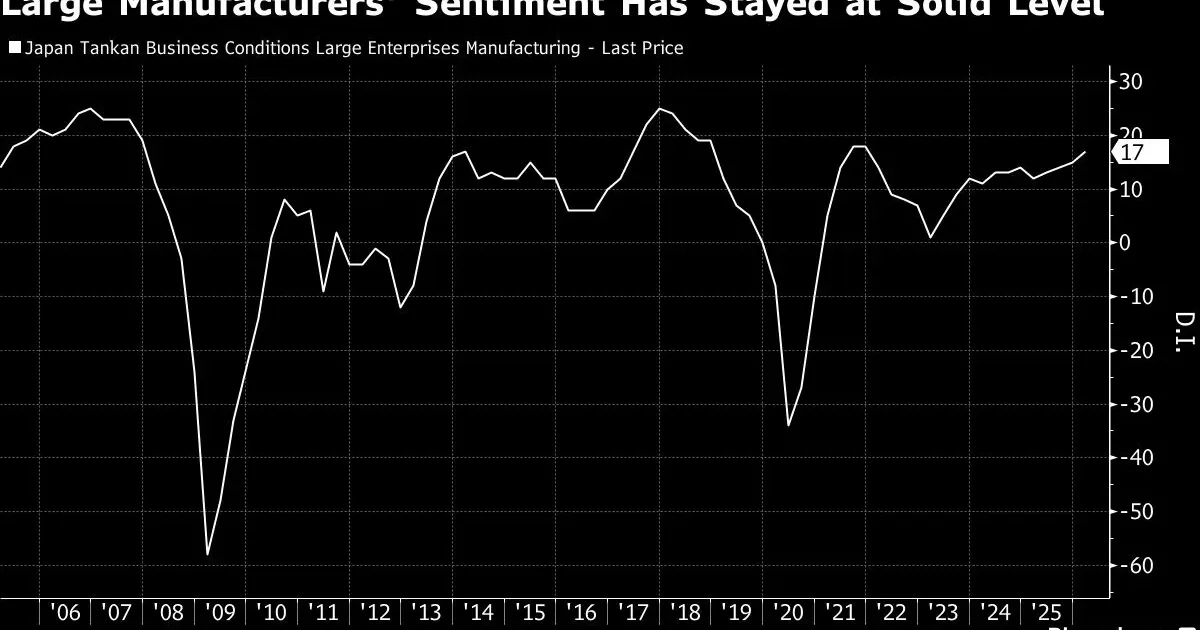
Japan's latest Tankan survey gave the Bank of Japan a stronger corporate signal than the earlier spring reading. Large-manufacturer sentiment rose to 22 in June from 17 in the previous quarter, marking a fifth straight improvement. Large non-manufacturers also edged higher to 37. On paper, that is the kind of business confidence a central bank wants to see while it exits decades of ultra-low rates.
But the number is less comfortable than it looks. Japan is still dealing with a weak yen, imported energy pressure, war-linked oil anxiety and the political risk of households feeling poorer even as major companies sound upbeat. The BOJ raised its policy rate to 1% in June, the highest level in three decades, so the Tankan is now being read in a different policy setting. It is not a green light for complacency.
The New Tankan Beat the Old Story
The earlier frame around Japan's business mood centered on a move from 16 to 17 and a fourth quarter of improvement. That was a useful March signal, but it is no longer the current story. The June survey showed a clearer gain, with the large-manufacturer diffusion index moving to 22. The services side also remained firm, rising slightly instead of cracking under price pressure.
The stronger reading matters because the Tankan is not just a sentiment headline. It captures the gap between firms reporting favorable and unfavorable conditions, and investors use it to judge whether corporate Japan can tolerate tighter money. A stronger reading tells the BOJ that big firms are still operating with confidence. It does not tell the BOJ that all parts of the economy are comfortable.
Exporters Benefit From the Yen, Households Pay for It
The weak yen remains the contradiction inside Japan's recovery. For exporters, overseas earnings translated into yen look better. Autos, machinery, electronics and capital-goods firms can report stronger revenue even when global conditions are uneven. That helps explain why large manufacturers can look resilient.
The same currency move hurts consumers and import-heavy businesses. Japan imports nearly all of its oil and gas, so yen weakness turns energy and food into a domestic inflation problem. A company can book stronger export income while a household pays more for utilities, groceries and travel. That split is exactly why the Tankan cannot be treated as a whole-economy victory lap.
The Iran Shock Changed the Policy Math
The Iran war added another layer to the BOJ's problem. Higher fuel prices pushed up inflation fears, even though crude prices eased after an interim U.S.-Iran deal. Japan's exposure is direct because Middle East energy disruption moves through shipping, LNG, petrochemicals, electricity bills and factory input costs.
Imported energy inflation is awkward for a central bank. It is not the clean demand-led price growth policymakers prefer to see. It can squeeze real incomes while making rate cuts harder and rate hikes riskier. The June rate increase to 1% showed that the BOJ was willing to keep normalizing, but the Tankan does not remove the two-way risk. It only says large companies have not yet broken under it.
Small Firms Are the Missing Test
Large firms usually absorb shocks first and pass them down later. They have currency hedges, supplier leverage, global earnings and access to credit. Smaller firms do not have the same buffer. When large manufacturers report better conditions, the next question is whether suppliers, retailers and regional employers can say the same after wages, fuel and financing costs are counted.
The pressure below the headline is where the BOJ has to be careful. A policy path built only on big-company confidence can miss the pressure below the headline. If small and mid-sized firms pull back on investment or hiring, the stronger Tankan becomes a narrow corporate signal rather than proof of broad economic health.
Ueda Has Cover, but Not a Blank Check
Governor Kazuo Ueda can use the Tankan to defend a gradual normalization path. Business confidence is improving, investment plans are still relatively firm, and Japan is not behaving like an economy that needs emergency settings forever. Those conditions support continued discipline after the June hike.
The opposite risk is moving as if the Tankan solved the distribution problem. It did not. Exporters, households, service firms, small suppliers and fiscal authorities are living through different versions of the same economy. BOJ caution should mean reading those differences honestly, not using one strong survey to flatten them.
Corporate Strength Still Has Weak Spots
Japan's corporate mood is improving while the economy remains exposed to the very forces that can turn confidence brittle: imported inflation, yen weakness, energy dependence and political pressure against tighter money. The Tankan gives Ueda cover to keep policy normalization alive. It does not prove that Japan has escaped the old trap of mistaking large-company strength for national resilience.
If the BOJ pauses too long, the yen can keep feeding imported inflation. If it tightens too quickly, weaker firms and households will carry the cost. The June Tankan strengthened the central bank's hand, but it also raised the standard for judgment. Stronger data now demands sharper policy, not easier slogans.