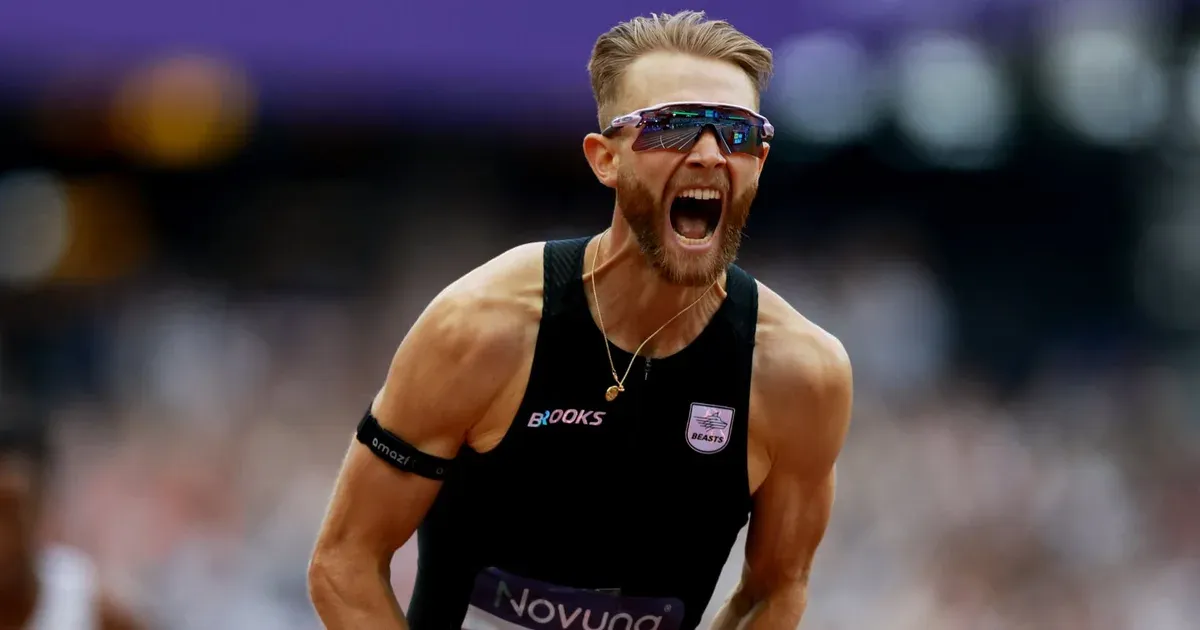
Josh Kerr delivered the race he had advertised for months. The 28-year-old British middle-distance runner won the Emsley Carr Mile in 3 minutes, 42.66 seconds at the London Diamond League, taking the men’s world record away from Hicham El Guerrouj after 27 years. Kerr arrived with a world 1,500-meter title and Olympic bronze and silver medals; his previous mile best was 3:45.34 at the 2024 Prefontaine Classic.
The run on July 18, 2026, lowered El Guerrouj’s 3:43.13 mark, set in Rome on July 7, 1999, by 0.47 seconds and made Kerr the first man under 3:43 for the outdoor mile. World Athletics said the performance remains subject to its usual ratification procedure.
Kerr had publicly tied his season to this one race when he announced the Project 222 record attempt in March. The project’s name referred to the 222-second territory he believed he could reach. The Guardian reported that he wrote the planned result and July 18 date in a notebook each day and timed his ice baths to 3 minutes, 42 seconds. There was no tactical disguise in London: the pacemakers, trackside lights and field were assembled around that target.
Kidder and Rudolf Put Kerr on Record Schedule
Training partner Brannon Kidder handled the opening pace with Žan Rudolf. World Athletics recorded Kidder at 54.75 through 400 meters and 1:50.63 at 800, fast enough to keep the record available without forcing Kerr to lead from the gun. A missed split would have been visible immediately to Kerr and the London Stadium crowd; the pair instead gave him a controlled first half. The arrangement also let Kerr conserve the smallest amount of energy available before he had to face the clock without shelter.
Once the pacemakers left, Kerr reached 1,200 meters in 2:46.39. The evenness of those checkpoints mattered more than a dramatic early surge: he arrived at the final lap close enough to the line set by El Guerrouj, with enough room to accelerate rather than repair a deficit. That was the section Kerr still had to own. Pacers could establish the schedule, but they could not carry him through the last bend or prevent his stride from tightening in the straight.
Kerr’s 3:42.66 Replaces the 1999 Benchmark
American Olympic medalist Yared Nuguse followed Kerr after the pacemakers stepped away, preventing the attempt from becoming a solitary time trial too early. The separation came late. Kerr passed 1,500 meters in 3:27.62, according to the Guardian, improving his own British record at that distance while still facing another 109.34 meters. He held his form down the straight and crossed with 3:42.66 on the clock.
Nuguse finished second in 3:45.69, 3.03 seconds behind Kerr. Jake Heyward ran a personal best of 3:46.73 for third, while Robert Farken took fourth in a German record of 3:46.82. Those marks show that the chase behind Kerr remained fast even after he had detached from it. The strain was less hidden in Kerr’s account than it looked from the stands. Speaking to the BBC after the race, he described how close the finish felt:
“I nearly lost it there at the end, but I got over the line.”
That admission fits the final margin. Kerr found less than half a second against a mark that had survived changing tracks, shoe designs and generations of elite milers. The result completed a plan rather than an unexpected breakthrough: his team built the season around July 18, used two designated pacemakers and accepted the pressure of a named campaign. The Guardian placed Kerr in the British mile lineage that includes Roger Bannister, Sebastian Coe and Steve Ovett. Sky Sports reported that the run also earned him a $50,000 world-record bonus.
The mile is not contested at the Olympic Games or World Athletics Championships, which helps explain why this attempt was built as a purpose-made race before a crowd reported at 60,000. Ratification is the administrative step between the stadium result and an official record. If the mark clears that process, the target will no longer be El Guerrouj’s time from Rome in 1999. Future milers will have to solve Kerr’s pattern: 1:50.63 at halfway, 2:46.39 at 1,200 meters and a closing stretch that left Nuguse three seconds back.