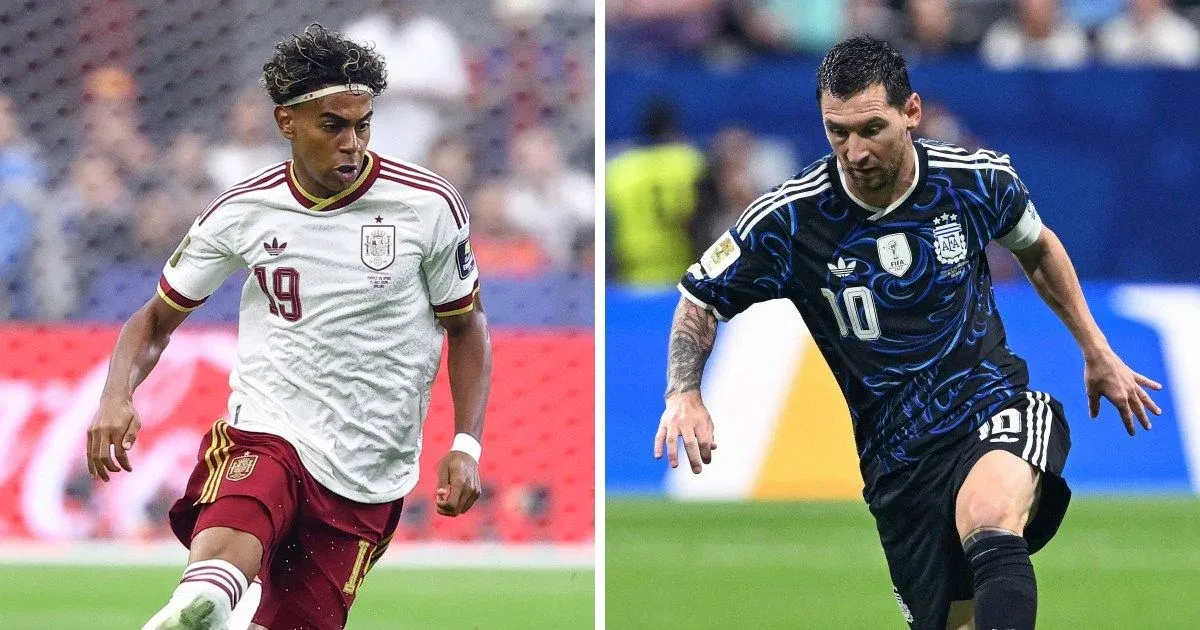
Lionel Messi and Lamine Yamal will lead Argentina and Spain into a World Cup final that pairs the defending champion with the most controlled attacking side of the tournament.
The match also places two Barcelona generations on opposite teams. FIFA scheduled the final for 3 p.m. Eastern Time on July 19, 2026, at New York New Jersey Stadium in East Rutherford, with more than 80,000 spectators expected inside.
Spain is seeking its second title after winning in 2010. Argentina can claim a fourth championship and become the first country since Brazil in 1958 and 1962 to win consecutive men's World Cups. The countries have met only once before at a World Cup, a 2-1 Argentina victory in the 1966 group stage. Sunday's match is their first meeting for the trophy and closes the first 48-team men's tournament after 104 games across the United States, Canada and Mexico, in sixteen host cities.
Spain Arrives With the Tournament's Best Attack
Spain beat France 2-0 in the semifinal after Lamine Yamal's movement drew the penalty converted by Mikel Oyarzabal and Pedro Porro added the second goal. The clean sheet denied Kylian Mbappe the central running lanes France had used earlier in the tournament. Luis de la Fuente's team reached only the second World Cup final in Spain's history with six wins and one draw.
FIFA's tournament analysis described the matchup as the best attack against the best defense. Rodri controls Spain's circulation under pressure, while Yamal leads the competition in receptions behind the opposing back line, giving the team both patient possession and a direct route into the penalty area. Spain opened with a draw against Cape Verde and then won six consecutive matches. Its quarterfinal against Belgium finished 2-1 before the semifinal shutout of France, a sequence that tested both the team's possession game and its ability to protect narrow leads late.
Argentina Has Survived Repeated Tests
Argentina is the tournament's only team with seven wins and no draws. The record hides a difficult knockout route: Lionel Scaloni's side needed extra time against Cape Verde and Switzerland, recovered from two goals down against Egypt, then overturned England's second-half lead in the semifinal. The group stage had been more direct: Argentina beat Algeria 3-0, Austria 2-0 and Jordan 3-1. The difference between those wins and the knockout rounds matters because Spain is unlikely to allow the same volume of transitions or uncontested central possession.
Enzo Fernandez equalized against England before Lautaro Martinez headed in a Messi cross during stoppage time for a 2-1 victory. Argentina had trailed after the interval, so Scaloni's substitutions and the timing of Messi's delivery carried the semifinal as much as the starting plan. Those late recoveries have given the team proof that it can win without controlling every phase of a match.
Messi, 39, is playing in his sixth World Cup and has another chance to extend his tournament scoring record. A victory would deliver the first consecutive titles since 1962, a standard no champion has matched during the modern expansion of the competition or its longer knockout paths.
Messi and Yamal Stretch Defenses in Different Areas
Messi receives between midfield and the penalty area, slows defenders and chooses the moment for a pass or central shot. Yamal attacks from Spain's right side, forcing the left back to defend width while a second player tracks his runs inside.
Those movements create two different defensive problems. Spain must keep a midfielder close enough to Messi without opening lanes for Martinez or Julian Alvarez; Argentina must prevent Yamal from isolating Nicolas Tagliafico while also protecting the central space occupied by Oyarzabal and Dani Olmo.
FIFA's performance rankings placed Messi first and Yamal second for creativity during the tournament. The comparison is not a claim that they perform the same job: Messi builds attacks from central pockets and set pieces, while Yamal's speed changes the width and timing of Spain's possessions.
Rodri and Alexis Mac Allister therefore carry as much influence as the headline forwards. FIFA data placed both among the tournament leaders for receiving the ball under pressure, with Rodri ahead of Mac Allister and Messi in that measure. The team that receives cleanly can keep its attackers facing goal; the team that loses those central exchanges will spend longer defending its own penalty area.
Smoke Forecast Adds a Match-Day Variable
Wildfire smoke affected the New York metropolitan area in the days before the final, prompting questions about training, spectators and exertion. A National Weather Service forecast cited by AP expected winds to improve conditions by Sunday, though officials continued to monitor air quality.
The expanded 48-team tournament has already drawn about 6.7 million spectators, according to FIFA figures reported by AP, a record total for the competition. The final is match 104 and the eighth game staged at the New Jersey venue, placing rail service, road access, stadium entry, heat and air monitoring under the heaviest crowd pressure of the competition. AP estimated that roughly 1.5 billion people could watch worldwide.
The stadium uses a temporary natural-grass surface laid over its regular field, a playing surface that has received mixed reviews during the tournament. Match officials can use cooling breaks if heat conditions demand them, while a tied score after 90 minutes would send the teams to two 15-minute extra-time periods and then penalties if needed.
Midfield Control Will Decide the Final Chance
Messi kept his public message brief before the match:
“We will give it our all.”
Spain has been better at establishing territory; Argentina has been better at escaping losing positions. If Rodri's midfield keeps the ball beyond Argentina's first pressure line, Yamal receives closer to goal. If Mac Allister and Messi turn those same exchanges into early passes, Spain's defenders must retreat rather than compress the field. Set pieces offer a separate route because both teams have delivery specialists and defenders comfortable attacking the first contact. The balance between central control and those restarts will determine which star sees the final's decisive opening.