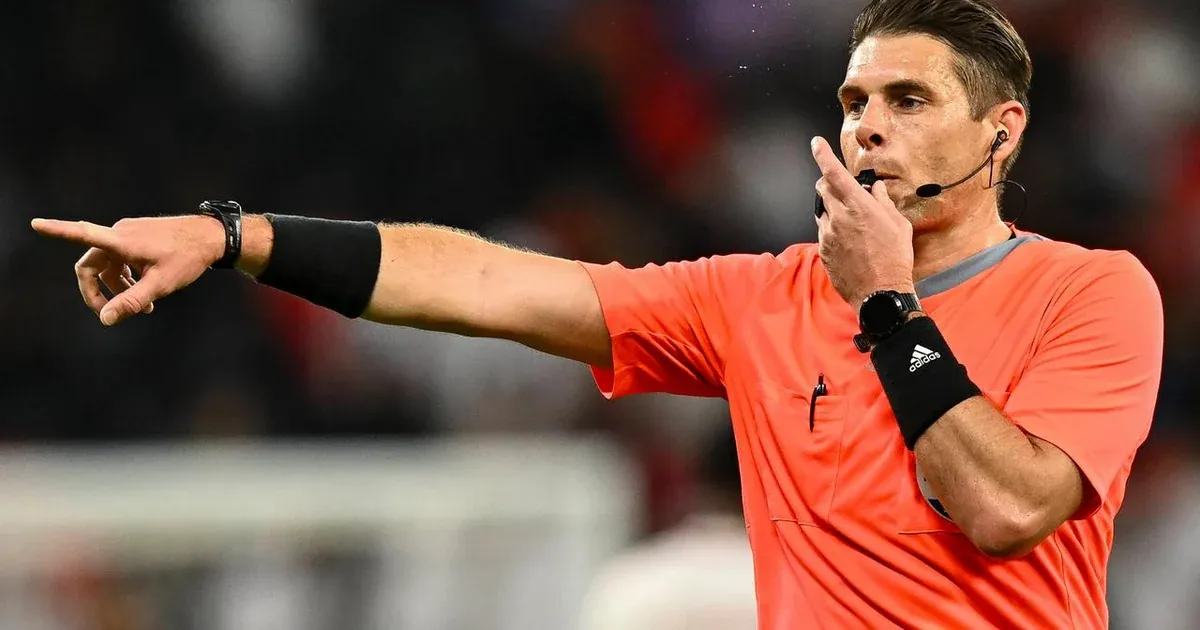
FIFA has cleared Australian video review official Shaun Evans after a World Cup broadcast showed him making a hand gesture that drew immediate criticism from anti-discrimination monitors. The incident became a tournament flashpoint because the gesture resembled an upside-down OK sign, a symbol that can carry extremist meaning depending on context.
Evans said the movement was not intentional and was instead an involuntary twitch while he was working in the VAR area. On June 16, 2026, the controversy remained active because FIFA accepted his explanation while Fare, the anti-discrimination network that works with global soccer bodies, had urged officials to remove him from the tournament.
The distinction matters because video review officials are not usually part of the public spectacle. They work behind screens, but World Cup broadcasts have increasingly shown VAR rooms to demonstrate transparency around major calls. That access also means a small movement by an official can be replayed, clipped and interpreted far beyond the original match context.
FIFA Finds No Code Breach
FIFA’s disciplinary committee reviewed the broadcast footage, Evans’s statement and the complaint around the gesture before concluding there was no evidence of a disciplinary-code breach. That finding allows Evans to continue in his tournament role, though it does not remove the wider debate about how governing bodies should handle symbols with contested meanings.
Evans described the movement as involuntary rather than an attempt to communicate a message. His explanation focused on the physical movement itself, not on a broader political argument. FIFA’s response effectively accepted that distinction and treated the case as an optics problem rather than misconduct.
Evans said he did not intend to communicate a message or affiliation through the gesture.
Fare took a different view of the risk. The group argued that the gesture resembled a symbol used by far-right groups and said FIFA should remove the official to protect the tournament’s anti-discrimination standards. That disagreement leaves FIFA defending both the integrity of its inquiry and the sensitivity of its public-facing protocols.
The underlying difficulty is that the OK hand sign has more than one public meaning. It can be a childish prank, a neutral gesture or a symbol adopted by extremist communities. That ambiguity makes context essential, but it also means governing bodies cannot rely only on intent when deciding whether a broadcast image damages public confidence.
Evans’s role also shaped the outcome. He was not accused of making a match decision based on bias, and FIFA did not identify evidence that the gesture affected play, players or the officiating crew. The complaint instead centered on whether an official visible during a global broadcast should remain assigned after creating a public anti-discrimination controversy.
Broadcast Transparency Creates a New Risk
The case shows how VAR transparency can create a new category of controversy. Cameras inside review rooms were meant to reassure viewers that decisions are being checked carefully, but they also expose officials to scrutiny normally reserved for players and coaches. In a tournament watched globally, context can collapse quickly once a clip moves across social platforms.
For FIFA, the next question is procedural. If officials remain visible during broadcasts, the organization may need clearer guidance on camera framing, conduct expectations and the review process for complaints involving gestures or symbols. That is especially true when anti-discrimination partners and disciplinary panels reach different public conclusions.
There is also a practical communications issue. A short disciplinary statement may close the formal case, but it does not necessarily answer viewers who saw the clip without the surrounding explanation. Tournament organizers now have to decide how much detail to provide when a ruling depends on intent, context and a technical role that many fans rarely see closely.
The ruling also affects other officials assigned to the tournament. It signals that FIFA will investigate disputed conduct, but it will not automatically remove an official when the evidence supports a nonintentional explanation. That standard may become important if future broadcast moments create similar complaints.
World Cup VAR depends on trust. Fans must believe officials are both technically competent and neutral under pressure. FIFA’s ruling keeps Evans in place, but the episode gives tournament organizers another reminder that transparency is not only about showing decisions; it is also about anticipating how every visible detail can be read by a global audience.