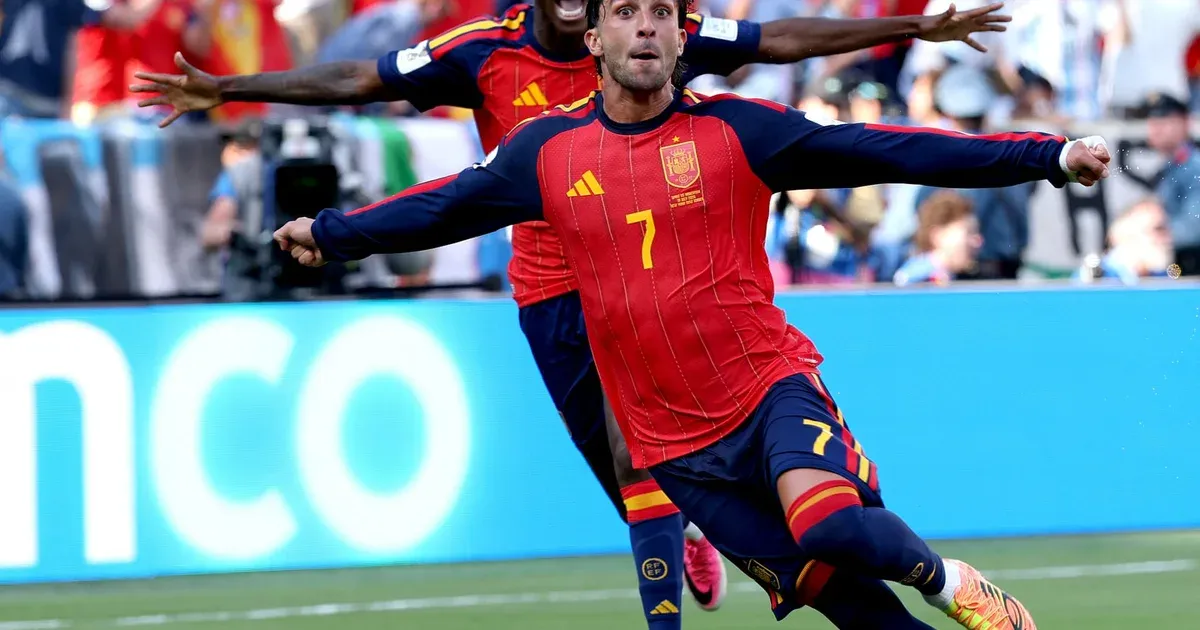
Spain won the 2026 men's World Cup by beating Argentina 1-0 after extra time at the New York New Jersey Stadium. Ferran Torres finished the decisive move in the 106th minute, ending a final that Spain had controlled without finding a way past goalkeeper Emiliano Martinez during regulation. The victory put a second star on Spain's shirt and ended Argentina's attempt to retain the trophy it won in Qatar four years earlier.
The final was played on July 19, 2026, and gave Spain its first men's title since 2010. Argentina finished regulation with 10 players after Enzo Fernandez collected two yellow cards. Lionel Messi and the defending champions then had to chase the match while short-handed, but their late attacks did not produce an equalizer. Messi collected a runners-up medal after what was widely expected to be his final World Cup appearance.
Ferran Torres Finished the Move Spain Had Been Building
Spain set the terms through possession, pressure and repeated attacks from wide areas. The final numbers reflected the imbalance: Spain held a 20-2 shot advantage, while Argentina did not register an attempt until the closing minutes of extra time. Rodri controlled the central exchanges, and Spain kept Argentina's forwards too far from goal to threaten Unai Simon for most of the night. Argentina's expected-goals figure remained at zero through the first half.
Spain's first opening came when Dani Olmo returned a pass to Lamine Yamal inside the area. Martinez and Lisandro Martinez combined to block the shot from a narrow angle. Spain continued to send runners around Argentina's low defensive line, although several promising moves ended with an extra pass rather than a clean attempt. The pattern favored Spain without producing an early goal.
Argentina defended in a compact shape and relied heavily on Martinez. The goalkeeper stopped Yamal's free kick late in regulation, denied Nico Williams early in extra time and dealt with efforts from Pau Cubarsi and Aymeric Laporte. He also saved a Williams header after Pedri found the substitute in space. The saves allowed Argentina to reach 90 minutes at 0-0 despite long periods without possession or a sustained attack.
The personnel changes eventually gave Spain a different route into the penalty area. Nico Williams and Torres entered from the bench, while Pedri and Mikel Merino added fresh passing options. Argentina manager Lionel Scaloni replaced winger Nico Gonzalez with Leandro Paredes to reinforce midfield. He later withdrew Julian Alvarez for Marcos Senesi and formed a five-player defensive line, leaving Messi increasingly isolated when Argentina recovered the ball.
Spain broke through 37 seconds after the second period of extra time began. Pedro Porro sent a deep cross toward the far side, Nico Williams kept it alive with a controlled header and Torres arrived ahead of the recovering defenders. His 106th-minute winner flew high past Martinez from close range. The move involved three players who had not started the final. A later Torres finish was ruled out for a tight offside, but Spain no longer needed another goal.
Two Yellow Cards Left Argentina Defending Extra Time With 10
Fernandez received his first booking for dissent in the 83rd minute. He was shown a second yellow in stoppage time after catching Cubarsi, leaving Argentina a player short before extra time began. Martinez had just pushed away a dangerous Yamal free kick to preserve the draw. The dismissal made an already defensive approach harder to sustain because Spain could circulate the ball across the field and force the remaining midfielders to cover wider gaps.
Argentina's first recorded attempt came in the 115th minute, when a Messi shot struck Merino. Giuliano Simeone later drove a dangerous cross through the area and sent another chance over the bar in added time. Cubarsi also diverted a low delivery away from the near post as Argentina finally committed players forward. All three moments arrived after the goal rather than as part of a consistent attacking plan, and Simon completed the final without being forced into a defining save.
Tension carried beyond the final whistle. Leandro Paredes was dismissed after a confrontation involving Gavi, and players from both teams crowded together before the medal ceremony. The scenes did not alter the result: the Spain-Argentina final preview had centered on Messi and Lamine Yamal, yet the game was settled by Spain's collective pressure and three substitutes involved in the winning sequence.
Spain's Second Star Was Built on Control at Both Ends
The trophy completed a tournament in which Spain conceded only one goal. Rodri received the Golden Ball as the competition's best player, Cubarsi was named the best young player and Simon took the Golden Glove. Kylian Mbappe won the Golden Boot with 10 goals, becoming the first player to claim that award twice. Spain's awards stretched through midfield, defense and goalkeeping, matching a campaign that depended on coordinated pressure as much as its attacking talent.
Spain now holds the men's and women's World Cups at the same time, a first for any country, and has a second men's World Cup title to place beside the 2010 victory. The final supplied a precise account of how the latest title was won. Argentina delayed Spain for 105 minutes, but it never forced Spain to abandon possession or expose its defense. When the red card created more space, the substitutes converted the same territorial control into the one chance the match required. Patience, a one-goal defensive record and useful options from the bench give the trophy a broader foundation than a single extra-time finish.