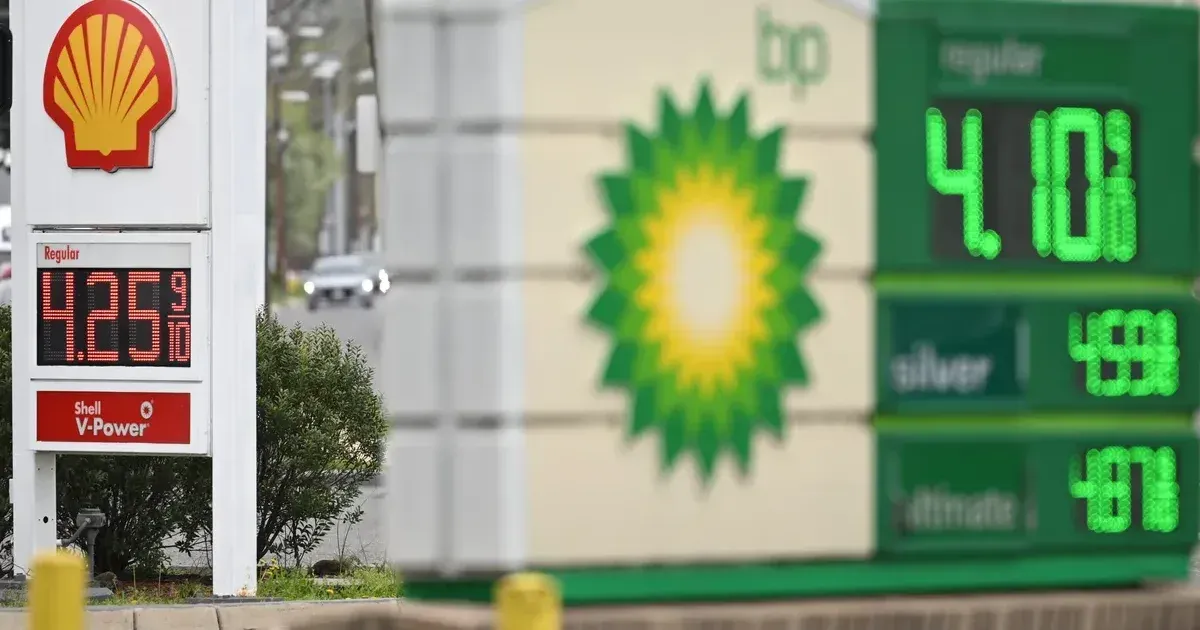
Fuel markets are now pricing the Iran-Israel conflict as a direct risk for American households. A prolonged Strait of Hormuz disruption would turn a regional war into a consumer shock at the pump.
JPMorgan analysts warned on April 6, 2026, that U.S. gasoline could rise above five dollars per gallon within weeks if the disruption persists. The warning landed as Brent crude hovered near $110 per barrel and Leslie Vinjamuri of the Chicago Council on Global Affairs said a cease-fire remains difficult because Washington lacks a clear regional strategy.
JPMorgan Forecasts Five-Dollar Gas Prices
JPMorgan researchers identified the middle of April as a critical deadline for American consumers. If the blockade of the Strait of Hormuz persists, the bank projects a surge in retail fuel costs that would mirror the record highs of 2022. California residents already endure prices approaching six dollars per gallon according to data from GasBuddy. Energy costs in the United States typically peak during the summer driving season, yet the current geopolitical crisis has accelerated this timeline by months.
National average prices broke the four dollar threshold earlier this month, a level not seen since the global economic disruptions of late 2022. Analysts at JPMorgan suggest that while the United States maintains some insulation through domestic production, the global nature of oil pricing ensures domestic pain. Global benchmarks remain sensitive to every missile launch and naval skirmish in the region. Consumers in the United States will feel the impact of this war primarily through the depletion of their disposable income at the pump.
"Asia is the first region to feel physical shortages, while the US is more likely to avoid supply disruptions but still face higher gas prices at the pump," JPMorgan analysts said.
Chicago Council on Global Affairs Warns of Strategy Gap
Leslie Vinjamuri spoke to Bloomberg Open Interest regarding the inability of international mediators to secure a truce. She noted that the lack of clear objectives from Washington has emboldened Iran to maintain its aggressive stance. Tehran views its control over the Strait of Hormuz as a primary bargaining chip against Western sanctions. This strategic leverage makes any immediate cessation of hostilities improbable under current conditions.
Washington faces a difficult choice between military intervention and economic endurance. Leslie Vinjamuri emphasized that the conflict with Israel has highlighted a significant gap in how the United States manages its commitments in the Middle East. Strategic ambiguity has failed to deter the Iranian leadership from targeting maritime trade. Military readiness suffers as resources are diverted to protect commercial shipping in the Gulf of Oman.
Strait of Hormuz Closure Rattles Global Energy Supply
Strait of Hormuz transit routes handle approximately twenty percent of the world's total oil consumption daily. Closure of this narrow waterway effectively traps millions of barrels of crude within the Persian Gulf. Beyond oil, the strait is an essential artery for liquefied natural gas and essential commodities like fertilizer and helium. Disruptions to these supplies could trigger a secondary wave of agricultural inflation globally.
Oil markets now reflect a permanent risk premium. Goldman Sachs echoes these concerns, noting that the physical availability of fuel has become a secondary worry to the sheer cost of procurement. Rising energy prices often act as a regressive tax on the American public, dampening consumer spending in unrelated sectors like retail and hospitality. Inflationary pressure, which many hoped had stabilized, is once again a central concern for the Federal Reserve.
Tehran understands that the longer the conflict lasts, the more political pressure builds on the White House to find a resolution. Leslie Vinjamuri indicates that Iran is intentionally stretching the timeline of the war to maximize its diplomatic hand. This approach places the burden of escalation on the Israeli military and its American supporters. Tactical gains on the ground are often outweighed by the broader economic attrition occurring in global markets.
Global energy security depends on twenty-one miles of water. JPMorgan warned that if the waterway remains shuttered past the middle of April, the global supply chain for petroleum products will begin to fracture. Refineries in Europe and North America rely on a steady flow of Middle Eastern heavy crude to maintain optimal output. A sustained shutdown forces these facilities to seek more expensive alternatives from the Atlantic Basin.
Asia is currently bearing the brunt of the physical supply crunch. South Korea and Japan have reported severe delays in tanker arrivals, leading to industrial slowdowns in energy-intensive sectors. Goldman Sachs analysts indicate that Australian fuel reserves are under intense scrutiny as the shipping lanes from Singapore become increasingly volatile. Unlike the United States, these nations lack the strategic petroleum reserves necessary to withstand a multi-month disruption.
Shortages in Asia quickly manifest as supply-chain bottlenecks for Western technology and automotive companies. Components manufactured in Seoul or Shanghai require affordable electricity, which is currently at a premium due to high LNG prices. Global trade is a series of interconnected dependencies that Iran is now methodically testing. Economic stability in the Indo-Pacific region is directly tied to the security of the Persian Gulf.
Australia faces the prospect of fuel rationing if the conflict extends into May. Internal government documents suggest that current inventories could only sustain normal economic activity for three weeks without new imports. JPMorgan notes that while the United States avoids the worst of the physical shortages, the global price spike remains unavoidable. High prices are the mechanism through which the market rations a scarce resource.
Energy Security at the Pump
Global dominance is often measured in aircraft carriers, but it is actually maintained at the gas pump. The current energy crisis proves that the United States has allowed its strategic leverage in the Middle East to atrophy while clinging to the delusion of energy independence. While American politicians boast of domestic oil production, the reality of globalized pricing means a truck driver in Ohio is just as vulnerable to a Persian Gulf blockade as a commuter in Tokyo. The strategy gap mentioned by Leslie Vinjamuri is more than a diplomatic oversight; it is a fundamental failure to protect the economic lifelines of the Western world.
Washington appears paralyzed by a fear of escalation that Iran has already embraced. By allowing the Strait of Hormuz to become a persistent chokepoint, the international community has handed Tehran a veto over the global economy. This is a terminal decline in Western influence. Any nation that cannot secure its own energy routes has already lost the war, regardless of how many missiles it intercepts over Israel. The transition to a post-American Middle East is not a future possibility; it is the current reality manifesting in five-dollar gasoline.