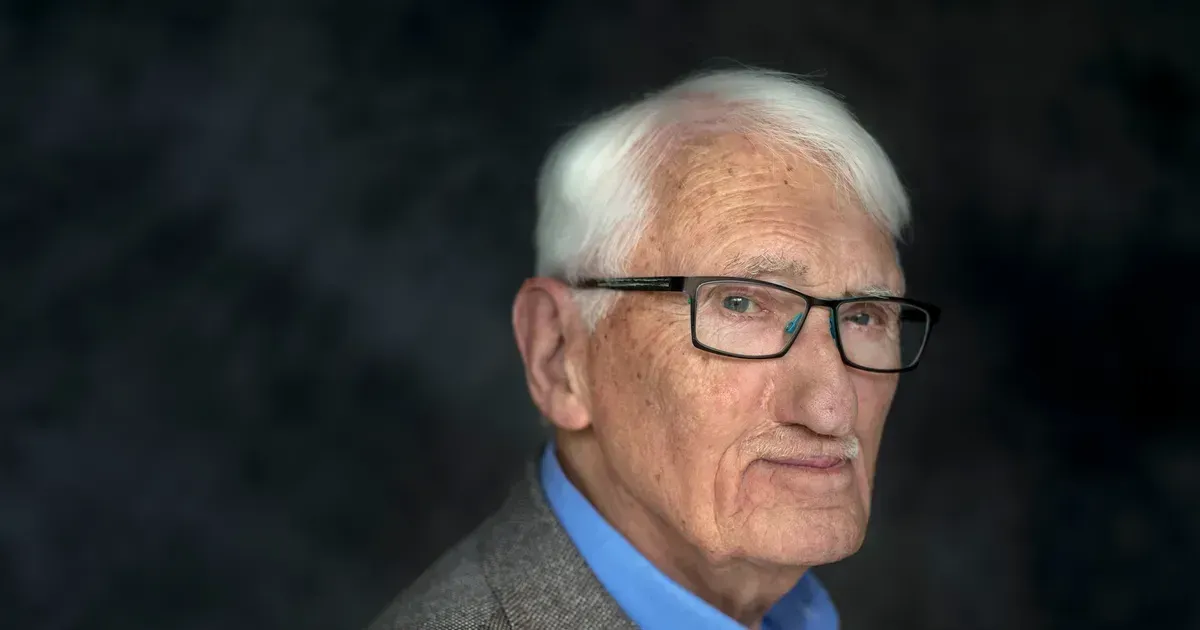
Starnberg served as the quiet backdrop for the final moments of a man who spent seven decades shaping the intellectual architecture of Western democracy. Jurgen Habermas died Saturday at the age of 96, according to a statement released by his longtime publisher. News of his passing reached the public through a brief announcement from the Suhrkamp publishing house, which cited information provided directly by the family of the deceased thinker. Suhrkamp confirmed Habermas died in Starnberg, closing the life of one of postwar Europe's defining democratic theorists. His death marks the disappearance of the last remaining titan from the second generation of the Frankfurt School, a group that redefined social theory after the horrors of World War II. Reports from local media suggest he passed away peacefully in his home near Lake Starnberg. Intellectuals across Europe began reacting to the news within minutes of the confirmation, noting that his absence leaves a void in the ongoing debate over the future of the European Union. He was born in Gummersbach in 1929 and grew up during the rise and fall of the Third Reich, an experience that fueled his lifelong obsession with the conditions necessary for a healthy, functioning democracy. This background informed his belief that rational debate could prevent the return of authoritarianism.
Suhrkamp Confirms Habermas Death
Suhrkamp officials kept the initial announcement focused on the basic facts of his passing. The publisher has handled nearly all of his major German-language releases since the mid-twentieth century, maintaining a close professional relationship with the philosopher. Starnberg, a wealthy town in Bavaria, had been his primary residence for many years, providing the solitude required for his voluminous writing schedule. His family requested privacy during the immediate aftermath of his death. But the public nature of his work makes such privacy difficult to sustain in the long term. His influence stretched far beyond the borders of Germany, reaching into the sociology departments of universities from Berkeley to Beijing. He was a thinker who refused to retreat into the ivory tower, frequently writing op-eds for major newspapers like Die Zeit and the Sueddeutsche Zeitung. His interventions in German political life were often as influential as his academic treatises. The public sphere is the primary venue for the communicative action that underpins democratic legitimacy. His most lasting contribution remains his formal theory of communicative action. He argued that the very structure of human language contains an inherent drive toward mutual understanding. The goal of politics should be to create a space where the unforced force of the better argument can prevail. This concept became the foundation of his political philosophy and his defense of liberal institutions.
Frankfurt School Legacy Endures
Scholars categorize him as the primary link between the early critical theory of Max Horkheimer and the contemporary social movements of the twenty-first century. He initially worked as an assistant to Theodor Adorno, though he eventually broke from the deep pessimism that characterized his mentor's view of modern culture. He believed that the project of the Enlightenment was unfinished rather than fundamentally broken. He sought to rescue the ideals of reason and progress from the wreckage of the twentieth century. For instance, his work on the structural transformation of the public sphere remains mandatory reading for anyone studying the impact of media on politics. He tracked how the coffee houses of the eighteenth century gave way to the mass media conglomerates of the twentieth. Meanwhile, he expressed deep concern about how digital platforms might further fragment the shared reality necessary for democratic debate. He viewed the decline of traditional journalism as a threat to the rational consensus he championed. His critics often argued that his theories were too idealistic for a world driven by power and money. They pointed to the persistence of irrationality and systemic violence as evidence that communicative action was a secondary force in human affairs. Even he never wavered in his commitment to the idea that humans could reach agreement through dialogue. He remained a stubborn optimist during increasing polarization.
One of his most famous academic battles took place in the 1980s.
Public Sphere Debate Lives On
Conservative historians in Germany tried to relativize the crimes of the Nazi era during the so-called Historikerstreit. Jurgen Habermas launched a fierce counterattack, arguing that Germany must maintain a constitutional patriotism based on universal values rather than ethnic identity. He insisted that a clear-eyed confrontation with the past was the only way to build a democratic future. This stance solidified his role as the moral conscience of the Federal Republic.
He became one of the most vocal proponents of the European Union as a post-national entity. He saw the integration of Europe as an essential step away from the destructive nationalism of the past. He advocated for a European constitution and a stronger democratic structure for the bloc. He frequently criticized the technocratic nature of Brussels, calling for more direct participation by the citizens of Europe.
Democratic legitimacy, in his view, could not be bestowed from above by bureaucrats. It had to emerge from a vibrant, transnational public sphere where Greeks, Germans, and French citizens debated common issues. His vision for Europe was a grand experiment in communicative action on a continental scale. He viewed the survival of the Euro and the integration of diverse cultures as essential to the global stability of the West.
Global recognition came in the form of numerous awards and honorary doctorates from the world's leading institutions. His 1981 masterwork, titled Theory of Communicative Action, sold thousands of copies in dozens of languages. It remains a standard text in sociology, philosophy, and political science. His ability to synthesize disparate traditions like American pragmatism and German idealism was virtually unparalleled.
He engaged in a high-profile dialogue with Joseph Ratzinger, who later became Pope Benedict XVI, to discuss the role of religion in a secular society. The two men agreed that secular reason and religious faith could learn from each other, despite their fundamental differences. In particular, he argued that religious traditions often carry moral insights that secular language has not yet fully articulated. The late-career shift showed his willingness to revisit his own assumptions about the nature of modernity. Reason and faith were not enemies in his mature philosophy.
The final years of his life were spent in productive semi-retirement in Starnberg. He continued to publish essays on international law and the decline of the liberal world order well into his nineties. According to Suhrkamp, he remained intellectually active until his final days, maintaining a correspondence with colleagues around the world. He leaves behind a body of work that spans over forty volumes of dense, rigorous analysis.
Reason Lost One of Its Defenders
History rarely offers the luxury of a clean break, but the silencing of the most influential voice of the Frankfurt School provides exactly that. We are left now with a hollowed out version of the public sphere that Habermas spent his life defending. While he preached the gospel of the better argument, the digital age has replaced reason with the loudest echo chamber. It is easy to celebrate his passing as the end of an era, yet it is more accurate to view it as the final failure of the Enlightenment project he refused to abandon.
His belief in a rational consensus feels like a relic from a world that no longer exists, a world where facts mattered and language was a tool for connection rather than a weapon of division. The tragedy of his death is not only the loss of a great mind, but the realization that his optimistic vision for democracy has been utterly steamrolled by the reality of algorithmic tribalism. We should stop pretending that the unforced force of the better argument has any currency in a political field defined by grievance and spectacle.
Habermas was a man who tried to build a cathedral of reason in a swamp of human impulse. The swamp has finally won.