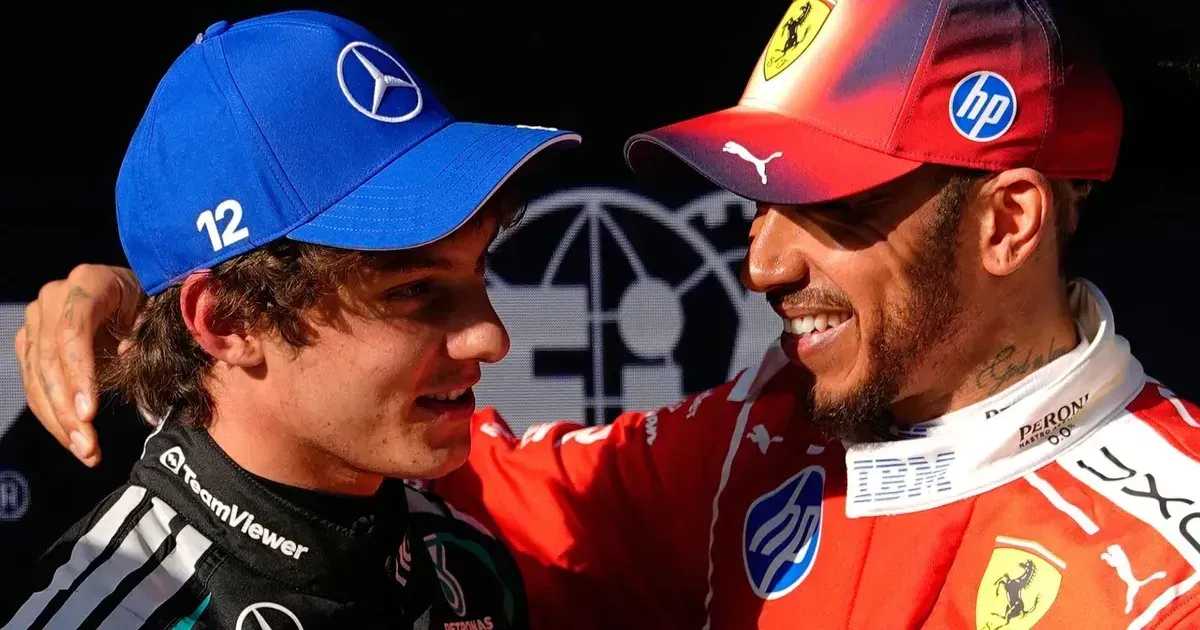
Shanghai International Circuit witnessed a shift in the hierarchy of motor racing on Saturday. Kimi Antonelli secured the top spot for Sunday's race, eclipsing previous records for youthful dominance in a session defined by technical failures and aerodynamic instability among the top teams. The Italian teenager took advantage of a mechanical breakdown on the other side of the garage to secure his first career pole position. His final flying lap registered a time 0.042 seconds faster than his nearest rival. The Shanghai qualifying result turned Antonelli's first pole into a test of whether F1's new rules reward drivers or software-managed machinery. Engineers at Mercedes confirmed that George Russell suffered a catastrophic gearbox failure during the final stage of qualifying. This mechanical issue prevented Russell from setting a representative time, clearing the path for his younger teammate to claim the record. Telemetry data indicated a sudden loss of hydraulic pressure in the seventh-gear actuator. The car returned to the pits on the back of a recovery vehicle. Russell will start the Grand Prix from the back half of the grid. Records previously held by Sebastian Vettel and Max Verstappen fell as the stopwatch confirmed the result. At 19 years old, Antonelli is now the youngest pole-sitter in the history of the sport. His achievement comes in the first year of the new 2026 technical regulations, which emphasize a 50-50 power split between the internal combustion engine and electric battery systems. Mercedes appears to have mastered the initial deployment of these power units better than its rivals in Milton Keynes.
Antonelli Takes Shanghai Pole
Data from the qualifying session shows that the Mercedes W17 is highly sensitive to the high-speed lateral loads of Turn 1 and Turn 2. While Antonelli found a balance that allowed for aggressive entry speeds, Russell's car succumbed to the stress of the Shanghai tarmac. The gearbox problem is not an isolated incident for the team this weekend. Mechanics worked through Friday night to address similar concerns on the spare chassis. An official report from the FIA technical delegate noted the replacement of several seals on the energy recovery system. But the focus remains on the reliability of the Mercedes drive unit under the new 2026 rules. These regulations removed the MGU-H component, forcing teams to rely more heavily on the kinetic energy harvested from the rear axle. The increased torque from the larger electric motors puts unusual strain on the transmission. Engineers at Brackley must now determine if Antonelli's car is susceptible to the same failure that sidelined Russell.
Mercedes and Red Bull Show Different Problems
Max Verstappen cut a frustrated figure after finishing the session in eighth place. The four-time world champion has struggled throughout the weekend with a car he described as virtually undriveable. His performance in the earlier sprint race yielded zero points, a rarity for the driver who dominated the previous three seasons. Red Bull's RB22 chassis seems to lack the aerodynamic stability required for the long back straight and the tight hairpin of Turn 14. Wind tunnel correlation issues have reportedly plagued the team since the winter break. Every lap is survival. Verstappen noted that the car exhibits unpredictable porpoising at speeds exceeding 310 kilometers per hour. This physical bouncing disrupts the airflow under the floor, causing a sudden loss of downforce. He told reporters that the team has never faced a situation this severe in the current ground-effect era. Mechanics spent the hour between the sprint and qualifying adjusting the ride height, yet the changes failed to produce the desired grip. Verstappen finished more than six-tenths of a second behind the pole time. The RB22 is now the fourth-fastest car on the grid based on GPS overlays from the Shanghai circuit. The high-speed corners of the middle sector show Verstappen losing nearly three-tenths to the Mercedes and Ferrari entries. Red Bull engineers are analyzing the front wing flex, which appears to be stalling at high speeds. This imbalance creates a severe understeer that forces the driver to delay acceleration on corner exit. The car will start Sunday's race on the fourth row.
Race Pace Becomes the Test
Lewis Hamilton observed the session from the cockpit of his Ferrari, finishing just behind the front row. The veteran driver focused his efforts on a different tactic to counter the straight-line speed of his former team. Ferrari opted for a higher-downforce setup, sacrificing top speed for better tire preservation over the 56-lap race distance. Hamilton spent the majority of his post-qualifying briefing discussing the degradation of the Pirelli C4 compound on the abrasive Shanghai surface. His strategy relies on a long first stint to overcut the younger leaders.
The seven-time champion was quick to acknowledge the performance of his successor at Mercedes.
The Ferrari garage has been testing a new combustion pre-chamber design intended to improve fuel efficiency. The technical update aims to provide more power at the end of the long straights where the electric battery typically deploys all its energy. Hamilton believes that the race will be won or lost in the second half of the Grand Prix. The weather forecast for Sunday predicts a 40 percent chance of rain during the final 20 laps. Ferrari has historically performed well in mixed conditions at this venue.
Drivers entering the sport at younger ages has become a trend that started with Verstappen's debut in 2015. The record for the youngest pole-sitter has changed hands three times in the last two decades. Vettel set the standard at Monza in 2008 at the age of 21. Before that, Fernando Alonso held the record with a pole in Malaysia in 2003. Antonelli's jump to the top of the standings at 19 marks the first time a teenager has achieved this feat in a full-length Grand Prix weekend. His career path skipped the traditional Formula 3 step entirely.
Meanwhile, the physical demands on these young drivers have decreased due to the introduction of power steering and more complex cockpit ergonomics. But the mental pressure of managing complex energy systems has increased sharply with the 2026 regulations. Antonelli must manage over 1,000 sensors while racing at speeds of 200 miles per hour. His training regimen includes over 200 hours in the Mercedes simulator at Brackley. The team uses these sessions to calibrate the software that controls the hybrid deployment. The result in Shanghai validates this data-driven approach to driver development.
Software Advantage Is Changing the Grid
Questioning the sustainability of the current Formula 1 youth obsession is a task most pundits avoid, but the record-breaking pole for Kimi Antonelli demands a cold assessment of the sport's technical direction. We are seeing a shift where the car's software interface has become so complex that it masks the raw experience gap between a veteran and a teenager. When a driver like Max Verstappen, a four-time champion with unparalleled car control, describes his vehicle as a survival vessel while a rookie cruises to pole, the integrity of the competition is in doubt.
The 2026 regulations were promised as a way to prioritize driver skill, yet the early results in Shanghai suggest we have instead entered an era of battery management dominance. Mercedes has not necessarily built a better car for a driver; they have built a more efficient computer for an operator. If the sport continues to prioritize electrical efficiency over aerodynamic predictability, the value of a driver's historical racecraft will continue to diminish. The record for Antonelli is less about the arrival of a new prodigy and more about the total capitulation of the Red Bull engineering philosophy. The grid is no longer a meritocracy of talent but a laboratory for high-voltage reliability. Watching a champion struggle to keep a car on the track while a rookie wins on a software advantage is a bitter pill for the purists to swallow.