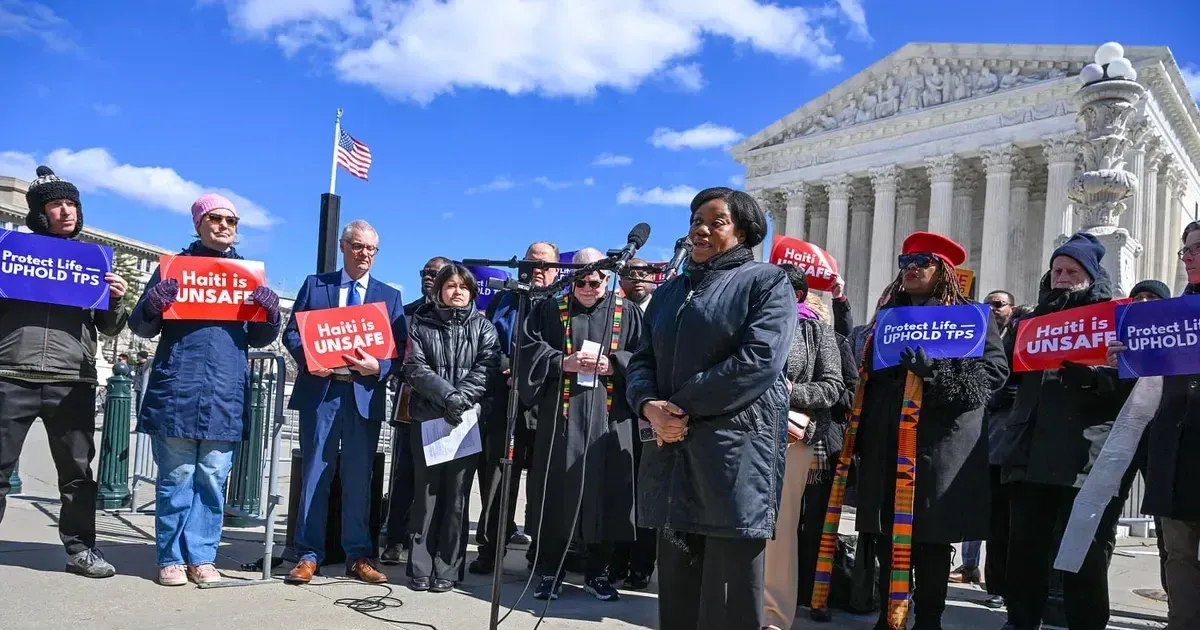
The Supreme Court case places immigration status, executive power and humanitarian relief in the same argument. For affected migrants, the legal dispute is also a question of work permits and family stability. Supreme Court justices began evaluating the legality of executive branch efforts to terminate humanitarian protections for hundreds of thousands of immigrants. Oral arguments held on April 29, 2026, focused on the Trump administration and its multi-year plan to rescind Temporary Protected Status for nationals from Haiti and Syria. Government lawyers argued that the president maintains broad authority to determine when foreign crises have stabilized enough for residents to return home safely.
Temporary Protected Status allows individuals to live and work in the United States if they cannot return to their home countries because of extraordinary or temporary conditions. Under current law, the Department of Homeland Security designates specific nations for this benefit based on armed conflict, natural disasters, or other catastrophic circumstances. Legal eligibility for these individuals hinges on the interpretation of executive discretion under the 1990 Immigration Act.
Protecting these residents has become a central point of contention between the White House and civil rights organizations.
Procedural History of the TPS Litigation
Officials within the Trump administration moved to end these protections by arguing that the original conditions justifying the status no longer persist in Port-au-Prince or Damascus. Previous attempts to finalize these terminations met resistance in various federal courts, where judges issued injunctions to pause the removals. The administration, however, maintains that judicial interference in these designations undermines the statutory power granted to the Secretary of Homeland Security.
Critics of the termination notice point to ongoing gang violence in Haiti and the protracted civil conflict in Syria as proof that conditions remain unsafe for return. Advocates for the affected populations suggest that revoking status would lead to enormous economic disruption for families that have resided in the U.S. for years. They cited specific reports of infrastructure collapse and famine in the designated regions during the hearing.
The dispute centers on the TPS program, which permits eligible individuals to live and work in the United States when extraordinary or temporary conditions prevent their return home.
Haitian community leaders argue that the 2010 earthquake and subsequent political instability created a permanent state of crisis. Syria remains embroiled in a fractured civil war that has displaced millions since 2011. Judicial review of these facts will determine whether the Supreme Court permits the executive branch to exercise absolute authority over the renewal process.
National Security and Immigration Policy Intersections
Administration attorneys contend that keeping humanitarian protections active indefinitely creates a de facto permanent residency program without congressional approval. Federal law, they argue, was never intended to provide a life-long shield for people whose home countries are slowly recovering from past disasters. National security concerns also play a role in the government's argument for tighter control over who is permitted to stay in the country under these specific humanitarian banners.
Lower court rulings previously found that the government failed to follow the Administrative Procedure Act when it announced the program's end. Proponents of the migrants' rights argue that the government did not sufficiently explain why the situation on the ground in Haiti and Syria no longer met the legal threshold for protection. Judicial oversight often focuses on whether an agency's decision was arbitrary or capricious.
Future immigration policy rests on the narrow definitions of authority the court decides to uphold this term.
Justice Department representatives emphasized that the primary responsibility for foreign relations and border management lies with the president. Legislative intent behind the 1990 act suggested that these statuses were designed to be temporary fixes, not indefinite solutions. Settlement patterns and employment histories of those affected suggest that many have integrated into the American workforce over the last decade.
Legal consequences for future humanitarian relief will likely turn on the specific wording of this ruling. If the court sides with the administration, the precedent could allow for the rapid dismantling of other humanitarian programs that lack explicit permanent statutory protections. The executive branch would effectively gain a blank check to define the end of a foreign crisis, regardless of contradictory reports from international humanitarian organizations.
Stability for nearly 400,000 individuals hangs in the balance as the court weighs these competing interpretations of the 1990 Immigration Act. A decision in favor of the government would likely trigger immediate deportation proceedings for thousands who have built lives in major U.S. metropolitan areas. By contrast, a ruling that demands more rigorous justification for termination would force the Department of Homeland Security to conduct exhaustive country-condition reports before moving forward. This decision will define the boundary between administrative flexibility and the rights of protected foreign nationals.