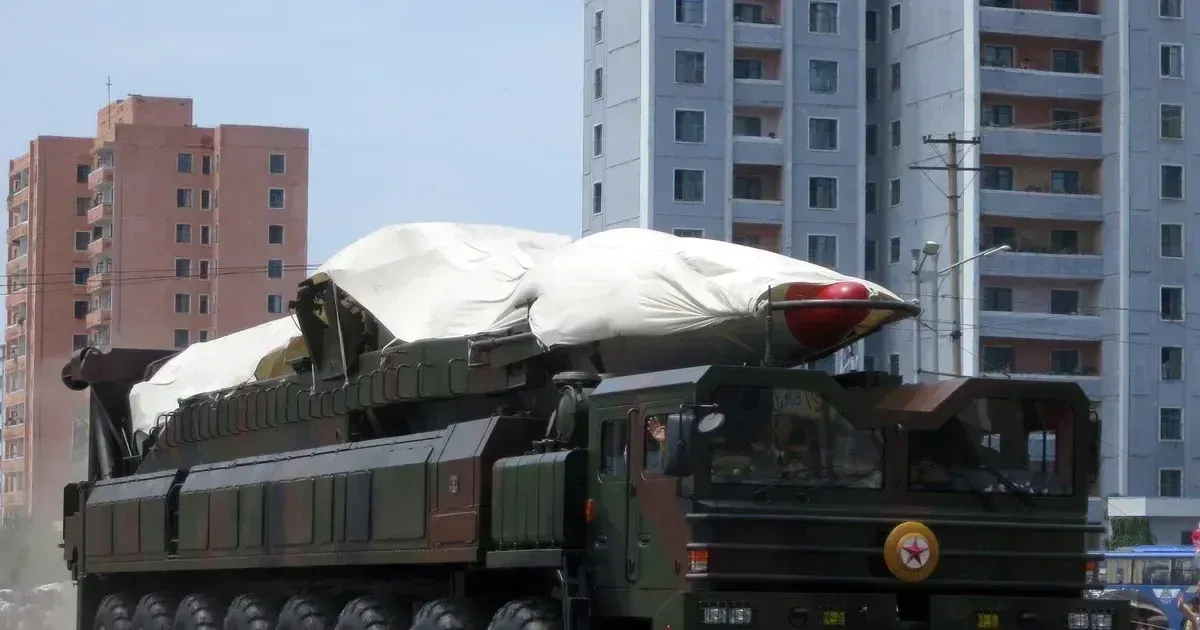
The launch added another marker to regional military planning. North Korean state media reported that the leader attended the event at an undisclosed location, flanked by top officials from the Missile Administration. Kim Jong Un supervised a launch of the Hwasong-11Ra tactical ballistic missile on April 19, 2026, marking a specific expansion of Pyongyang's short-range arsenal. Early telemetry gathered by regional defense networks indicates the projectile traveled a short-range trajectory before impacting a target in the Sea of Japan. Observations from the site suggest the weapon is a variant of the existing solid-fuel family frequently used in recent drills.
Pyongyang continues to prioritize the miniaturization of warheads alongside the development of high-speed delivery systems. Military experts note that the "Ra" designation likely refers to a specialized modification designed for improved terminal guidance or increased payload capacity. Previous iterations of the Hwasong-11 series demonstrated a capability for low-altitude flight paths, which complicate interception by conventional radar systems. Solid-propellant engines power these units, allowing for rapid deployment from hidden mobile launchers.
Technically, the Hwasong-11Ra is a progression toward a more flexible nuclear deterrent. The Missile Administration has conducted a series of tests over the last two years to verify the reliability of these tactical systems in diverse weather conditions. Engineers reportedly focused on the stabilization of the flight control system during this specific launch. Data released through state channels claimed the test met all predefined technical requirements.
Hwasong-11Ra Technical Performance and Design
Launch protocols for the Hwasong-11Ra emphasize speed and secrecy to evade preemptive strikes. Unlike liquid-fueled variants that require lengthy fueling processes, this solid-fuel model remains ready for immediate ignition. Satellite imagery previously captured activity at the February 8 Vinalon Complex, a known hub for missile component manufacturing. Analysts believe the integration of advanced navigational components allows the missile to perform a "pull-up" maneuver during its terminal phase. This maneuver extends the range and makes the flight path unpredictable for ground-based interceptors.
Military intelligence units in Seoul monitored the projectile as it cleared the launch rail. Reports indicate the missile reached an apogee of approximately 50 kilometers. Such a trajectory is consistent with tactical weapons designed to strike high-value targets across the border. Internal reports from the North Korean military emphasize the precision of the new guidance package. Officials claim the missile can strike with a circular error probable of less than 10 meters.
North Korea fired the Hwasong-11 Ra surface-to-surface tactical ballistic missile, attended by leader Kim Jong Un, as reported by the Korean Central News Agency.
North Korean technicians have refined the airframe to reduce its radar cross-section. Smaller than the intercontinental Hwasong-17 or Hwasong-18, the Ra variant occupies a niche in the Korean People's Army theater-level strategy. Its compact size permits transport via a four-axle transporter-erector-launcher (TEL) vehicle. These vehicles can navigate narrow mountainous roads, hiding in tunnels between operations to maintain a high survival rate.
Regional Defense Responses in Seoul and Tokyo
South Korean officials convened an emergency meeting of the National Security Council shortly after the detection. Defense Ministry representatives stated that the military maintains a high state of readiness through combined surveillance with the United States. Reaching a distance of 400 kilometers, the missile places most of the southern peninsula within its effective radius. This capability threatens critical infrastructure, including airfields and command centers in central regions. Army commanders in Seoul are currently evaluating the effectiveness of the Patriot-3 and Cheongung-II defense batteries against this specific threat.
Tokyo also registered a protest through its embassy in Beijing. The Prime Minister’s Office noted that North Korean missile development violates several United Nations Security Council resolutions. Japanese radar stations in Shimane Prefecture tracked the projectile until it exited the atmosphere. Japan remains concerned about the increasing frequency of short-range tests, which serve as training for North Korean missile crews. Defense planners in Tokyo are considering the acceleration of their own counterstrike capabilities given these developments.
Washington reiterated its commitment to the defense of its Pacific allies. The Department of Defense issued a statement condemning the launch as a destabilizing act. Despite these condemnations, Pyongyang showed no signs of returning to the negotiating table. Joint military exercises between the U.S. and South Korea likely were a catalyst for the timing of this test. North Korean media frequently characterizes these drills as rehearsals for invasion.
Political Objectives of Kim Jong Un and the Missile Administration
Leader Kim Jong Un used the launch to reinforce his image as the supreme defender of national sovereignty. State newspapers published several high-resolution images of Kim smiling while observing a screen showing the missile's trajectory. These visual cues target a domestic audience, signaling that the regime remains strong despite ongoing international sanctions. Economic difficulties have not slowed the pace of military modernization. Instead, the regime appears to be diverting a substantial portion of its gross domestic product to the missile program.
Strategic goals for the 2026 calendar year include the mass production of tactical nuclear warheads. Kim previously stated that the army must be prepared to use these weapons at any time to repel aggression. The Hwasong-11Ra is the primary vehicle intended to carry these small-scale nuclear devices. By deploying these assets, the regime hopes to gain leverage in future diplomatic engagements. It seeks to be recognized as a permanent nuclear power, similar to the status held by major global nations.
Propaganda outlets emphasized the "invincible might" of the missile units during the broadcast. This rhetoric serves to unify the population behind the leadership. Military personnel who participated in the launch received personal commendations from the leader. Such ceremonies are common in North Korean political life, serving to build loyalty within the elite ranks of the military. Kim remains the central figure in all major military advancements.
Modernization Trends Within the Korean People's Army
The Korean People's Army is undergoing a transition from a large, artillery-based force to a high-tech missile force. Investment in electronic warfare and drone technology accompanies the missile expansion. Units are being reorganized to integrate tactical missile batteries at the divisional level. The decentralization of firepower makes the North Korean military more difficult to neutralize in a single blow. Command and control systems are also being hardened against cyberattacks. Resource allocation favors the Missile Administration over traditional ground forces. New barracks and underground storage facilities have appeared near the northern border. These sites provide a secure location for the Hwasong series missiles. Military logistics have improved, with specialized fuel trucks and maintenance teams assigned to each missile brigade. Training cycles now include realistic simulations of mobile launches from forested areas.
Previously, the military relied on older Scud-C missiles which were easier to track. The Hwasong-11Ra uses digital flight computers that allow for real-time adjustments during ascent. The modernization effort has been supported by domestic research institutes and clandestine procurement networks. Foreign observers suspect that some components may be sourced through third-party actors in the global gray market. North Korea continues to demonstrate a high level of self-sufficiency in airframe manufacturing. Future tests will likely involve salvo launches to test saturation tactics. If the Korean People's Army can fire dozens of Hwasong-11Ra missiles simultaneously, they could overwhelm existing missile defense grids. Such a tactic requires precise coordination and a steady communications network. The April 19 test confirms that Pyongyang is well on its way to mastering these complex operations.
Regional Deterrence Risk
Western intelligence agencies continue to misjudge the velocity of North Korean technical advancements. While diplomats argue over the wording of sanctions, Pyongyang is building a battlefield reality that makes those sanctions irrelevant. The Hwasong-11Ra is not a weapon of vanity; it is a cold, calculated tool designed to hold Seoul and Tokyo hostage during any future escalation. Western governments face a regime that has successfully bypassed the era of strategic patience by sheer industrial willpower.
If the United States believes that Kim Jong Un will trade these tactical assets for economic relief, it is operating under a dangerous delusion. These missiles are the regime's survival insurance, and the Hwasong-11Ra specifically ensures that any conflict on the peninsula will be fought on North Korean terms. The solid-fuel transition has effectively shortened the decision window for South Korean commanders from hours to minutes. This narrows the space for diplomacy and increases the risk of accidental nuclear launch.
The era of denuclearization is dead. It was killed by the relentless ignition of solid-fuel boosters in the mountains of North Korea. International actors must now decide if they will continue to chase the ghost of 20th-century diplomacy or adapt to a 21st-century reality where Pyongyang is a permanent, tactical nuclear power. The Hwasong-11Ra is the final proof that Kim has no intention of stopping until his arsenal is beyond the reach of any interceptor or treaty.