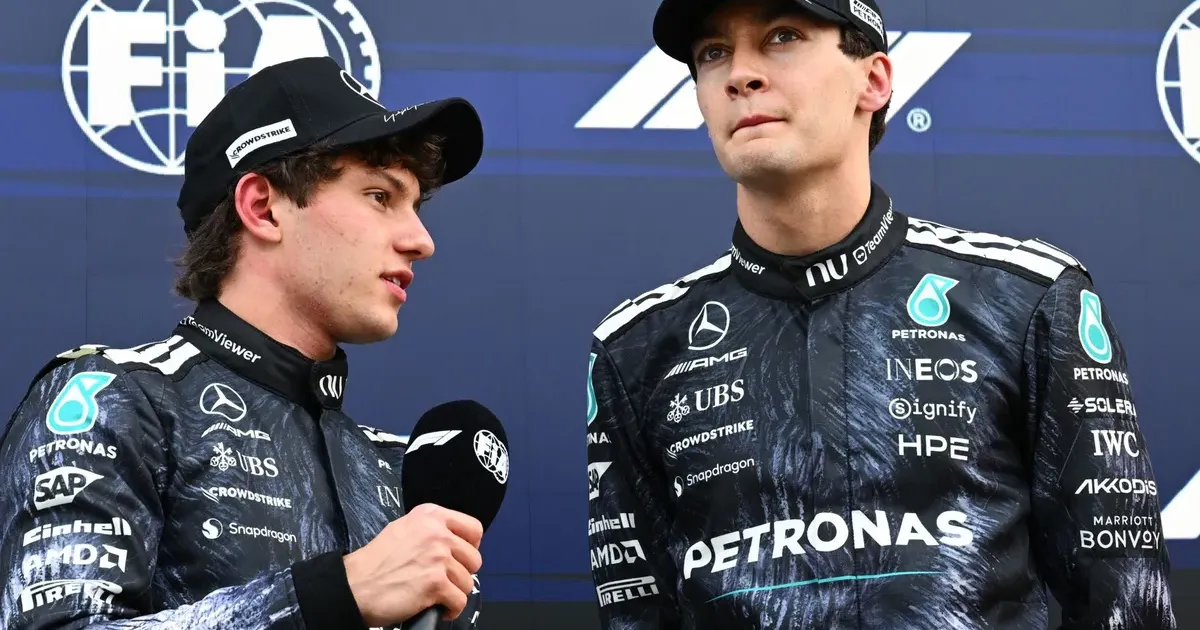
Kimi Antonelli's Japanese Grand Prix pole at Suzuka confirmed that Mercedes has begun the 2026 season with control of Formula One's qualifying picture. The pole gave Mercedes a cleaner signal about its development path. It also raised expectations around Antonelli faster than a normal rookie curve would. The update had entered the public record by March 28, 2026. The young Italian beat George Russell to the top spot and gave the team another front-row lockout, turning what should have been an early-season contest into a question about whether rivals can close the gap quickly enough.
Suzuka is a revealing circuit because it punishes imbalance. A car that is unstable through the S-curves, Degner or 130R cannot hide behind straight-line speed alone. Antonelli's lap therefore said something about both driver confidence and Mercedes' aerodynamic platform.
Mercedes Front Row
Mercedes looked settled from practice onward, especially in high-speed direction changes. The car carried speed without visibly punishing the tires, giving both drivers a platform strong enough for pole contention. When the final laps arrived, Antonelli extracted more from it.
Russell's deficit was damaging because it came against a teammate in the same machinery. A gap near three-tenths at a circuit like Suzuka is difficult to dismiss as traffic or timing. It points to confidence through the most technical parts of the lap. The result also changes the internal Mercedes storyline. Antonelli is no longer only the future. If he keeps taking poles, he becomes the immediate competitive reference inside the garage.
This is delicate for Russell. He has the experience, development knowledge and race management that teams value across a long season, but qualifying gaps create a public hierarchy fast. Mercedes will want the competition to sharpen both drivers without turning strategy calls or garage communication into a weekly referendum.
McLaren Chases
Oscar Piastri led the chase behind Mercedes, with McLaren again appearing closest to the front without fully threatening pole. That is a useful place to be in race trim, but it is not enough if Mercedes can keep locking out Saturdays. Track position at Suzuka is too valuable to concede repeatedly. Lando Norris' frustration showed the thin line between a podium start and a compromised lap. A small oversteer moment can cost enough momentum to settle the grid before strategy even begins. McLaren's race hope depends on tire management, starts and any Mercedes vulnerability in traffic.
Race Setup
Suzuka's figure-eight layout forces teams into a compromise between downforce and drag. Mercedes appears to have found a balance that protects tires while keeping enough speed on the straights. That is the most worrying combination for rivals because it works in both qualifying and race conditions. Strategy will still matter. High lateral loads can punish the left-front tire, and safety cars often change Japanese Grand Prix calculations. But a Mercedes front row gives the team the cleanest air and the easiest first strategic call.
The start is the main opening for rivals. If Piastri or Norris can split the Mercedes cars before the first sector settles, the race becomes more tactical. If Antonelli leads cleanly through Turn 1 with Russell behind him, the rest of the field may be forced into undercuts, tire offsets or safety-car hopes.
Ferrari and Red Bull also need to decide how much risk to take with setup. Chasing Mercedes with aggressive tire strategy can create a short-term threat, but Suzuka punishes cars that slide. Degradation could turn ambition into a slow final stint.
The race will show whether the qualifying advantage is durable or simply a perfect Saturday. Suzuka punishes cars that cannot protect tires through the long first-sector sequence, and a front-row start can disappear if degradation forces Mercedes into defensive strategy. Antonelli still has to prove that pole pace can become controlled race pace under pressure from Piastri, Norris and Russell.
Mercedes also has to manage the politics of success. A young driver beating an established teammate is valuable until strategy calls become sensitive. If Antonelli leads, Russell will expect equal treatment; if Russell has better tire life, the team may face an early choice about whether to protect track position or maximize the race win.
For rivals, the development clock is already loud. McLaren can live with a small qualifying gap if race pace is close, but Ferrari and Red Bull cannot allow Mercedes to build a points cushion while they search for balance. The Japanese Grand Prix may therefore become the first serious measure of whether 2026 is a title fight or a Mercedes-controlled campaign. Antonelli's pole also changes how sponsors, broadcasters and fans read the season. A teenager at the front of the grid creates a storyline Formula One can sell immediately, but the sporting question is sterner: can he manage starts, tire phases and pressure when rivals stop treating him as a surprise and start racing him as a threat?
Competitive Picture
The analysis is that Mercedes' advantage is becoming a sporting problem before the season has fully opened. Dominance can be admired, but it also narrows the drama if rivals cannot pressure the leader on pace. Antonelli's rise is compelling; a field reduced to chasing silver cars is less so. For Formula One, the ideal outcome is not to weaken excellence but to restore uncertainty. Ferrari, Red Bull and McLaren need development answers fast. Otherwise the 2026 season may become less a title fight than an internal Mercedes contest between a veteran and a prodigy.