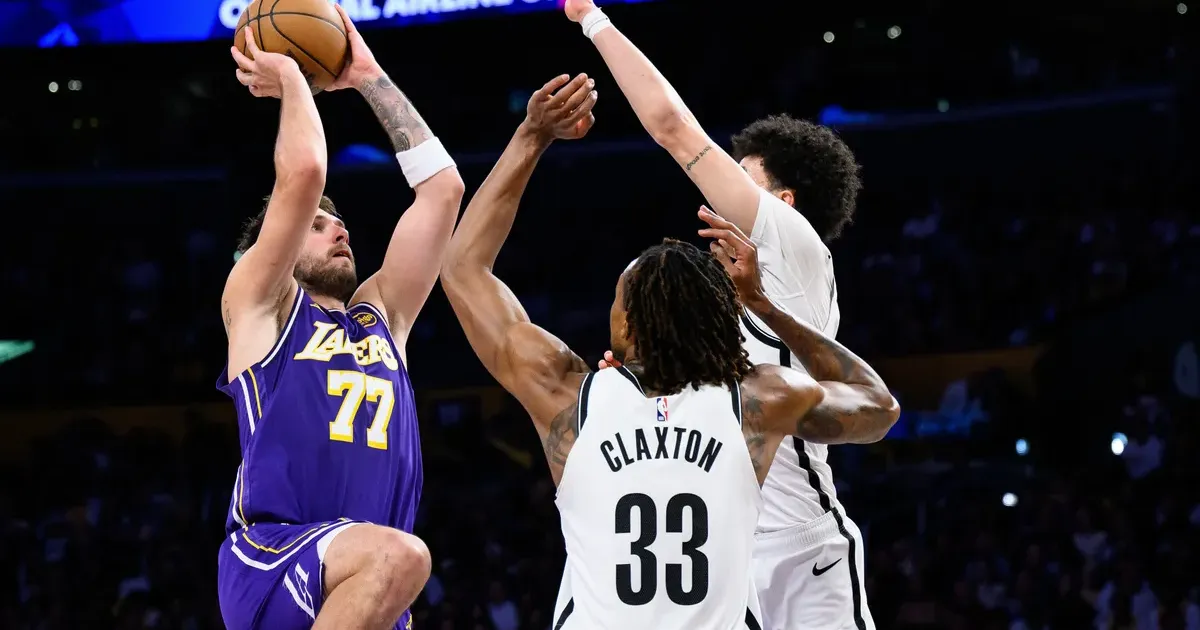
Luka Doncic's 41-point night gave the Lakers a comfortable 116-99 win over the Brooklyn Nets, but the box score did not control the story for long. The scoring night showed how quickly the Lakers’ offense can tilt when Doncic controls the pace. The margin made the performance harder to dismiss as a one-player highlight. The game captured the central contradiction of the Lakers' season: their best player can make the offense look simple, then turn availability into a question through avoidable disciplinary accumulation. His 16th technical foul of the season triggered the NBA's automatic suspension rule, leaving Los Angeles with a victory that immediately created a rotation problem.
The performance showed why the Lakers depend on him. Doncic controlled pace, created late-clock offense and kept Brooklyn's defense moving until clean shots opened around him. The disciplinary threshold showed the other side of that dependency: one emotional exchange can remove the team's primary creator from the next game.
Doncic Carries the Offense
Brooklyn never found a stable coverage. The Nets tried to change angles, bodies and help timing, but Doncic kept forcing the defense to make the first concession. When defenders switched, Doncic hunted mismatches. When they helped early, he moved the ball to shooters. When the Nets tried to crowd the lane, he used footwork and pull-up range to keep the Lakers ahead of schedule.
The Lakers also received enough bench support to keep the game from becoming a one-man exhibition. That matters because the next test will be whether those same secondary players can create offense without the gravitational pull that Doncic supplies.
The result kept Los Angeles moving in a crowded Western Conference race. A March win over a struggling opponent may not sound defining, but seeding margins are thin enough that avoiding bad losses is part of playoff preparation.
Technical Foul Consequence
The technical foul changed the tone of the night. A technical in November can be treated as a flash of frustration; a 16th technical in late March becomes a roster-management event. NBA rules impose an automatic one-game suspension after a player's 16th technical in the regular season, with additional penalties at later thresholds. The league can rescind a technical after review, but the Lakers cannot plan as if that will happen.
The issue connects directly to the broader disciplinary question around Doncic. His edge is part of his game, but officials now watch his reactions closely. Opponents know that too.
That makes restraint a competitive skill. The Lakers can build a scouting report for an opponent, but they also need an internal plan for moments when Doncic feels the whistle is turning against him. The Lakers do not need Doncic to become emotionless; they need him to avoid giving defenders and officials a path to remove him from the floor.
Rotation Without the Star
If the suspension stands, Los Angeles will have to distribute initiation duties across guards and wings who usually operate from advantage rather than create it. The frontcourt will need more screening, cutting and offensive rebounding to generate easier possessions.
That adjustment is not only tactical. It will reveal whether Los Angeles has practiced a second identity or merely survived non-Doncic minutes by waiting for him to return. It is psychological. Teams built around a dominant playmaker can lose clarity when that player sits, because everyone touches the ball earlier and decisions arrive faster.
The coaching staff can use the suspension threat as a rehearsal rather than only a punishment. If the Lakers cannot generate coherent possessions for one regular-season game without Doncic, opponents will remember that limitation when playoff defenses start trapping, switching and forcing the ball away from him. More touches for secondary creators, more scripted actions out of timeouts and a stronger defensive identity would all reduce the feeling that every possession must be solved by Doncic. The Lakers will need those options in the postseason anyway.
There is also a communication issue with officials. Star players often believe constant dialogue helps them manage the game, but repeated complaints can narrow the benefit of the doubt. Doncic does not have to stop advocating for calls; he has to choose the moments when the argument is worth the cost.
What the Win Reveals
The analysis is that the Lakers are both dangerous and exposed. The Brooklyn game was a reminder that high-end shot creation can cover many regular-season flaws, but suspension risk is not an opponent-specific matchup problem; it follows the team into every arena. Doncic can make a regular-season offense look playoff-ready, but his technical count has turned composure into a team variable. That is not a minor personality note. It affects availability, matchups and seeding.
Los Angeles should treat the Brooklyn win as useful evidence, not comfort. The night proved the ceiling remains high, but it also proved that discipline can become as consequential as shooting percentage when a team is built around one indispensable creator. The Lakers can live with technical fouls as emotional noise; they cannot live with technicals that change availability during a seeding race. A playoff team has to know the difference between competitive fire and a self-inflicted scheduling problem. That is the difference between personality and cost, and the cost is now visible on the schedule. The Lakers need his edge in close games, but they need it controlled enough that a referee's whistle does not become a rotation decision in March. The offense is strong when its centerpiece is available. The next game will show whether the roster has enough structure to survive a preventable absence.