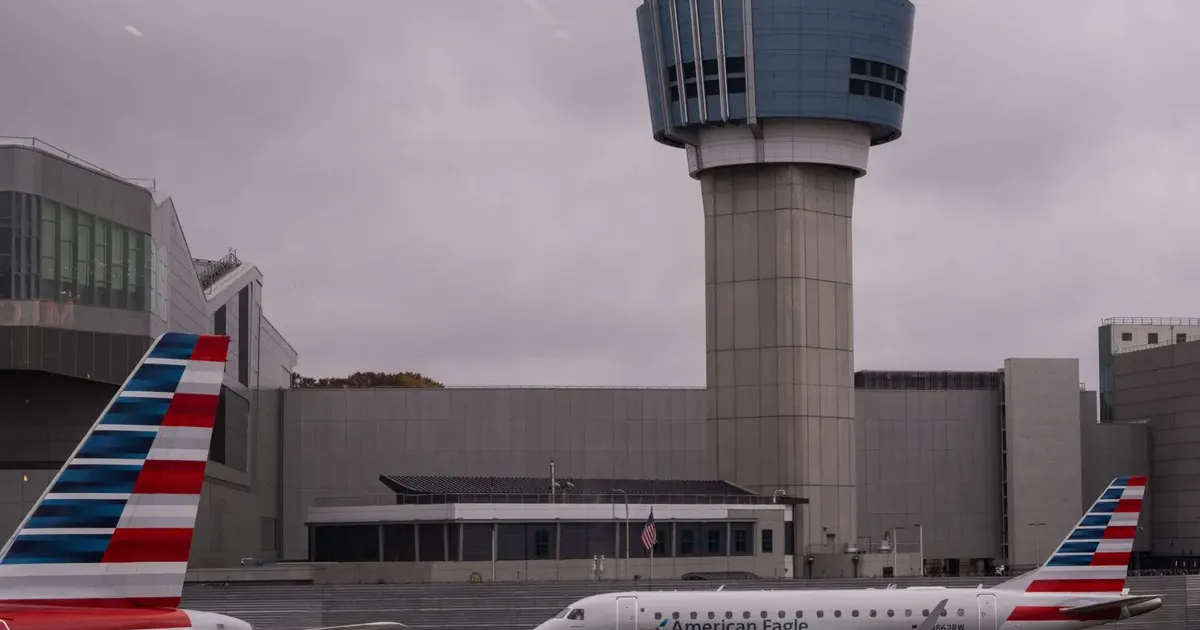
The LaGuardia runway collision turned an overnight staffing question into a national aviation-safety issue. On March 22, 2026, Jazz Aviation Flight 646, operating as Air Canada Express Flight 8646 from Montreal to LaGuardia, collided with an airport rescue and firefighting vehicle while landing on runway 4. The National Transportation Safety Board said the captain and first officer were fatally injured, and 39 people were transported to hospitals, with six serious injuries reported.
Those facts are already grave enough without pretending the final cause is settled. The NTSB investigation remains ongoing, and preliminary information can change. Still, the known sequence has put communications, ground-vehicle movement, tower workload and overnight staffing under scrutiny because the collision happened at the exact point where runway clearance, emergency response and arriving-aircraft control had to line up precisely.
The Quiet Shift Can Become The Complex Shift
The old defense of lean overnight staffing is volume. Fewer flights should mean fewer controllers, fewer positions and lower cost. That logic is incomplete. Risk is not counted only by the number of scheduled arrivals. It is shaped by how many live decisions must be made at the same moment: a vehicle crossing, an aircraft on short final, another aircraft with a possible emergency, radio congestion, weather, visibility and supervisory awareness.
LaGuardia is not a forgiving airfield. Its runways, taxiways, water boundaries and New York-area traffic pressure leave little slack when the operation stops being routine. A calm schedule can become a complicated shift in seconds. The staffing question therefore extends beyond one accident. Minimum staffing rules have to be tested against workload spikes, not just average traffic counts.
Ground Vehicles Need Their Own Safety Layer
The aircraft collided with Rescue 35, an Oshkosh Striker 1500 airport rescue and firefighting vehicle, while the jet was landing. The NTSB's preliminary page identifies the vehicle and the runway, and public reporting has described the truck as moving in response to a separate aircraft issue. That kind of ground movement is not unusual at a busy airport. The danger comes when the system does not keep the vehicle, the runway and the landing aircraft separated with enough redundancy.
Runway safety depends on more than a single clearance. It depends on repeatable procedures, clear radio discipline, accurate surface awareness and enough controller capacity to notice when a permission that made sense a moment earlier has become dangerous. When several tasks stack together, a tower needs spare attention. Without it, one missed cue can outrun the system.
Fatigue Belongs In The Same Review
Overnight work pushes against human biology. Controllers can be trained, experienced and serious while still facing narrower attention and slower reaction under late-night strain. That is not an insult to controllers. It is the reason safety systems are supposed to be built around human limits rather than around a fantasy of perfect alertness.
If a nighttime tower runs with fewer active positions, the operation has to ask a direct question: what happens when the quiet hour stops being quiet? A person handling multiple responsibilities may be fully capable in normal flow and still become saturated when an emergency response, aircraft movement and radio traffic converge. Staffing policy should not assume that the most demanding minute of the night will arrive politely.
Technology Helps, But It Does Not Replace People
Surface surveillance, runway-alert tools and digital displays are essential. They can warn, map, record and help controllers see movement that would otherwise be simpler to miss. But technology is not a substitute for enough trained people watching the operation. If a warning arrives late, is ambiguous or lands on a controller who is already saturated, it becomes a record of failure rather than a barrier against it.
The FAA's broader air traffic control staffing challenge makes the issue more difficult. Certified controllers cannot be created quickly, and complex facilities need local experience under pressure. That reality should not be used as an excuse for thin margins. It should make redundancy more urgent, because a system short of people has less room for surprise.
Aviation Safety Cannot Be Budgeted By Average Nights
Airlines, airports and federal managers will always face cost pressure. More staffing, stronger minimums and better surface systems cost money. But the budget argument has to be measured against the cost of failure: lives lost, survivors injured, crews traumatized, airport disruption, litigation and public distrust in a system that depends on confidence.
The LaGuardia investigation should not end with a vague demand for vigilance. Vigilance is a human quality; redundancy is a system design choice. If investigators find that staffing design, position consolidation or workload saturation contributed to the collision, the answer has to be operational, not rhetorical. The midnight shift still moves aircraft, vehicles and people in darkness, weather and abnormal conditions. It cannot be treated as a discounted version of the daytime airport.