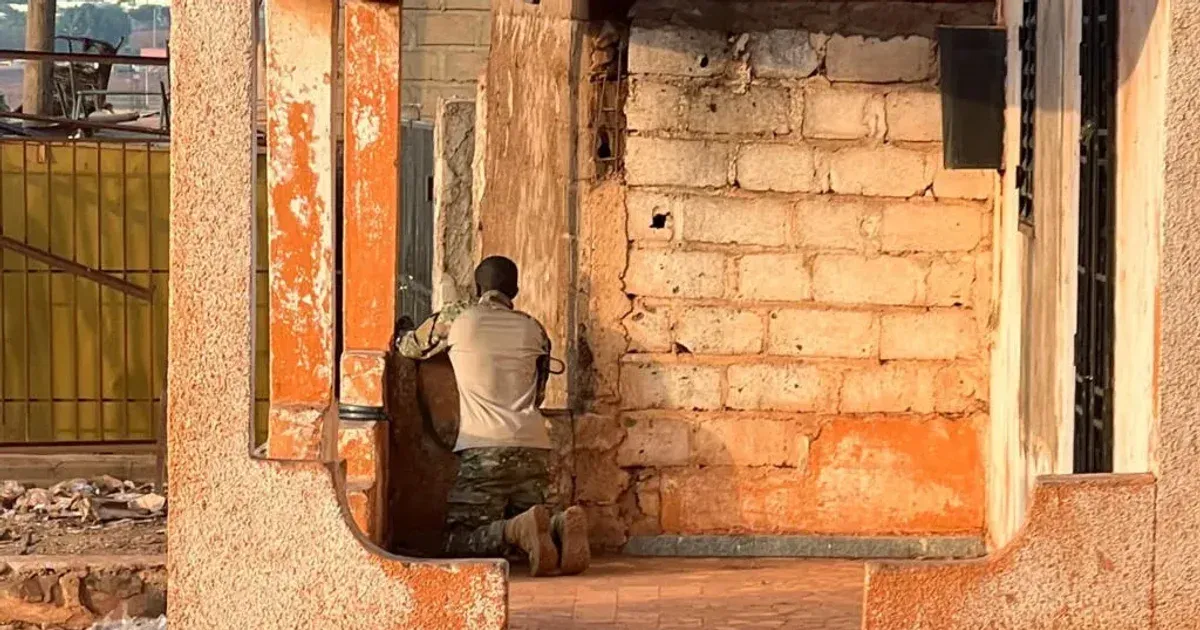
April 25, 2026, began with explosions at Mali's main military camp as coordinated insurgent groups launched strikes across the capital and the interior. Heavy smoke billowed from the Kati barracks near Bamako shortly after dawn, marking the start of a multi-pronged assault that caught security forces in a wide-scale defensive posture. Armed men targeted military installations and transport hubs, using a combination of small arms fire and heavy explosives to overwhelm perimeter guards. Reports from residents in the capital indicate that the sound of heavy weaponry echoed through the streets for several hours. This operation represents one of the most complex security challenges faced by the ruling military government since it seized power in a series of coups.
Military officials confirmed that several positions in Bamako and other major towns came under fire simultaneously. Army units scrambled to reinforce key government buildings and intersections, while civilian traffic came to a standstill. Security cordons now block major arteries leading to the administrative heart of the country. Fighting broke out in multiple locations, suggesting a high level of logistical preparation and tactical synchronicity among the attackers. No group has yet issued a formal claim of responsibility for the morning's violence.
Assault on Kati Military Camp
Kati military camp, the traditional seat of power and the site of multiple past military uprisings, was a primary target during the early hours of April 25, 2026. Explosions ripped through the facility, which is located approximately 15 kilometers from the city center. Soldiers stationed at the base engaged in sustained firefights with militants who attempted to breach the main gates. Kati is historically significant as the starting point for the 2012 and 2020 coups d'état. Control of this facility is essential for any administration seeking to maintain stability over the Malian state. The resilience of the camp's defenses was tested by waves of mobile insurgent units.
Mali's army deployed armored vehicles to the perimeter of the camp to repel the advancing forces. Witnesses reported seeing ambulances racing toward the site to treat wounded personnel. Military helicopters were observed circling the area, providing air support to ground troops pinned down by sniper fire. The intensity of the engagement at Kati forced the temporary closure of the road connecting the capital to the northwestern regions of the country. Government sources state that the situation at the barracks is now under control, although sporadic gunfire continues to be heard in the surrounding hills.
Gunfire Disrupts Modibo Keita International Airport
Gunfire erupted at the Modibo Keita International Airport on the southern outskirts of the capital, forcing an immediate suspension of all commercial flights. Journalists on the ground reported that militants reached the vicinity of the main terminal and the nearby military airbase. Security forces engaged the attackers near the hangars, where several aircraft are stationed for domestic and regional operations. International carriers diverted incoming flights to neighboring countries, including Senegal and Ivory Coast. The disruption of the airport creates a major logistical hurdle for the government's rapid response efforts.
Aviation data showed that several cargo planes and military transport vessels were grounded as the fighting intensified. Defense units established a defensive perimeter around the fuel depots to prevent catastrophic explosions. Security at the airport is normally tight due to its dual use by civilian and military authorities. Breaking through these defenses indicates a serious failure in the early warning systems of the national intelligence services. Local residents reported seeing smoke rising from the direction of the military apron, where the Mali air force maintains a fleet of helicopters and trainer jets.
Nationwide Coordination of Insurgent Groups
France 24 reported that the violence was not limited to the capital, with unidentified armed "terrorist" groups attacking military positions in several towns in the country's interior. Fighting is ongoing in regions that have long been the epicenter of the conflict between the state and various jihadist factions. These synchronized strikes point to a sophisticated command structure capable of managing operations across vast distances. Previous attacks in Mali have often been localized, making this nationwide surge a departure from standard insurgent patterns. The army is currently attempting to re-establish communication with isolated outposts in the northern and central zones.
“Unidentified armed terrorist groups attacked several military positions in the capital and in the country's interior early on Saturday,” the army said.
Security analysts note that the capability to strike Bamako and interior towns simultaneously requires large manpower and intelligence. This coordination often involves months of reconnaissance and the infiltration of urban centers. DW News reported that the scale of the explosions suggests the use of suicide vehicle-borne improvised explosive devices in at least two locations. The army has not released official casualty figures for the soldiers or the attackers. Military patrols in the interior are currently on high alert, fearing secondary ambushes along supply routes. Rural garrisons remain vulnerable to these mobile hit-and-run tactics.
Regional Security Implications for the Sahel
The security vacuum in the Sahel has widened since the withdrawal of the United Nations peacekeeping mission, known as MINUSMA, and the exit of French forces. Mali has increasingly relied on private military contractors and regional alliances to fill this gap. However, the current assault demonstrates that these new security arrangements may be insufficient to deter large-scale insurgent maneuvers. The Algiers Peace Agreement, once the foundation of stability between the government and northern groups, has effectively collapsed. This breakdown in diplomacy has left the door open for radical elements to expand their influence into previously secure southern regions. Border security with Burkina Faso and Niger is also under strain as similar groups operate across these porous frontiers.
Regional observers are monitoring the situation for signs of spillover into neighboring West African states. The Sahel region continues to be a focal point for global counter-terrorism efforts, yet the Malian government has moved away from traditional Western partnerships. Russia's presence through military advisors has been a key foundation of the current junta's strategy. These advisors are reportedly assisting in the defense of Bamako, though their direct involvement in today's combat has not been confirmed. The outcome of the current fighting will likely dictate the government's future stance on international military cooperation. Security in the interior stays unstable as the state struggles to project power beyond urban hubs.
Coordinated Assaults Shatter the Junta’s Security Claims
Discarding the illusion of junta-led stability is the first step toward understanding the current Malian collapse. For years, the military leadership in Bamako has promised that the expulsion of Western forces and the embrace of Russian mercenaries would secure the nation. The April 25, 2026, attacks prove that this was a strategic fantasy. By dismantling the United Nations mission and severing ties with traditional allies, the government has traded a flawed international safety net for a hollow security apparatus that cannot even defend its own capital. It is the predictable result of prioritizing political survival over professional counter-insurgency. Insurgents are no longer confined to the desert; they are knocking on the doors of the Kati barracks.
Will the junta survive a prolonged urban insurgency? History suggests that when a military government fails in its primary duty of providing security, its legitimacy evaporates as quickly as its ammunition. The coordination of these attacks implies intelligence failure of catastrophic proportions. It reveals that the state's eyes and ears have been blinded, likely by internal purges and a focus on silencing domestic dissent rather than monitoring the perimeter. If the airport can be shut down by a handful of militants, then Mali is effectively a landlocked island in a sea of its own making. The state is fragile. The center cannot hold. The era of the junta's unchallenged authority is over.