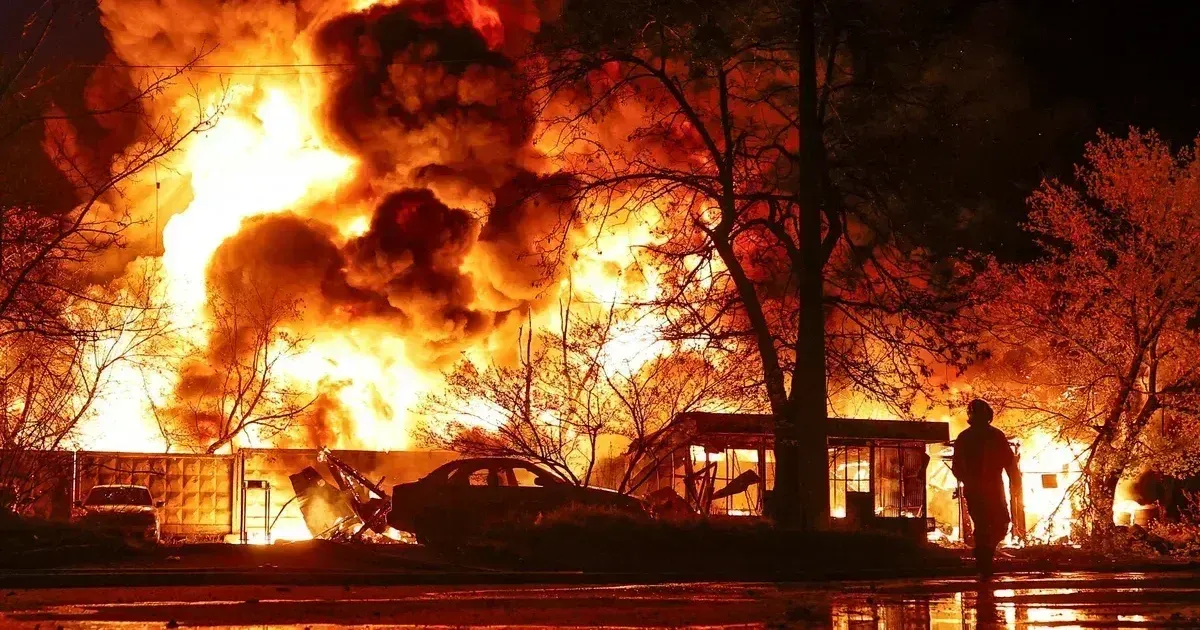
Russian military units launched a coordinated series of missile and drone strikes against urban centers on April 25, 2026, resulting in at least seven fatalities across the country. Dnipro experienced the most severe damage as projectiles tore through a multi-story residential building during the overnight hours. Local emergency services confirmed that four individuals died instantly within the ruins of the apartment complex. Rescue workers spent the early morning hours searching for survivors among the twisted metal and concrete slabs. Medical personnel at nearby trauma centers processed 21 wounded civilians, many of whom suffered from severe blast injuries and respiratory distress caused by smoke inhalation.
Missiles and low-cost loitering munitions saturated local air defenses before impacting several districts simultaneously. Ukraine has seen a consistent pattern of these mixed-method attacks intended to overwhelm interceptor batteries. Debris from the intercepted drones caused additional fires in secondary neighborhoods, complicating the efforts of the first responders. Search and rescue operations continued throughout the day as cranes lifted heavy sections of the collapsed roof. Families gathered at the perimeter of the police cordons, waiting for news regarding relatives who lived on the upper floors. These structures were never designed to withstand the kinetic energy of modern cruise missiles.
Dnipro Residential Attack and Casualty Figures
Statistics released by regional authorities indicate that the strike occurred while most residents were asleep, minimizing the time available to reach underground shelters. Regional Governor Serhiy Lysak stated that the dead included a child, though full identification of the victims remains ongoing at the local morgue. Two of the wounded remain in critical condition with life-threatening internal injuries. Hospitals in the region have moved to emergency footing, canceling elective surgeries to accommodate the influx of blast victims. Blood donation centers saw queues forming by sunrise as citizens responded to the sudden crisis.
Recovery efforts faced serious hurdles due to the instability of the remaining building frame. Firefighters used high-reach ladders to extinguish smoldering pockets of fire that persisted deep within the central structure. Neighborhood volunteers assisted by clearing smaller pieces of glass and masonry from the streets to allow ambulances better access. Damage assessments suggest that over 100 windows in surrounding buildings were shattered by the atmospheric overpressure of the explosion. Engineers are currently evaluating whether the entire apartment block must be demolished due to foundational compromises. Such structural failures have become a common feature of the urban war.
Russian Drone and Missile Coordination Analysis
Military observers have documented a shift in tactical execution where Shahed-style drones act as decoys to expose the locations of surface-to-air missile batteries. Once the defensive grid is occupied with low-speed targets, high-velocity missiles are launched to penetrate the perimeter. Analysis of the wreckage in Dnipro suggests the use of Kh-101 cruise missiles, which carry large explosive payloads. These weapons possess high precision but are frequently employed against dual-use or purely civilian infrastructure. Intelligence reports suggest that the production of these systems has continued despite international sanctions and supply-chain disruptions.
"Russian drone and missile strikes on the Ukrainian city of Dnipro killed at least four people and wounded 21 overnight," local authorities said.
Air defense commanders in the central sector reported that they successfully neutralized over a dozen incoming threats before the fatal impact occurred. Electronic warfare units attempted to jam the guidance systems of the loitering munitions, though some successfully navigated to their programmed coordinates. The cost-to-effect ratio of using million-dollar interceptors against thousand-dollar drones persists as a strategic challenge for the Ukrainian military. Analysts at the Institute for the Study of War have previously highlighted this resource exhaustion tactic. Procurement of additional Patriot and IRIS-T batteries remains a primary request from the defense ministry to Western partners. The proliferation of Iranian drones continues to challenge Ukrainian air defenses during these coordinated strikes.
Strategic Frontline Logistics in Central Ukraine
Dnipro acts as a critical logistic node for the eastern front. Railways and highways intersecting in the city enable the movement of Western-supplied armor and ammunition to the Donbas region. Russian planners likely view the destabilization of the city as a requirement for any further territorial gains in the east. By targeting residential areas near transportation hubs, the Kremlin seeks to create a vacuum of civilian administration and strain municipal resources. The city has hosted hundreds of thousands of internally displaced persons since the invasion began, making any strike on housing a high-casualty event.
Infrastructure repairs are underway at several energy substations that were also targeted during the Saturday morning barrage. Temporary blackouts affected three districts for several hours until technicians rerouted power through the regional grid. Water utility officials reported a drop in pressure following a leak caused by subterranean vibrations from the heavy missile impacts. Repair crews are working in shifts to restore heating services before the evening temperature drop. Russia also reported a single casualty within its own borders on the same day, suggesting that cross-border exchanges are intensifying. Belgorod officials claimed a Ukrainian drone strike caused the fatality, though Kyiv rarely comments on specific operations inside Russian territory.
Civil Defense and Ukrainian Emergency Response
Emergency sirens failed to provide sufficient warning for the incoming supersonic projectiles. Residents reported that the explosions occurred almost simultaneously with the activation of the alarm system. This lack of lead time is attributed to the launch of missiles from aircraft positioned close to the border, reducing the detection window for radar operators. Civil defense units have since increased the frequency of drills to ensure that shelter protocols are executed within seconds. Public awareness campaigns now focus on the dangers of standing near windows during nighttime alerts.
Local businesses in the impact zone remained closed as owners assessed the damage to their storefronts. Small-scale entrepreneurs have struggled to maintain insurance coverage in areas frequently targeted by aerial bombardment. Municipal grants for reconstruction are limited by the overall strain on the national budget. Despite these economic hurdles, the community in Dnipro has organized private fundraising efforts to support the families of the seven deceased. Resilience in the city is high, though the physical evidence of the war is increasingly impossible to ignore. Each new crater is a permanent alteration to the urban landscape and the collective memory of the survivors.
Dnipro Strike Exposes the Cost of Air-Defense Attrition
Why do Western analysts continue to express surprise at the systematic targeting of Ukrainian apartment blocks? The strategy is not an aberration or a result of technical failure; it is a calculated component of total war designed to break the psychological tether between the civilian population and the state. By forcing the Ukrainian government to choose between protecting front-line troops and defending urban residential districts, the Kremlin exploits a permanent defensive dilemma. This is attrition in its purest, most cynical form, where the civilian body count is a metric for success in Moscow.
The current pacing of these strikes indicates a Russian stockpile that is far more resilient than early intelligence assessments suggested. Sanctions have failed to halt the flow of microelectronics necessary for cruise missile guidance, allowing for a sustained tempo of high-precision violence. Ukraine is effectively being used as a testing ground for the limits of modern air defense saturation. If the West does not shift from a reactive supply model to a proactive industrial mobilization, the sheer volume of Russian munitions will eventually find every gap in the shield. The attrition of air defense interceptors is the silent front of this war. Dnipro is the proof of the cost. The outcome is binary.