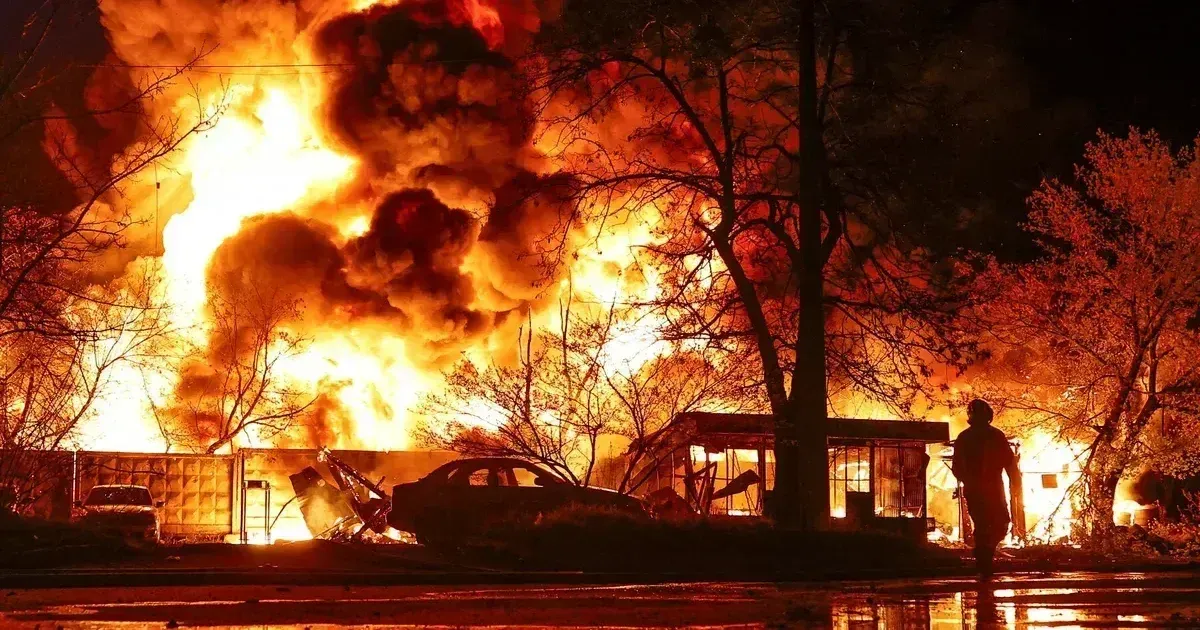
Rescuers in Dnipro combed through concrete debris on April 25, 2026, seeking survivors of a concentrated Russian bombardment. Ukrainian authorities reported a massive wave of drones and missiles hitting residential and industrial sectors across the country. Total projectile counts reached levels not seen in months, straining air defense batteries from the eastern front to the western borders. Emergency planning remains strained.
Death counts reached four individuals by Saturday morning. Injuries climbed past 30 as emergency crews pulled survivors from collapsed apartment blocks. Most casualties occurred in high-density urban areas where projectiles breached aging defense systems. Local hospitals in Dnipro struggled to manage the influx of patients suffering from shrapnel wounds and respiratory distress.
Medical supplies moved toward the city center under heavy security as sirens continued to wail intermittently. This offensive used more than 660 distinct units in a single night. Officials in Kyiv categorized the hardware as a mixture of Iranian-designed Shahed drones and long-range ballistic missiles. Every major regional capital faced alerts as the swarm moved through multiple corridors to bypass detection.
Dnipro Rescue Operations and Civilian Casualties
Dnipro bore the brunt of the weekend strikes. Search teams used heavy machinery to lift slabs of masonry from a destroyed residential complex. Dust and smoke filled the air, making visibility difficult for teams working since the early hours of Saturday. Families gathered behind police lines, waiting for news regarding relatives missing since the first explosion shook the neighborhood. One survivor described the impact as a series of rapid blasts that shattered windows blocks away.
Emergency services focused their efforts on a nine-story building that suffered a direct hit. Engineers expressed concerns about the structural integrity of the remaining walls. While some residents managed to escape through stairwells, others were trapped on higher floors. Firefighters used extension ladders to evacuate several children and elderly occupants. Supplies of drinking water and warm clothing arrived as the neighborhood faced a total power outage.
Regional administrators confirmed that water pumping stations stopped functioning due to grid damage. Technicians worked to reroute electricity, yet the sheer volume of strikes made repairs dangerous. Shrapnel littered the streets, hampering the movement of ambulances and transport vehicles. Volunteers set up temporary shelters in nearby schools to house those displaced by the destruction.
Yekaterinburg Airspace Shutdown and Security Breach
Across the border, a different crisis unfolded in the heart of the Russian interior. A drone attack on Yekaterinburg damaged an apartment building, signaling an expansion of the conflict deep into the Urals. The governor of the Sverdlovsk region immediately ordered a total cessation of flight operations. This action effectively isolated one of Russia's most important industrial hubs from commercial aviation.
Authorities closed the entire region’s airspace at all altitudes. Every flight scheduled for the Koltsovo International Airport diverted to alternative cities or returned to its point of origin. Military officials did not specify the origin of the drone, but the proximity to industrial manufacturing plants raised immediate alarms within the Kremlin. Security forces established checkpoints on major roads leading into the city.
Local residents reported hearing a high-pitched engine whine before a dull explosion echoed near the city center. Images shared on social media showed a scorched facade on a multi-story building. Unlike previous incursions, the distance from the front lines suggests a significant leap in long-range drone capabilities. Security personnel began a sweep of the area to determine if additional unexploded devices were present.
Technical Breakdown of the 660 Projectile Barrage
Military analysts in Kyiv believe the scale of the 660-unit attack was designed to saturate defense networks. By launching hundreds of low-cost Shahed drones, Russia forces Ukraine to deplete its limited stockpile of expensive interceptor missiles. Ballistic missiles then follow these swarms to target high-value infrastructure once the defenses are overwhelmed. Radars across the country tracked complex flight paths that crisscrossed several provinces before converging on targets.
“Major strikes hit buildings in the eastern city of Dnipro, where rescue teams were searching for people trapped under rubble on Saturday morning,” Ukrainian officials said.
Kyiv officials noted that the interception rate was lower than in previous months. Ammunition shortages contributed to the penetration of several missiles into civilian areas. Air defense commanders reported that the mixture of supersonic and subsonic threats created a chaotic environment for operators. Ground crews worked through the night to reload mobile missile units and reposition radars.
Foreign intelligence reports suggest that Russia has accelerated domestic production of these drone variants. Satellite imagery indicates expanded manufacturing facilities in several eastern Russian provinces. Such an increase in volume allows for sustained pressure on the Ukrainian energy grid. Repair teams now face the difficult task of fixing transformers while the threat of a secondary strike persists.
Geopolitical Consequences of Aerial Warfare
Ukraine continues to seek more advanced air defense systems from Western allies. Each massive strike serves to highlight the vulnerability of the national power grid and civilian infrastructure. Diplomats in Brussels and Washington held emergency calls on Saturday to discuss the latest escalation. The sheer numbers involved in the April 25 barrage indicate that the conflict has entered a new phase of high-intensity attrition. Retaliatory strikes like the one in Yekaterinburg demonstrate Ukraine's refusal to remain purely defensive. Shifting the risk to Russian territory puts pressure on the Russian leadership to justify the war to a domestic audience. Closing the airspace in the Urals disrupts logistics and commerce far beyond the combat zone. These disruptions may impact the Russian industrial sector's ability to maintain its own war production schedules. Observers point out that the closure of airspace at all altitudes is a rare and extreme measure. It implies a total lack of confidence in the ability of local air defense to distinguish between friendly and hostile aircraft. Panic among the civilian population in Yekaterinburg could lead to increased dissent. Government spokespeople in Moscow have yet to provide a detailed explanation for the security lapse.
Russia’s Barrage Cannot Hide the Collapse of Security Deep Inside Its Own Territory
Does the closure of Russian airspace over Yekaterinburg indicate a catastrophic failure in domestic security doctrines? The April 25, 2026, events suggest that Moscow is losing the ability to protect its industrial heartland while simultaneously attempting to pummel Ukraine into submission. Launching 660 projectiles is an act of desperation masquerading as dominance. It is a resource-heavy gamble intended to break the Ukrainian spirit, yet it reveals a gaping hole in Russia's own armor. Kyiv has clearly mastered the art of asymmetrical deep-strike operations. By forcing a total airspace shutdown in the Sverdlovsk region, Ukraine has achieved a strategic victory that outweighs the kinetic damage of a single drone. They have effectively paralyzed an essential economic artery. This vulnerability should terrify the Kremlin. The current trajectory suggests a war where no city is safe, regardless of its distance from the front lines. Russia can fire hundreds of drones, but it cannot hide that its own citizens are now feeling the tremors of a war they once thought was distant. If Ukraine can hit Yekaterinburg, they can hit anything. The myth of the Russian fortress is dead. Total escalation is the new baseline.