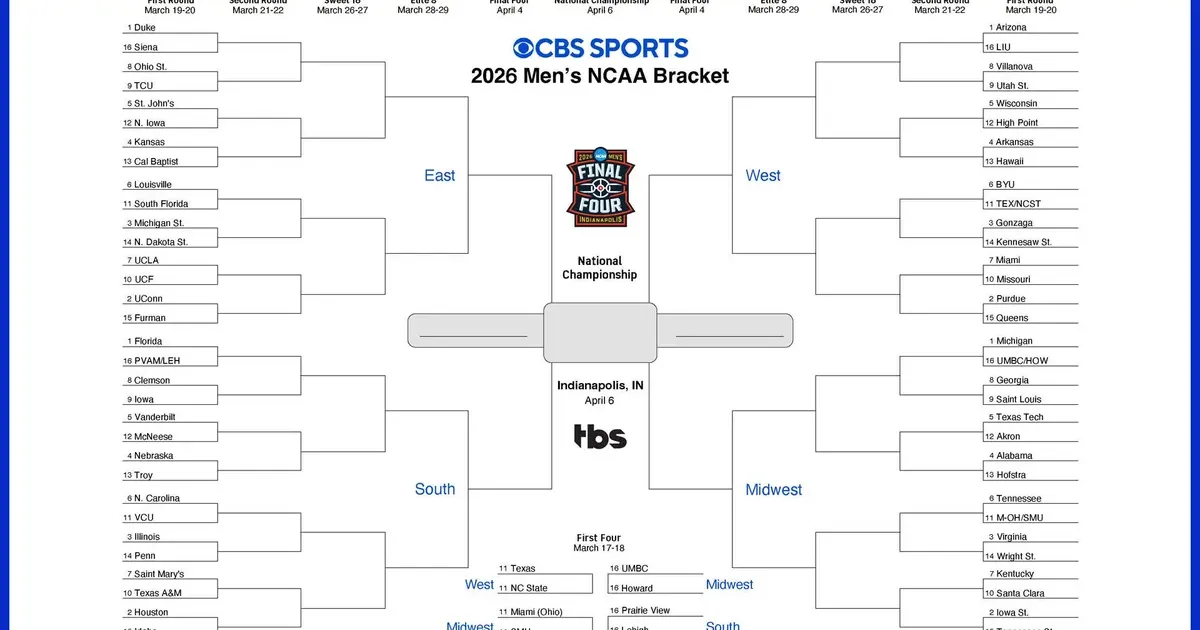
NCAA leadership confirmed that the current March Madness tournament has generated higher television engagement than any previous collegiate athletic cycle. The confirmation came on April 1, 2026. Initial data from CBS Sports suggests that digital bracket downloads increased by 14 percent compared to the prior season. The tournament business story expanded beyond tickets. By March 12, 2026, March Madness revenue had become a larger college-sports signal.
NCAA Tournament Schedule and Economic Impact
Dayton, Ohio, hosted the initial First Four contests, maintaining its position as the traditional gateway to the main bracket. Officials at the NCAA noted that sell-out crowds attended these Tuesday and Wednesday matchups despite the midweek scheduling. Transitioning to the Round of 64 required mobilizing thousands of personnel across 16 different states simultaneously. Each venue must adhere to strict court-surface specifications and lighting requirements dictated by the broadcast partners. Logistics firms handled the transport of team equipment and specialized hardwood floors using dedicated regional freight corridors. Local municipalities in Indianapolis reported a 22 percent increase in hotel occupancy rates during the opening weekend. Revenue sharing agreements between the tournament and participating conferences are based on a rolling units system tied to wins. Each victory in the tournament earns a conference one unit, which translates to a specific financial payout over a six-year period. High-performing mid-major teams often secure the future of their entire athletic departments through a single Cinderella run. Internal memos from the tournament committee suggest that future expansion to 72 teams stays under active consideration for the 2028 cycle.
Market analysts observe that the 2026 schedule was specifically designed to capture the growing international audience in European and Asian markets. Late-night games on the East Coast of the US now align with early morning hours in London and Tokyo, driving global streaming numbers. Streaming platforms recorded a 30 percent rise in international subscribers during the first weekend of play. Meanwhile, the domestic audience continues to prioritize the printable PDF bracket as a primary engagement tool. CBS Sports integrated live QR codes into its broadcast to allow fans to update their digital brackets in real-time.
This technological integration bridges the gap between traditional linear television and interactive mobile experiences. Data privacy concerns regarding these digital platforms persist among consumer advocacy groups. Some users reported that bracket-tracking applications required excessive permissions for location and contact data. The NCAA has not issued a formal response to these specific privacy complaints.
March Madness Media Strategy and Viewership Data
Broadcast partners shifted their focus toward personalized athlete narratives to drive engagement in the 2026 season. NIL deals have allowed players to market themselves during the tournament, creating individual brands that surpass the recognition of their respective universities. Networks used these individual followings to promote specific game windows, particularly those featuring star guards from the Big East and SEC conferences. While some traditionalists argue this detracts from the team-centric nature of the sport, the viewership numbers tell a different story. Games featuring players with over one million social media followers saw a 40 percent higher peak audience.
Demographic shifts show that younger viewers under age 25 are now the fastest-growing segment of the March Madness audience. This group consumes the tournament through 15-second highlights and vertical video feeds rather than full four-hour broadcasts. Producers have adjusted by creating dedicated social media rooms at every regional site to feed this demand. The cost of maintaining these high-speed data uplinks is built into the site-selection criteria for host cities.
The tournament is no longer just a series of basketball games, but an enormous logistic and data exercise that requires year-round planning to execute successfully in the modern media environment.
Radio broadcast rights also saw a resurgence as commute times in major metropolitan areas increased. Westwood One reported that their audio streams reached a record number of in-car listeners during the Thursday and Friday afternoon windows. Advertisers in the automotive and insurance sectors prioritized these slots to reach a captive audience. By contrast, traditional print media coverage of the tournament has dwindled to its lowest level in the history of the event. Local newspapers in host cities have largely abandoned special tournament editions in favor of digital-only updates.
National sports magazines have followed a similar path, focusing on archival-quality commemorative issues after the final buzzer. The shift to digital has allowed for more precise measurement of ad performance and viewer retention. CBS Sports employs over 400 analysts to track real-time sentiment during the broadcast to adjust commentary on the fly. The level of data-driven production is now standard for Tier-1 sporting events.
Bracket Logistics and Regional Venue Dynamics
Host cities are selected several years in advance based on their ability to provide tier-one infrastructure and transit. Large-scale stadiums in the 2026 cycle include venues typically reserved for NFL franchises, allowing for seating capacities exceeding 70,000. These large enclosures require sophisticated curtain systems and temporary stands to maintain the sightlines necessary for basketball. Engineers spend weeks calibrating the HVAC systems to prevent floor condensation caused by large crowds. Security protocols at these venues have evolved to include biometric scanning for all credentialed media and staff.
The NCAA maintains a 200-page manual outlining every requirement from the temperature of the locker rooms to the brand of bottled water provided. Failure to meet these standards can result in a city being removed from the future hosting rotation. Selection committee members visit each site anonymously to verify compliance with these operational mandates. The competition for hosting rights is fierce due to the guaranteed economic injection the tournament provides. Cities like Las Vegas and New Orleans have become permanent fixtures in the rotation due to their established tourism infrastructure.
Recent changes to the transfer portal have introduced a new level of volatility into the 2026 bracket predictions.
Roster turnover has reached an all-time high, with some programs starting five players who were at different schools the previous year. The fluidity makes it difficult for casual fans to track team chemistry and long-term development. Expert bracketologists note that the traditional advantage of experienced senior-heavy teams is still a factor in the second weekend of play. Physicality and defensive rotations hold more value in the pressure-cooker environment of the Sweet 16. Data shows that teams with a top-20 defensive efficiency rating according to KenPom statistics have a 75 percent higher probability of reaching the Final Four.
Offensive-minded teams often struggle with the depth perception issues found in football-stadium settings. The 2026 tournament has seen several top-seeded teams fall early due to inconsistent shooting in these cavernous environments. The trend persists despite improvements in lighting technology and court positioning. Betting markets have adjusted by lowering the over/under totals for games played in domed stadiums. Every variable, from travel distance to altitude, is now factored into the point spreads offered by major sportsbooks.
The 2026 NCAA tournament has finally shed the pretense of being a collegiate extracurricular activity. It is now a tax-exempt commercial utility designed to extract maximum value from a transient labor force of 19-year-olds. While the NCAA continues to hide behind the shield of education, the $8.8 billion economic impact figures suggest a professional enterprise in everything but name. The integration of gambling and NIL collectives has created a hyper-capitalist environment where loyalty is a commodity and the transfer portal is the new free agency. The evolution is not a failure of the system but its logical conclusion.
Skeptics who pine for the days of four-year starters and regional loyalty are ignored by a broadcast machine that thrives on the churn of new faces and immediate drama. The printable bracket is the last vestige of the analog era, a paper tether for a generation that increasingly interacts with sport only through a betting app or a social media feed. If the NCAA expands to 72 or 80 teams, it will not be for the benefit of the athletes, but to provide more inventory for a television contract that is the only thing keeping the collegiate model solvent. The spectacle is permanent, but the soul of the game is for sale. It is a terminal reality.
Tournament Revenue Scale
The revenue readout keeps the focus on what changed, who is directly affected and which decision point comes next.