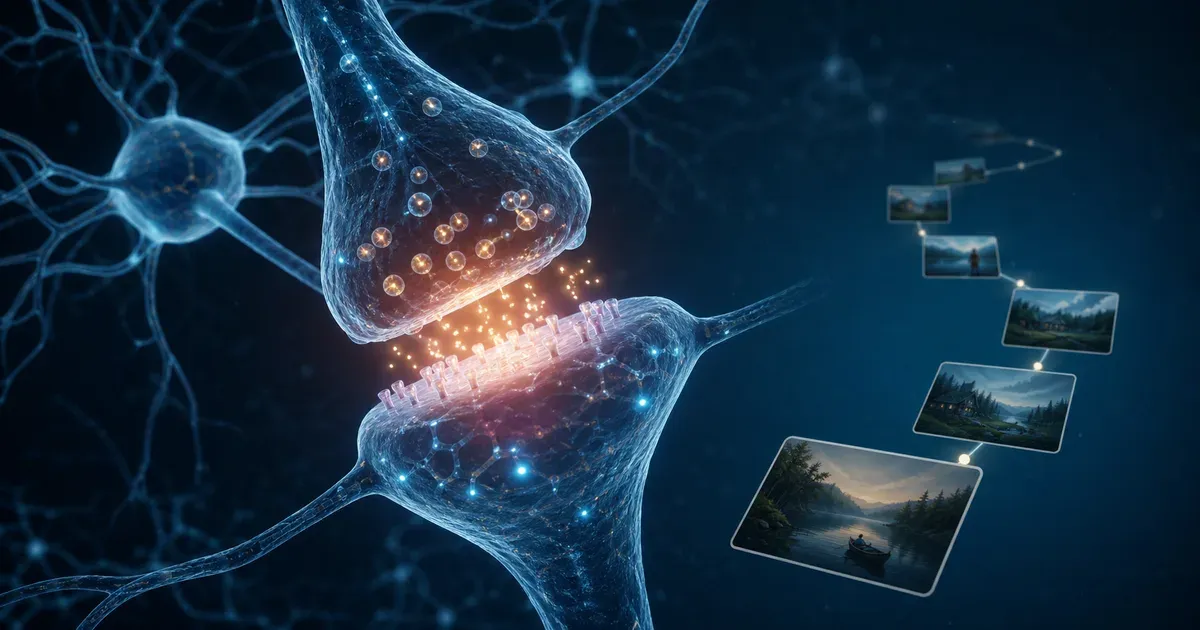
Two memory studies published in 2026 examined very different questions. One used mouse models to test how calcium-sensitive machinery at hippocampal synapses supports temporary strengthening. The other asked human participants whether placing unrelated words into stories improved recall after a brief delay.
The studies should be read separately. The Cell Reports paper investigated Munc13-1 signaling at mossy-fiber synapses and performance in a mouse spatial working-memory task. The Evolutionary Psychology paper compared story processing with two established ways of encoding word lists in more than 380 people.
Together they show the range of levels at which memory can be studied, from vesicle release at a synapse to the instructions given during a recall experiment. They do not demonstrate that storytelling changes the calcium pathway, that one finding explains the other or that either approach is ready to treat a memory disorder.
The Synapse Study Altered Munc13-1 Signaling in Mice
Neurons release chemical messengers from small vesicles at synapses. Munc13-1 helps prepare those vesicles for release, a step known as priming. The Cell Reports team examined two routes through which calcium regulates the protein: calcium-phospholipid signaling through its C2B domain and a calcium-calmodulin pathway.
The experiments focused on hippocampal mossy-fiber synapses connecting to CA3 pyramidal cells. These synapses can temporarily become more effective during repeated activity through short-term facilitation and post-tetanic potentiation. Both effects fade, unlike the longer-lasting changes associated with long-term memory.
When the researchers disrupted Munc13-1's ability to respond properly through the two calcium-sensitive routes, the synapses lost much of that temporary strengthening. The pathways made complementary contributions, while the calcium-phospholipid route was especially important for triggering strong post-tetanic potentiation.
The team then tested spatial working memory in an eight-arm radial maze. Mice carrying a mutation that disrupted calcium-dependent phospholipid binding repeatedly returned to reward locations after collecting the reward. The behavior was consistent with impaired working memory in that task.
This was mechanistic animal research. It did not observe human thoughts in real time, establish a general capacity limit for working memory or test a medicine. Human UNC13A variants have been associated with neurological symptoms, but that clinical context does not turn a mouse synapse experiment into evidence for a dementia drug.
The Story Study Tested Recall of Unrelated Words
Matthew Reysen and Zoe Fischer at the University of Mississippi ran four experiments comparing story processing, survival processing and pleasantness processing. Participants worked with unrelated common nouns, then completed an incidental recall test after a brief delay.
Story participants either created a short narrative using the words or judged how easily each word could be included in a story. The survival condition asked participants to consider the words in an imagined ancestral grasslands survival scenario. The pleasantness condition required judgments about whether each word was pleasant or unpleasant.
In the first experiment, participants who received a full list and wrote a story recalled more words than either comparison group. When the researchers controlled presentation order and rate in later experiments, story and survival processing produced comparable recall, and both outperformed pleasantness processing.
A fourth experiment combined the survival and story instructions. The combined condition did not produce a clear additive advantage. The authors proposed that the two methods may draw on overlapping forms of deep encoding, including attention to individual items and relationships among them.
The result supports story creation as a useful mnemonic for this laboratory task. It does not show that every story is remembered accurately, that listening to any narrative improves memory or that the brain evolved specifically for storytelling. The evolutionary explanation remains a hypothesis discussed by the researchers.
The Experiments Do Not Form a Clinical Treatment
Treating the synaptic pathway as biological hardware and storytelling as software designed to exploit it would create a model neither research team tested. The mouse study did not include narrative tasks, and the human study did not measure Munc13-1, calcium signaling or neural activity.
The participant study also assessed a narrow outcome: recall of unrelated nouns after a short interval. It did not enroll people with dementia, intellectual disability or a confirmed working-memory disorder. Longer retention, classroom learning, recognition accuracy and real-world medical use all require separate tests.
The animal study has a different translation gap. Disrupting a protein pathway can reveal what normal synapses need, but safely modifying that pathway in a person is another question. Munc13-1 participates in neurotransmitter release, so any therapeutic proposal would need evidence about selectivity, dosing and effects beyond one hippocampal circuit.
Claims that narrative training could compensate for a molecular defect therefore go beyond both papers. So do claims that social media has caused a collapse in collective memory. Neither study measured media use, attention trends, cultural change or population-level cognitive decline.
The Value Lies in Keeping the Levels of Evidence Clear
The synapse work strengthens a specific account of how brief, activity-dependent changes in neurotransmission can support working-memory behavior in mice. The storytelling work shows that actively organizing words into a narrative can be as effective as a well-studied survival-encoding task under the conditions tested.
Each finding creates a different next step. The molecular result can be tested in other circuits, models and human-relevant systems. The behavioral result can be tested with longer delays, educational material, different age groups and outcomes beyond free recall.
Combining them into a treatment story would make both studies sound more advanced than they are. Their real contribution is more disciplined: one identifies components of temporary synaptic strengthening, while the other compares instructions that shape how people encode a word list.
Memory research advances when those distinctions survive the headline. A mouse maze is not a dementia trial, and a short-delay noun test is not proof of a cultural cure. The experiments are useful precisely because they isolate narrow questions. Turning them into one grand mechanism would trade that evidence for a narrative the researchers never tested.