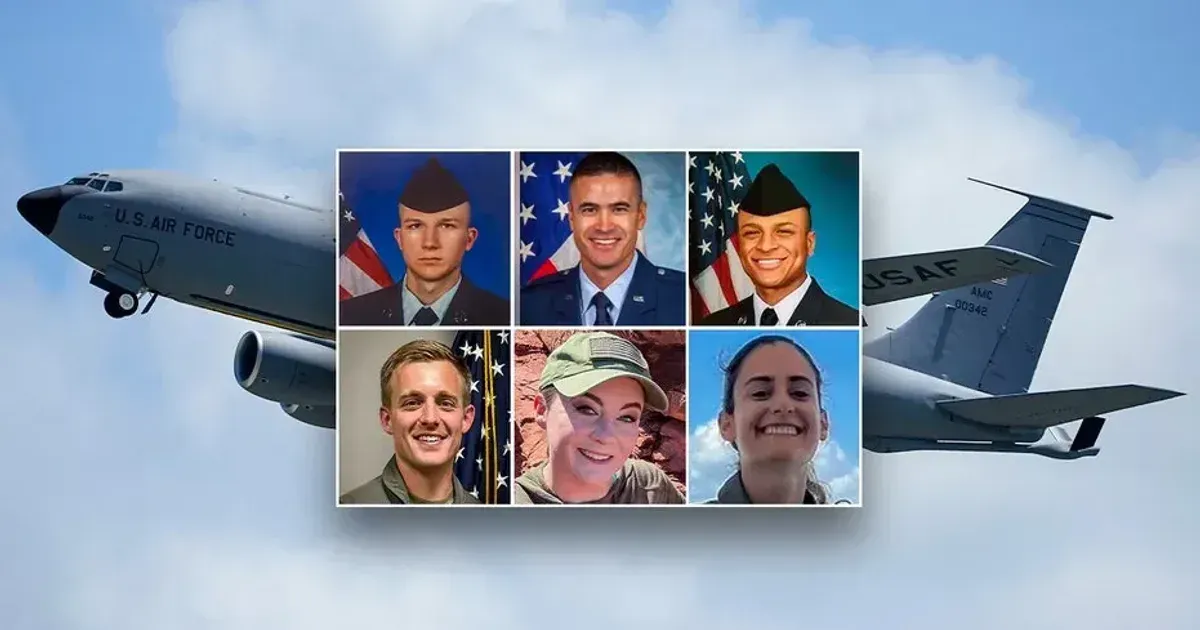
Smoke rising from the western Iraqi desert on Thursday marked the end of a combat mission for a KC-135 refueling aircraft. Maj. John Alex Klinner and five other service members died when their tanker collided with another aircraft in airspace military officials described as controlled by friendly forces. Military officials confirmed on Sunday that the incident took place during an active sortie for Operation Epic Fury. While the second aircraft involved in the collision managed to land safely at a nearby installation, the heavy refueling tanker disintegrated upon impact with the ground. Six families received notification of the deaths as the Pentagon released the names of the fallen airmen. The crew included Maj. John Alex Klinner, 33; Capt. Ariana Savino, 31; Tech. Sgt. Ashley Pruitt, 34, Capt. Seth Koval, 38, Capt. Curtis Angst, 30, and Tech. Sgt. Tyler Simmons, 28. These individuals represented two distinct units within the Air Force refueling community. Personnel from the 6th Air Refueling Wing at MacDill Air Force Base in Florida made up a portion of the crew. Other members were assigned to the 121st Air Refueling Wing, an Air National Guard unit based at Rickenbacker Air National Guard Base in Columbus, Ohio. This loss is a notable blow to both the active duty and guard components of the aerial refueling mission.
Pentagon Investigates Iraq Collision
Families of the deceased have begun sharing details of the lives cut short by the disaster. Klinner, a graduate of Auburn University and an eight-year veteran from Birmingham, Alabama, leaves behind a wife and three young children. His family recently moved into a new home just before his latest deployment to the Middle East. Friends described the pilot as a steady presence who balanced his military career with a deep commitment to his community. James Harrill, Klinner's brother-in-law, spoke to reporters about the officer's character. Harrill recalled how Klinner spent his last leave helping neighbors clear snow and preparing his family for the long separation of a combat tour.
Alex was one of those guys that had this steady command about him. He was literally one of the most kind, giving people.
Capt. Ariana Savino and Capt. Seth Koval were seasoned officers with multiple deployments between them. Tech. Sgt. Ashley Pruitt served as the boom operator, a role that requires precision and nerves of steel while maneuvering a fuel line within feet of a trailing fighter jet. Tech. Sgt. Tyler Simmons and Capt. Curtis Angst completed the crew, providing the technical expertise required to keep the aging KC-135 operational in a high-stress environment.
Families Learn the Names of Airmen
Operation Epic Fury has increased the tempo of American sorties in the region as tensions with Iran reach a boiling point. Aerial refueling remains the primary bottleneck for sustained air operations over Iraq. Tankers must loiter in designated tracks for hours, waiting for thirsty strike packages to arrive from bases in Qatar or the United Arab Emirates. This constant cycle of high-altitude station-keeping places immense strain on both the airframes and the flight crews. Military records indicate that the KC-135 is one of the oldest airframes in the current inventory. Most of these planes were built in the late 1950s and early 1960s. The Pentagon maintains that the fleet is safe for flight provided maintenance protocols are strictly followed. Investigators are now looking into whether mechanical failure played a role in the sudden collision or if human error during a nighttime join-up led to the catastrophe.
Recent maneuvers against Iranian-backed proxies have forced tankers to operate closer to active combat zones. The proximity of various coalition aircraft in the crowded Iraqi corridor increases the risk of traffic management errors. Air traffic controllers at regional hubs must manage hundreds of daily movements involving drones, transport planes, and fast-moving interceptors. One mistake in a transponder setting or a missed radio call can lead to disaster.
Casualties in western Iraq often prompt immediate reviews of existing rules of engagement. Central Command officials stated that the crash did not result from hostile fire or friendly fire from ground-based defense systems. The distinction is critical for preventing a diplomatic crisis between the United States and the Iraqi government. Western Iraq remains an unstable region where various factions compete for control of the border crossings.
Logistical support for the Iran mission will continue despite the loss of the tanker and its crew. Replacements from other wings will likely rotate into the theater to fill the gap left by the 6th and 121st. The mission parameters for Operation Epic Fury remain unchanged according to recent statements from the Secretary of Defense. Command officials are prioritizing the recovery of the flight data recorder from the wreckage to understand the final seconds of the flight.
Losses of this magnitude usually result in a temporary stand-down for similar units to conduct safety briefings. But the current security environment may not allow for a pause in operations. Tankers are now the lifeblood of the American presence in the Middle East. Without them, the reach of the U.S. Air Force is cut in half.
The loss of life highlights the hidden costs of long-term power projection. Six airmen are dead. Their plane is a charred ruin in the sand.
The deaths require more than ceremonial mourning. Investigators must explain how the aircraft came together, what communications failed, and whether combat tempo during the Iran mission created avoidable risk.