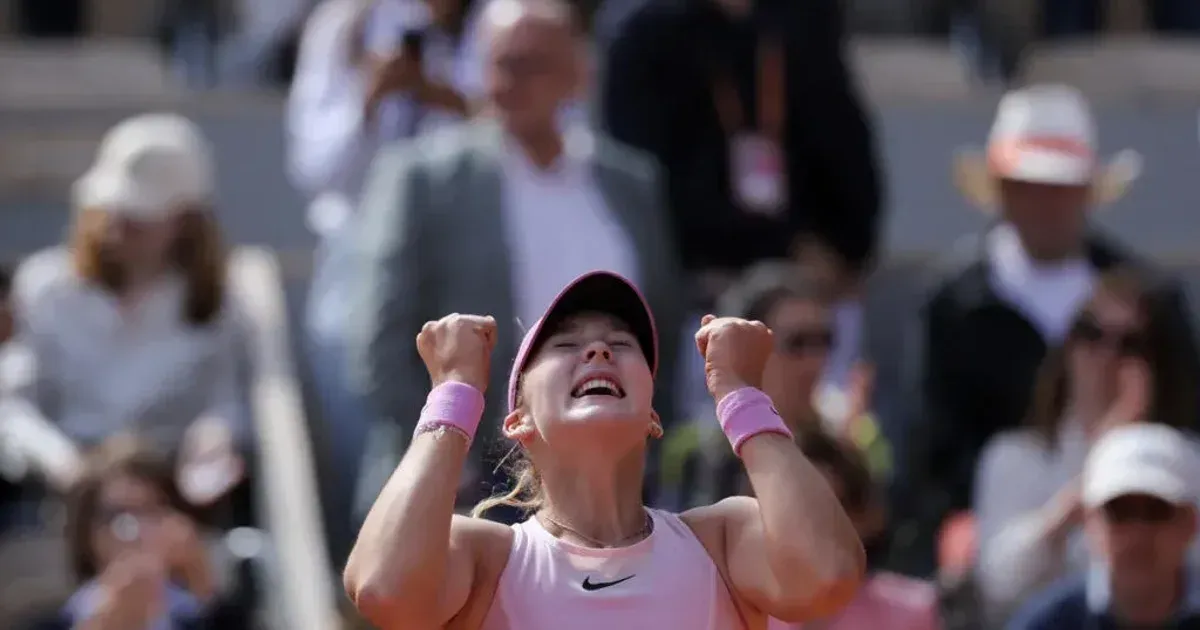
Mirra Andreeva turned a surprise French Open final into a clean statement of arrival, beating Maja Chwalinska 6-3, 6-2 on Court Philippe-Chatrier for her first Grand Slam singles title. The eighth seed controlled the match from the baseline, protected her serve under pressure and ended the qualifier's unlikely Paris run before it could become a three-set fight. The result gave the women's draw a teenage champion and gave Russian tennis its first major singles winner since Maria Sharapova's 2014 triumph in Paris.
The final was played on Saturday, June 6, 2026, after a fortnight in which both players had moved through a disrupted and unpredictable draw. Andreeva entered as the higher-ranked player, but the occasion still carried unusual pressure because Chwalinska had already beaten expectations by becoming a Grand Slam finalist from qualifying. That contrast shaped the afternoon: one player trying to confirm a fast rise, the other trying to extend one of the tournament's most unexpected stories.
Andreeva settled first. Her depth pushed Chwalinska behind the baseline, and her changes of direction kept the Polish player from building points around drop shots or angled forehands. The Russian broke early in both sets and rarely let the match drift into the loose, emotional tennis that can help an underdog. Chwalinska had brief windows on return, but Andreeva answered with first serves, heavy backhands and calm recovery points.
It was a title won with control rather than noise.
Andreeva Controls the Final from the Baseline
The scoreline reflected how little room Chwalinska found once rallies settled. Andreeva repeatedly struck through the middle of the court to deny easy angles, then opened space with the backhand when the qualifier was forced to defend. Reports from the match placed the contest at a little more than an hour and a half, with Andreeva finishing far ahead in total points and closing the second set without giving Chwalinska a late foothold.
Chwalinska's run remains a major part of the story. Ranked outside the top tier before Roland Garros, she came through qualifying and turned a tournament that began with modest expectations into the best two weeks of her career. The final showed the limits of that surge against a player with greater pace and cleaner first-strike tennis, but it did not erase the ranking lift and credibility she earned in Paris.
"Teenager Mirra Andreeva fulfills her huge potential with a first Grand Slam title," the BBC reported after the final.
For Andreeva, the championship also changed the scale of every coming event. At 19, she became the first teenager to win Roland Garros since Iga Swiatek in 2020. She had already been treated as one of the sport's most advanced young players, but a major title turns that promise into a measurable standard. Future opponents will no longer frame her as a prospect; they will prepare for her as a Grand Slam champion.
The way she closed the final will matter to coaches as much as the trophy. Young players often tighten when a first major title is within reach, especially against an opponent with little to lose. Andreeva instead kept the same patterns that had built the lead, trusted her serve and avoided the rushed winners that can reopen a match. That maturity made the straight-sets score feel earned rather than accidental.
What the Title Changes on Tour
The French Open title pushes Andreeva deeper into the center of the WTA conversation at a moment when the tour is already shifting toward younger contenders. Her win was not built on one hot afternoon. It followed two weeks of reliable movement, measured risk and enough emotional restraint to handle a final against a player carrying the crowd-friendly underdog label.
The Russian drought also matters. Sharapova's 2014 French Open title had remained the last Grand Slam singles victory by a Russian woman, leaving a long gap despite the country's history in the sport. Andreeva ending that run in Paris gives the result a national and historical layer beyond the trophy itself. Her ranking will rise, her expectations will rise with it and the grass-court swing will test how quickly she can reset after the biggest win of her career.
Chwalinska leaves with a different but still meaningful gain. A qualifier reaching a major final changes a player's calendar, sponsorship outlook and seeding path. Her next challenge is proving that Roland Garros was not a single-surface breakout but the beginning of a more stable place on tour. Even in defeat, she gave the tournament one of its defining runs.
The final did not produce a long tactical argument. It produced a clear champion. Andreeva's power, patience and court coverage were enough to keep the match on her terms from the opening set to the last point. That clarity is why the result will follow her into every major draw that comes next.