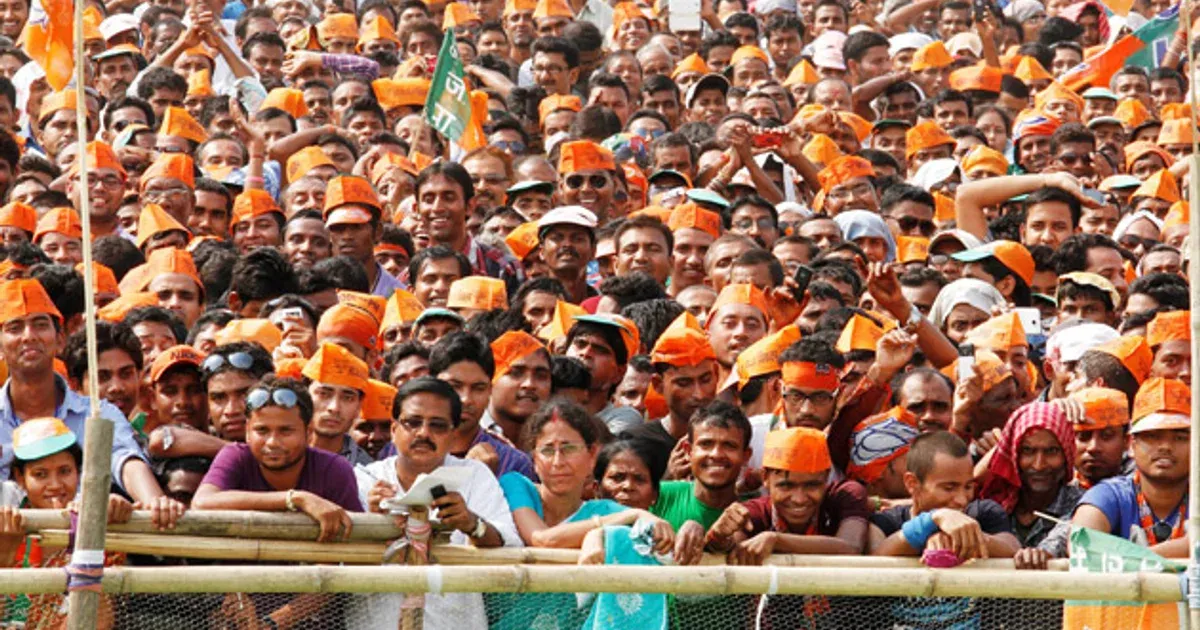
Narendra Modi arrived in Assam to headline three major election rallies as the local race entered its final stages. The campaign push combined welfare payments, identity politics and border-security themes. Party organizers expected large rural crowds across three districts. By April 6, 2026, the BJP was treating Assam as a key test of its northeastern voter base.
Regional dynamics in the Brahmaputra valley often dictate the national momentum for the ruling party. Political analysts observing the BJP campaign note a specific reliance on what critics describe as a blend of exclusive identity rhetoric and targeted financial assistance. Financial records from the state treasury show a meaningful increase in direct cash transfers to households over the last fiscal quarter. These disbursements often reach millions of families under the guise of poverty alleviation. Opposition leaders argue that the timing of these payments coincides too perfectly with the election calendar to be considered routine governance. Voter turnout in previous cycles suggests that such economic interventions can sway undecided blocs in closely contested constituencies.
Modi Targets Three Strategic Assam Districts
Campaign schedules released by the Prime Minister’s Office detail a grueling itinerary covering Upper Assam and the more volatile border regions. Each location serves a specific demographic purpose for the ruling coalition. One rally is situated in a tea-tribe dominated area where labor issues and wage disputes frequently dominate the political conversation. Another event targets urban middle-class voters who prioritize infrastructure development and regional connectivity. Modi plans to highlight several recently completed bridge projects and highway expansions that link the isolated northeast to mainland Indian markets. Infrastructure spending in the state has reached record levels under the current administration. Logistical challenges in the hilly terrain require serious engineering investments that the federal government frequently promotes as proof of progress.
Assam remains a complex electoral landscape due to its diverse ethnic and linguistic composition. Campaigning here requires a delicate balance between local regionalism and nationalistic fervor. Narendra Modi often speaks in a mix of Hindi and the local Assamese language to bridge this cultural gap. Party strategists believe his personal popularity outweighs local grievances regarding unemployment or inflation. Supporters often cite the central government’s focus on the Act East policy as a primary reason for their continued loyalty. Trade statistics show a modest increase in cross-border commerce with neighboring nations since the policy’s inception. Security forces maintain a heavy presence along the international boundaries to prevent any disruptions during the voting period.
Welfare Schemes Drive Female Voter Engagement
Female voters have become a foundation of the BJP electoral machine in the northeast. This shift is largely attributed to specific welfare programs designed to put liquidity directly into the hands of women. Schemes like Orunodoi provide monthly financial stipends to over 2.6 million female heads of households across the state. Government data reveals that these funds are primarily used for medical expenses, education, and nutrition. This direct intervention creates a loyalist base that often votes independently of the male members in their families. Social scientists tracking voting patterns note that the gender gap in political participation has narrowed sharply over the last decade.
Internal polling suggests that economic dependency on state-funded stipends acts as a powerful deterrent against switching party allegiances. While opposition parties promise larger sums, the BJP emphasizes its proven track record of consistent delivery. Administrative efficiency in distributing these funds has been a hallmark of the current state leadership. Banks in rural Assam report higher transaction volumes on the dates when these welfare payments are scheduled. Many recipients express concern that a change in government might lead to the suspension of these essential lifelines. Public discussion in village markets frequently revolves around the reliability of these monthly credits. The party maintains that these programs are sustainable long-term investments in human capital.
BJP Consolidates Hindutva Base Through Policy
Strategic maneuvering around identity politics continues to define the ideological core of the campaign. Al Jazeera reportage highlights a specific ideological mixture that defines the current political climate.
“Party banks on mix of xenophobic anti-Muslim policies and financial aid schemes aimed at women to retain power in state.”
Legal frameworks regarding citizenship and residency often feature prominently in the Prime Minister’s speeches. The implementation of the National Register of Citizens and the Citizenship Amendment Act has created deep divisions within the Assamese electorate. Proponents argue these measures are necessary to preserve the unique cultural identity of the indigenous population. Skeptics, however, point to the exclusion of specific religious minorities as a move to marginalize certain communities. Courts are currently processing thousands of appeals from individuals who found themselves left off the official residency lists. This legal uncertainty creates a permanent state of anxiety for many residents in the border districts.
Religious polarization serves to unify the majority Hindutva base while simultaneously fragmenting the opposition. Leaders from the ruling party frequently use rhetoric that frames the election as a choice between national security and external threats. Such messaging connects in a state that has historically struggled with migration issues. Political rallies often feature symbols and slogans that emphasize a specific religious heritage. Critics contend that this focus detracts from more pressing economic concerns like the rising cost of essential goods. Despite these objections, the BJP has successfully framed the narrative around the protection of civilizational values. Hardline activists within the party infrastructure work at the grassroots level to ensure this message reaches every polling station.
Border Security Remains Central to the Campaign
National security interests are closely linked to the political stability of Assam. Given its proximity to international borders, the state is an essential buffer for the Indian union. Narendra Modi frequently uses his rallies to discuss the modernization of border outposts and the deployment of advanced surveillance technology. Military analysts note that the integration of the border guards with local police units has improved response times to illegal crossings. Such security successes are a frequent talking point during campaign stops. The federal government has allocated meaningful resources to drone technology and electronic fencing along the most porous sections of the boundary. Local residents in these areas often prioritize security over other policy initiatives.
Border trade and illegal migration are the two sides of the same coin in northeastern politics. While the government promotes legal commerce, it maintains a strict stance on undocumented entry. The duality allows the BJP to appeal to both business interests and nationalist sentiments. Regional parties that once dominated the state are struggling to find a counter-narrative to this comprehensive security platform. Many smaller factions have been absorbed into the larger coalition led by the ruling party. The consolidation of power has reduced the number of viable alternatives for the average voter. Political competition is now largely limited to a few well-funded organizations with national reach.
Election observers expect the coming days to be marked by intense rhetorical exchanges and mass demonstrations. Campaigning will officially end forty-eight hours before the first ballot is cast. Each of the three rallies scheduled for Monday is a serious investment of political capital for the Prime Minister. Success in Assam is viewed as a requirement for maintaining the party’s dominance in the wider region. As the sun sets over the Brahmaputra, the final preparations for the evening rally are completed by the local organizing committee. Sound systems are tested and flags are hoisted across the city center. Thousands of supporters have already begun to gather in the designated assembly areas.
Assam Campaign Tradeoff
Democratic stability requires more than a series of automated cash transfers to a desperate populace. The BJP model in Assam is a cynical evolution of the modern state where welfare is no longer a right but a transactional tool for electoral retention. By marrying direct liquidity for women with a polarizing religious agenda, the party has created a psychological pincer movement that leaves little room for traditional democratic debate. Voters find themselves trapped between the immediate need for a monthly stipend and the abstract fear of cultural erasure. It is not governance; it is a sophisticated form of administrative hostage-taking where the ransom is a ballot.
Observers who mistake the crowd sizes at Modi’s rallies for genuine ideological consensus are missing the underlying economic desperation. If the state removes the Orunodoi payments tomorrow, the enthusiastic support would evaporate by the following morning. The reliance on xenophobic rhetoric is a low-cost distraction from the fact that industrial growth in the region has failed to keep pace with the rest of the country. Cash transfers are a confession of economic failure. They are the crumbs dropped by an elite that has no intention of building a sustainable labor market in the northeast.
India is trading its social cohesion for short-term political continuity. The long-term cost will be a fractured society that no amount of government spending can repair. The strategy is effective, but it is fundamentally hollow.