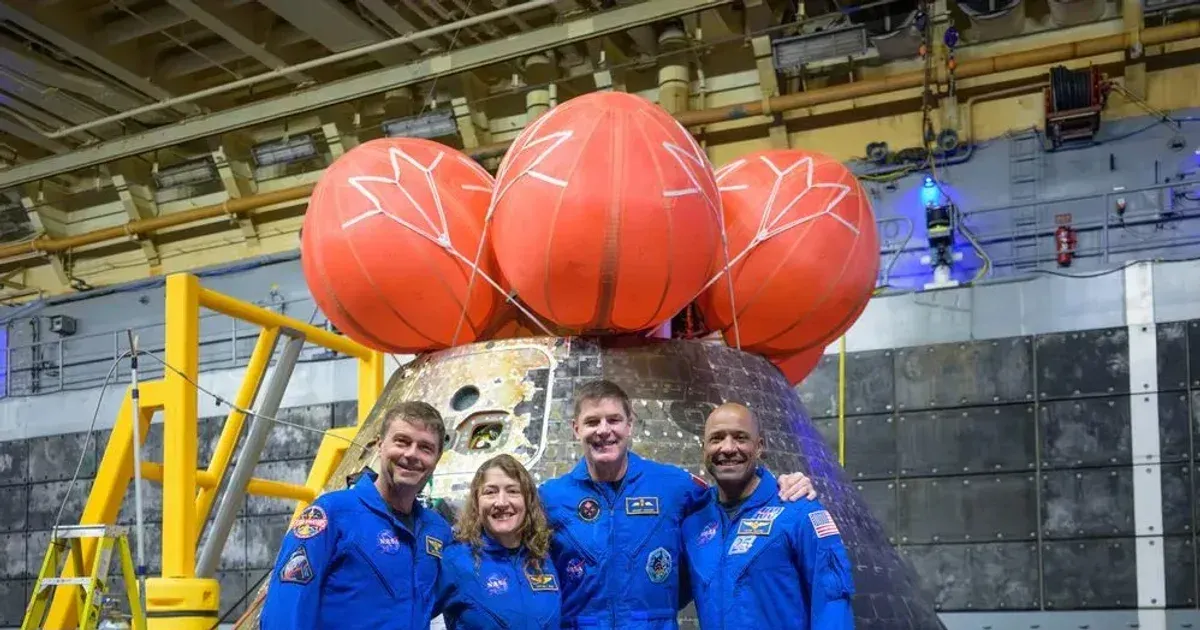
NASA astronauts touched down in Houston to face a crowd of hundreds celebrating the first human voyage to the moon's vicinity in over five decades. Arrival ceremonies at Ellington Field followed a precision splashdown in the Pacific Ocean on Friday night. Ground crews and family members gathered on the tarmac as the four-person team exited their transport plane, marking the conclusion of a 10-day journey that tested the limits of current deep space hardware. The Houston arrival took place on April 12, 2026. Hundreds of employees and space enthusiasts waved flags and cheered while the crew walked toward the hangar for their first public remarks on American soil.
Splashdown occurred off the coast of San Diego under clear skies, bringing the Orion spacecraft safely back after it survived atmospheric reentry temperatures reaching 5,000 degrees Fahrenheit. Navy recovery teams were positioned miles from the target zone to ensure a rapid retrieval of the capsule and its occupants. Initial reports from flight surgeons indicate the crew is in excellent health despite the physical toll of high-G forces during the descent. Engineers now begin the process of analyzing telemetry data to confirm if the thermal protection system performed within expected tolerances.
San Diego Recovery Operations and Splashdown Dynamics
Recovery operations in the Pacific Ocean involved a coordinated effort between the U.S. Navy and NASA specialists. Helicopter units arrived at the scene within minutes of the chutes opening to stabilize the capsule in the water. Divers secured the craft while the astronauts remained inside for preliminary medical checks. Retired Lieutenant Colonel David Mahan noted in a briefing that the precision of the landing demonstrated significant improvements in navigation software compared to earlier unmanned tests. Final positioning was within two miles of the primary recovery ship.
Astronauts and their families reunited privately in a hangar before the public ceremony began. Tears and long embraces defined the scene as the crew transitioned from the isolation of a spacecraft to the noise of a celebratory crowd. Flight controllers from Johnson Space Center joined the festivities, having managed the complex maneuvers required to slingshot the crew around the lunar far side. Emotional intensity peaked when the mission commander thanked the support staff for maintaining constant communication throughout the 240,000-mile journey.
Houston Welcomes Astronauts After Deep Space Record
Houston remains the heart of the American space program, and the reception at Ellington Field reinforced that status. Officials from the city and the space agency spoke briefly about the mission's role in reviving national interest in lunar exploration. While the crew appeared fatigued, they spent nearly an hour shaking hands and answering questions from local students. Hundreds of NASA employees who worked on the SLS rocket and Orion capsule were given priority access to the arrival zone to celebrate the successful culmination of their years of labor.
Records were shattered during this flight as the crew traveled farther from Earth than any human in history. This milestone surpassed the distance record set by the Apollo 13 crew in 1970, which was required by an emergency trajectory. Artemis II achieved its distance through a planned high-altitude orbit designed to test the communication relay systems of the Deep Space Network. Navigational accuracy during the lunar flyby ensured that the return trajectory required only minimal fuel consumption for course corrections.
Public reflection from the astronauts focused on the visual impact of seeing the lunar surface from only a few thousand miles away. They described the texture of the craters and the stark contrast between the gray lunar regolith and the blackness of the void. Detailed photographs taken from the cockpit windows will be released to the public after the imaging team completes a security and quality review. Such imagery is expected to provide the highest resolution views of the lunar south pole ever captured by human eyes.
Mission parameters for the 10-day trip included a series of proximity operations shortly after the Orion capsule separated from the upper stage of the SLS rocket. These maneuvers proved that the capsule can dock with future modules of the Lunar Gateway station. Testing the life support systems in a high-radiation environment was another primary goal. Radiation monitors located inside the cabin provided real-time data on how the hull shielding protected the crew from solar energetic particles during their transit. These findings will dictate the design of long-duration habitats for future Mars missions.
Critics of the program often point to the high cost of expendable launch vehicles, yet the success of Artemis II provides a counter-argument for the reliability of the current architecture. Projections for the next phase of the program suggest that the lessons learned from this splashdown will shorten the training cycle for the next crew. Logistics for the Artemis III mission are already being finalized, with hardware components arriving at Kennedy Space Center. The hardware includes the docking adapters and lunar landing suits that were not required for this orbital-only flight.
Future human presence on the moon depends on the reliability of the return systems tested on Friday. Recovery teams in San Diego have already begun debriefing the mission to identify any areas where the retrieval process could be streamlined. Efficiency in the water is paramount for ensuring astronaut safety, especially if a crew returns with medical complications. Technicians in Florida are waiting for the capsule to arrive by truck so they can begin a forensic teardown of the electrical systems.
Confidence in the Orion platform has surged following the successful completion of all primary mission objectives. Flight data confirms that the fuel cells provided more power than anticipated, allowing the crew to conduct additional science experiments during the return leg. These experiments included studying the behavior of fluids in microgravity and testing new water recycling filters. Every watt of power and gallon of water saved during this mission provides a larger margin of safety for the crews who will eventually spend weeks on the lunar surface.
What the Mission Sets Up Next
Technological superiority functions as the primary currency of geopolitical power in the modern age. The successful return of the Artemis II crew is more than a scientific victory but a blunt assertion of American and Western dominance in the cislunar theater. While competitors like the China National Space Administration move toward their own manned lunar targets, the operational proficiency demonstrated by the San Diego recovery teams and the Houston mission control identifies a gap in expertise that money cannot quickly bridge. Years of institutional knowledge from the Apollo and Shuttle eras have been successfully transmitted to a new generation of engineers and pilots.
Bureaucratic inertia and budget volatility are the true enemies of this progress. Maintaining the momentum of the Artemis program requires a ruthless commitment to flight schedules that often clash with the cautious nature of government-funded science. Skepticism toward the multibillion-dollar price tag per launch is valid, yet the strategic cost of ceding the lunar south pole to adversarial interests is far higher. Control of the high ground in space will define the resource wars of the 2030s. Washington must choose between sustained investment or a second, more permanent retreat from the stars. The mission is won.