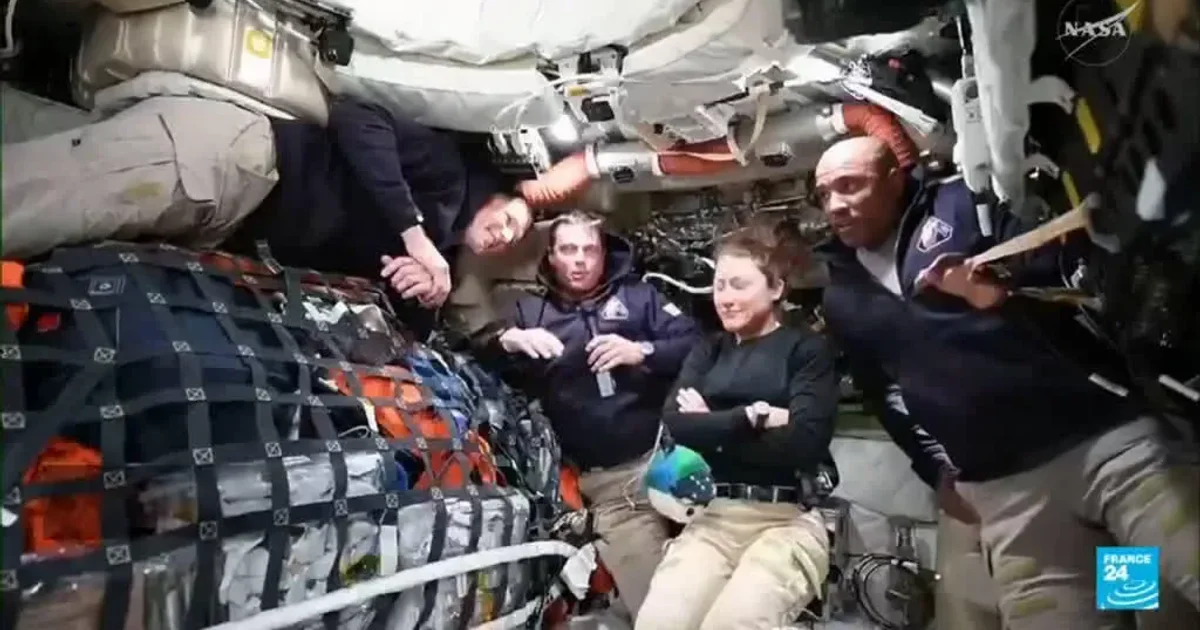
NASA officials confirmed that the four-person crew of the Artemis II mission successfully completed the critical translunar injection maneuver to exit Earth orbit. Flight controllers in Houston monitored the high-stakes engine burn that propelled the Orion spacecraft toward its lunar destination. The April 3, 2026, maneuver marked the mission's first decisive move beyond Earth orbit. Four astronauts, including three Americans and one Canadian, now occupy a trajectory that will carry them further from home than any human since the conclusion of the Apollo era. Records indicate the engine firing took place approximately 25 hours after the initial launch from Florida.
Orion spent its first day in space performing a complex series of checkouts while loitering in a high Earth orbit. Engineers used this period to test the life support systems and communication arrays before committing the crew to a deep-space environment. NASA managers reported that the spacecraft performed within all expected tolerances during the initial elliptical laps. The technical pause allowed the crew to capture high-resolution imagery of the planet they left behind. Photos transmitted back to Earth show the curvature of the blue marble against the absolute blackness of the void. The maneuver moved Artemis II from Earth-orbit operations toward lunar flight.
Translunar ignition occurred late Thursday night, providing the velocity necessary to escape the gravity well of the planet. Velocity readings jumped sharply as the propulsion system worked to overcome the terrestrial pull. Navigation data confirmed the craft reached the precise speed required to intercept the lunar sphere. The maneuver marked a departure from the low Earth orbit operations that defined the space shuttle and International Space Station eras. No human has occupied this region of space since Apollo 17 concluded in December 1972.
NASA Fulfills Mission Requirements for Translunar Ignition
Propulsion experts at the Kennedy Space Center spent months refining the specific burn duration for this leg of the journey. Every ounce of fuel in the service module must be managed with extreme precision to ensure enough remains for future corrections. Instead of a direct ascent, the mission profile favored a gradual increase in orbital altitude to maximize safety. Calculations for the burn involved accounting for the current positions of both the Earth and the Moon to create a perfect intercept point. Small errors at this stage would result in missing the lunar target by thousands of miles.
Ground teams at the Johnson Space Center assumed full control of the mission once the spacecraft cleared the atmosphere. Communication remained clear during the transition from the heavy lift rocket to the service module engines. NASA telemetry showed a clean separation and a flawless ignition sequence. The crew reported feeling the acceleration as the engines pushed them into the dark. Onboard sensors registered the shift in G-forces almost immediately.
Thermal management systems now face their most rigorous test as the spacecraft moves out of the protective magnetosphere. Solar radiation levels are expected to rise as the vessel leaves the Van Allen belts. Orion features advanced shielding designed to protect the electronic components and the human occupants from cosmic rays. The mission is a verification flight for these protective technologies. Engineers will analyze the radiation data in real time to prepare for future Martian expeditions.
Lunar Flight Ends Decades of Low Earth Orbit Operations
Historical data highlights the long gap in human exploration beyond the immediate vicinity of Earth. Between 1972 and 2026, every human spaceflight mission remained confined to a few hundred miles above the surface. Artemis II breaks this pattern by aiming for a distance of more than 238,855 miles from the launch pad. Critics of the program often point to the high costs associated with such long-range missions. Supporters argue that the scientific and geopolitical benefits outweigh the financial burden. NASA estimates the cost of the SLS rocket and Orion spacecraft development at several billion dollars per launch.
Astronauts Jeremy Hansen, Reid Wiseman, Victor Glover, and Christina Koch spent years training for this specific mission profile. Their preparation included thousands of hours in simulators replicating the exact engine burn they executed on April 3, 2026. Hansen, representing the Canadian Space Agency, marks the first non-American to leave Earth orbit. This international cooperation defines the modern approach to space exploration. The crew works as a single unit to manage the complex avionics of the Orion capsule.
NASA’s Artemis II astronauts fired their engines and blazed toward the moon Thursday night, breaking free of the chains that have trapped humanity in shallow laps around Earth in the decades since Apollo.
Public interest in the mission remains high across North America and Europe. Live streams of the launch and the subsequent images of Earth have garnered millions of views globally. Communication specialists at the agency continue to release video updates as the crew moves further away. The visual transition from a huge, detailed Earth to a shrinking sphere provides a sense of the vast distances involved. Radio signals now take over a second to travel between the capsule and the ground stations.
Engine Burn Keeps Artemis on Course
Has the quest for the moon become a vanity project for a fading superpower? While the technical prowess displayed by NASA on April 3, 2026, is undeniable, the strategic necessity of this mission is increasingly difficult to defend to a skeptical public. The $4.1 billion price tag for a single launch is an enormous sum when compared to the efficiency of private robotic missions. The picture emerging is a 1960s solution being applied to a 2020s world, where the prestige of planting a flag often outweighs the logic of sustainable exploration. The agency is betting its entire reputation on hardware architecture that is inherently disposable and prohibitively expensive.
The geopolitical landscape suggests that this mission is less about science and more about preventing China from claiming the lunar south pole. It is a Cold War redux disguised as international cooperation. The involvement of the Canadian Space Agency provides a veneer of global unity, but the command structure and the funding remain overwhelmingly American. The dynamic creates a brittle alliance that could fracture if domestic political priorities in Washington shift. Dependency on a single enormous rocket like the SLS limits our flexibility and makes the entire program vulnerable to a single catastrophic failure.