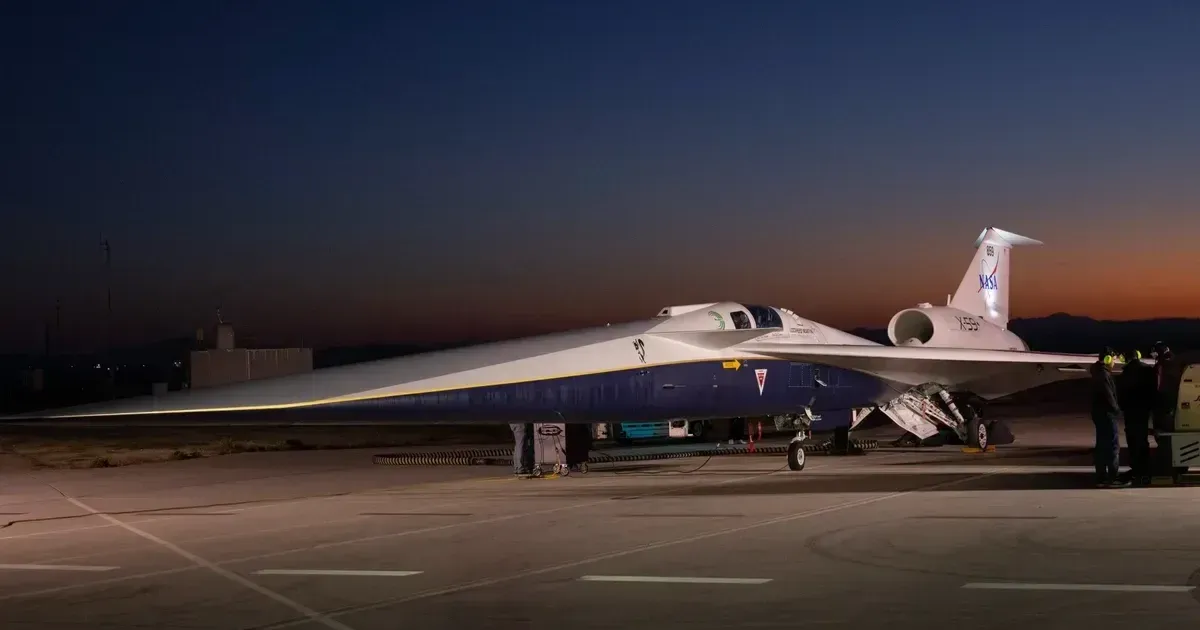
NASA is preparing two very different safety tests at once: a quieter supersonic aircraft over Earth and solar-risk planning for astronauts leaving it. NASA engineers at Armstrong Flight Research Center began critical engine tests for the X-59 supersonic aircraft on March 12, 2026. Technical progress on this experimental jet coincides with the finalization of solar radiation protocols intended to safeguard Artemis II astronauts during their upcoming lunar transit.
Quiet Supersonic Flight Gets Its Test
Preparation involves two distinct frontiers of safety: atmospheric noise reduction and deep space survival. Agency leadership scheduled a media teleconference for March 19 to detail these aeronautic advancements. Ground teams in California recently moved the aircraft from its hangar to verify engine performance before a planned one-hour flight. Success in these trials would validate years of research into sonic boom mitigation and commercial flight regulations.
Solar Weather Becomes a Crew Risk
Testing sessions at Edwards Air Force Base focus on a phase known as envelope expansion. Engineers monitor how the airframe reacts to increasing speeds and altitudes. Initial flights will see the aircraft reach a cruising speed of 230 mph at 12,000 feet. Data from these maneuvers will dictate when the pilot can safely accelerate to 260 mph at 20,000 feet. It is built to study quieter supersonic flight and collect data that may influence future overland flight rules. Both programs require NASA to turn uncertain physical risks into operational rules crews can trust.
Two Safety Programs Define the Mission
Still, the technical scope extends beyond raw velocity. The Quesst mission aims to prove that supersonic flight can occur over land without the traditional explosive noise that led to a federal ban in 1973. Experts from Lockheed Martin Skunk Works are working alongside agency technicians to ensure the airframe maintains structural integrity during these transitions.
X-59 Supersonic Tests at Edwards Air Force Base
Engine run testing provides the necessary validation for the aircraft's internal systems before it leaves the tarmac for its second flight. Technicians at the Armstrong facility performed these checks to confirm that the F414-GE-100 engine integrates correctly with the unique airframe design. This design features a long, slender nose and specialized control surfaces to prevent shock waves from coalescing into a loud boom.
Instead, the aircraft is expected to produce a quiet thump, comparable to a car door closing. Flight pilots Jim Less and Nils Larson will lead the upcoming sorties to test these aerodynamic theories in real-world conditions. Envelope expansion marks the transition from controlled taxiing to high-performance maneuvers. Separately, the mission integration team is preparing for a series of community overflights. These will involve flying the aircraft over several American cities to gather public feedback on the noise levels. Data collected from these tests will eventually be submitted to international regulators to support the lifting of supersonic flight restrictions.
In turn, this could reopen the market for high-speed commercial travel across the United States and Europe. Project manager Cathy Bahm and mission lead Peter Coen are overseeing the logistics of this multi-year data collection effort. The March 19 teleconference will provide the first look at the results from the second flight profile.
Solar Weather Monitoring for Artemis II Astronauts
Radiation protection remains the primary concern for the four astronauts assigned to the upcoming lunar mission. As the crew travels around the moon, they will venture beyond the protective reach of Earth's magnetic field. This exposure requires constant vigilance from the Space Weather Prediction Center. Scientists from NASA and the National Oceanic and Atmospheric Administration (NOAA) are collaborating to monitor the sun around the clock. Their goal is to translate solar activity into real-time operational decisions for the Orion spacecraft.
High-energy particles from solar flares can damage both sensitive electronics and human tissue during deep space travel. Solar activity follows an eleven-year cycle, and the timing of the mission coincides with a period of high volatility. In fact, ground-based observers must track sunspots and coronal mass ejections with high precision to provide early warnings.
Ground teams use a network of satellites to detect incoming radiation before it reaches the spacecraft. Once a warning is issued, the crew may need to shelter in the most heavily shielded areas of the vessel. Orion serves as the primary defense against these invisible hazards. According to mission planners, the 10-day flight duration leaves little room for error when interpreting space weather data.
Orion Spacecraft Shields and Deep Space Hazards
Spacecraft shielding for the lunar mission uses advanced materials designed to deflect or absorb ionizing radiation.
Unlike the International Space Station, which remains within the magnetosphere, Orion will be fully exposed to the solar wind. To that end, engineers have improved the internal layout to maximize protection during solar particle events. Water tanks and equipment lockers are positioned to serve as secondary shielding for the crew.
Still, the most effective protection comes from the ship's outer hull and thermal protection system. Agency experts are currently verifying the shielding's performance against historical solar storm data. The crew’s spacecraft, Orion, will carry and protect them as they journey into deep space and serves as the main protection against the sun’s intense power. Sunlight becomes a lethal variable once a vessel exits the magnetosphere. By contrast, previous Apollo missions relied on shorter durations and a degree of statistical luck regarding solar activity. Modern standards require much higher safety margins for the Artemis II crew.
NASA Is Testing Whether Risk Can Be Made Governable
The X-59 and Artemis solar protocols look unrelated only on the surface. One is about noise over American communities. The other is about radiation beyond Earth’s magnetic shield. But both ask the same institutional question: can NASA turn dangerous physics into rules precise enough for pilots, astronauts, regulators and the public to trust?
That is why these tests matter beyond engineering curiosity. Supersonic travel failed commercially over land because communities would not accept the boom. Deep-space exploration can fail just as quickly if crews are sent into solar weather with thin margins and vague procedures. NASA is trying to prove that ambition does not have to mean recklessness. The agency’s credibility now depends on making speed quieter, radiation survivable and risk legible before the next era of flight asks the public to accept both.