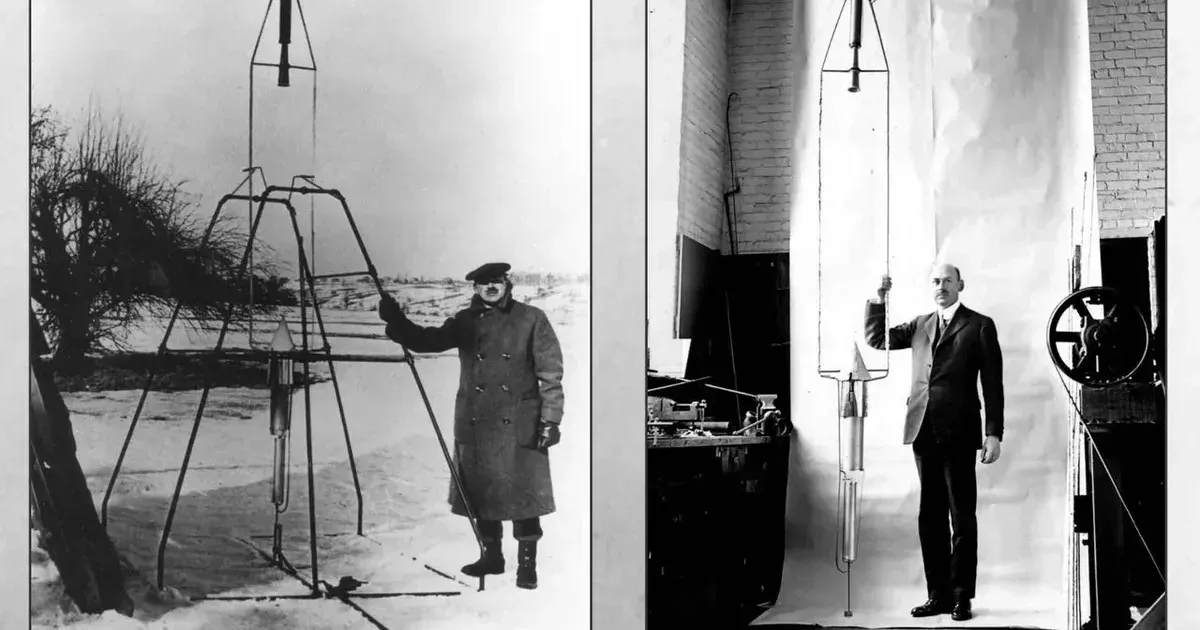
Robert Goddard drove to his Aunt Effie's farm with a spindly 10-foot frame tied to his car. Neighbors in the rural community ignored the quiet physics professor as he set up a skeletal apparatus in a snow-dusted cabbage patch. Robert Goddard launched the first liquid-fueled rocket in Auburn, Massachusetts, on this date exactly 100 years ago. The flight lasted only 2.5 seconds but proved that liquid propellants could provide the thrust necessary for modern space exploration. It rose to an altitude of 41 feet. Gasoline and liquid oxygen served as the combustible heart of the machine, which Goddard affectionately nicknamed Nell. Unlike previous solid-fuel rockets that burned like fireworks, this design allowed for controlled combustion and greater efficiency. The rocket accelerated to 60 miles per hour before gravity reclaimed the small projectile. It landed in the snow 184 feet from the launch frame. The success of the mission remained unknown to the wider world for years. Robert Goddard preferred the isolation of the New England countryside to the scrutiny of the press. He had already endured public ridicule for his theories on vacuum propulsion. A 1920 editorial had famously suggested he lacked the basic knowledge taught in high schools.
Auburn Launch Becomes Rocketry Proof
Massachusetts soil provided an unlikely backdrop for the dawn of the space age. The site at Aunt Effie's farm was chosen for its privacy and distance from local authorities. Goddard feared that the noise and fire of his experiments would lead to legal injunctions or police interference. For instance, he frequently disguised his research as meteorological study to avoid prying eyes. According to the New York Times, the professor from Clark University spent years refining the valves and injectors required to mix the fuels. His work in 1926 proved that liquid oxygen could be handled safely in a pressurized environment. He designed a system where the motor was placed at the front of the rocket, pulling the fuel tanks behind it. This configuration, though eventually abandoned for more stable designs, allowed the first successful ignition. Contemporary European researchers like Hermann Oberth were still struggling with theoretical calculations. Goddard was a man of hardware and practical application. He spent his own salary on materials, supplementing his income with modest grants. The Smithsonian Institution provided a critical $5,000 infusion that kept the project alive during the lean years of the early 1920s. The technical difficulty of the Auburn launch cannot be overstated. The freezing temperatures necessitated the use of a blowtorch to ignite the fuels. Liquid oxygen, which boils at minus 297 degrees Fahrenheit, posed a constant threat of frostbite and explosion. Goddard handled these materials with primitive safety equipment, often standing just a few yards from the live rocket.
Esther Goddard Preserves the Record
Esther Goddard played a role that went far beyond that of a supportive spouse. She served as the official photographer, fire marshal, and record keeper for every test flight in the cabbage patch. On the morning of the 1926 launch, she stood ready with a motion picture camera to capture the event. But the flight was so rapid and the camera so difficult to crank that she missed the actual liftoff.
Robert Goddard is the father of modern rocketry, but Esther was the hand that ensured his work survived for the generations that followed her.
Esther began a meticulous filing system that preserved every blueprint and mathematical proof her husband produced. She understood that the world would eventually catch up to his vision. Her records show that the rocket used on March 16 weighed only 6 pounds empty. The experiment was a proof-of-concept test rather than a bid for high altitude.
Liquid Fuel Changes Spaceflight
Propulsion technology evolved rapidly after the Auburn milestone. Goddard eventually moved his operations to Roswell, New Mexico, where the open desert allowed for larger and more powerful tests. He developed gyroscopic controls and vane steering, elements that are now standard in aerospace engineering. Yet he never forgot the lessons learned on the farm in 1926. Spaceflight historians often compare the Auburn launch to the Wright brothers' flight at Kitty Hawk. Both events involved short durations and modest distances.
According to Space.com, the 1926 rocket reached its peak and then fell when the fuel supply was exhausted. The impact shattered the frame and the motor, but the data was intact. Goddard noted in his diary that the flight was almost indistinguishable from his mental simulations. He viewed the event as a beginning rather than a conclusion.
But the public did not celebrate this achievement until long after his death in 1945. The New York Times did not formally retract its mocking 1920 editorial until the day after the Apollo 11 moon landing in 1969. The newspaper admitted that it is now definitely established that a rocket can function in a vacuum. This late apology highlighted the extreme skepticism Goddard faced throughout his career. Engineers today still marvel at the simplicity and effectiveness of the 1926 design. The use of gasoline as a fuel was a practical choice, as it was readily available and high in energy density. At the same time, the challenge of pumping that fuel into a high-pressure combustion chamber was the primary hurdle Goddard had to overcome. He used an external pressure source to force the liquids through the lines.
Auburn officials have since turned the launch site into a National Historic Landmark. A small monument sits on what is now the Pakachoag Golf Course, marking the exact spot where the rocket rose. For instance, golfers often pause at the ninth hole to read the plaque dedicated to the professor. The site remains a pilgrimage destination for aerospace enthusiasts from around the world. The centennial anniversary is a focal point for modern discussions on innovation. The transition from a cabbage patch to the lunar surface took only 43 years. This rapid acceleration of technology was made possible by the liquid-fueled engine. Solid boosters continue to provide initial lift, but liquid engines provide the precision and restart capability required for orbital maneuvers.
Robert Goddard died before he could see his rockets reach the edge of the atmosphere. He spent his final years working for the Navy, developing takeoff assistance for aircraft. His patents, eventually purchased by the government for $1 million, remain some of the most influential documents in aviation history. The 1926 launch remains the single most important moment in that path.
A Two-Second Flight Built Modern Rocketry
Was Robert Goddard a visionary or a casualty of an incurious age? We love to lionize the lone inventor today, but the truth is that American society in the 1920s did its best to bury him. It is a shameful reality that Goddard's work was taken more seriously by German engineers in Peenemünde than by his own government in Washington. We only celebrate his 1926 achievement now because it serves a convenient national story of progress. In reality, Goddard was a man driven into secrecy by the persistent mockery of a press that could not grasp basic physics.
The lesson of the Auburn cabbage patch is not about the triumph of science, but about the enormous cost of public and institutional ignorance. We must ask how many contemporary Goddards are now being dismissed as eccentrics while their breakthroughs are quietly studied by foreign adversaries. Innovation requires not only a man with a rocket; it requires an audience capable of understanding why it needs to fly. If we wait for a moon landing to apologize for our skepticism, we have already failed the next generation of pioneers.