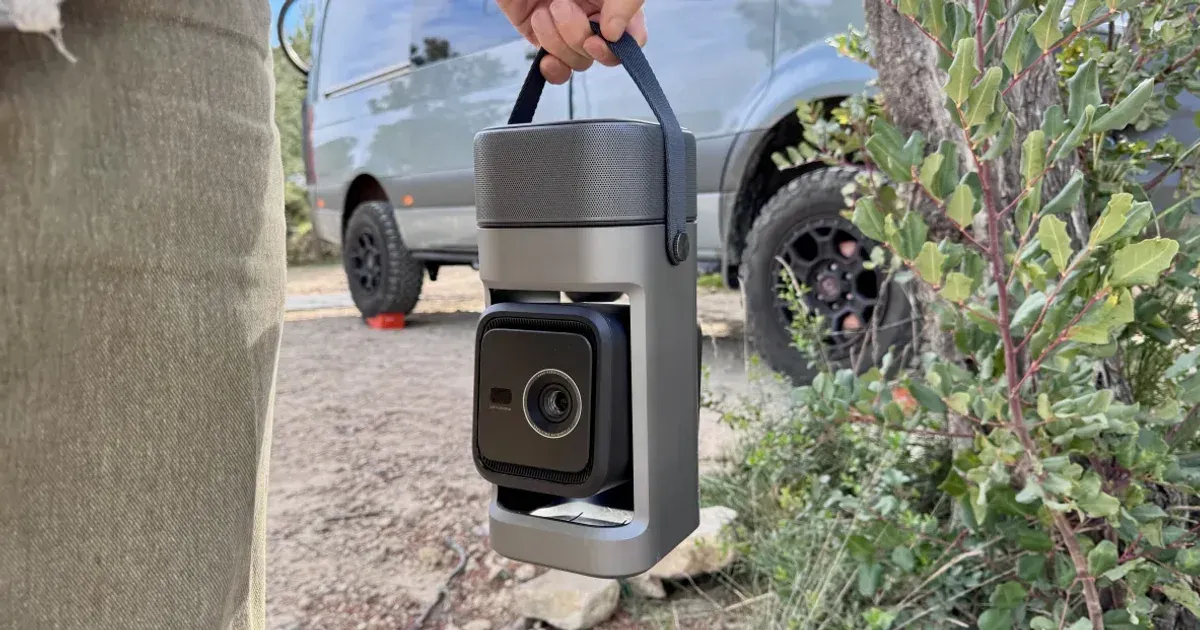
Anker redefined the hardware profile of mobile cinema by prioritizing acoustic depth over internal battery capacity in its newest offering. The Nebula P1 directly challenges to the industry standard of integrated, mono-directional sound systems. The April 4, 2026 product cycle put portable projectors back into the home-entertainment debate. Mobile projectors typically compromise audio quality to maintain a small footprint, resulting in tinny output that fails to fill a room. Engineers at the Soundcore division bypassed this limitation by engineering a modular chassis. Soundcore is the audio-focused sub-brand responsible for the P1, and its influence is visible in the device's specialized speaker architecture.
Nebula P1 Engineering Decouples Audio from Visuals
Two modular speakers sit flush against the sides of the Nebula P1 during transport. These units detach physically from the main projector body to provide genuine left- and right-channel stereo separation. Most competing devices, including the Xgimi MoGo and the TCL PlayCube, rely on internal drivers that sit only inches apart. Physics dictates that such proximity limits the soundstage, making it impossible to achieve true spatial immersion. Anker solves this by allowing users to place the speakers several feet away from the lens. Connectivity between the components relies on high-bandwidth wireless protocols to ensure zero latency during playback.
Hardware enthusiasts noted that the P1 lacks an internal battery, a choice that separates it from the existing Capsule line. Reliance on an external power source suggests Anker is targeting users who have access to portable power stations or van-based electrical systems. Travelers moving through the European countryside often use high-capacity lithium batteries, making the lack of an internal cell less of a hindrance for that specific demographic. The omission of a battery allowed for larger speaker magnets and better thermal management within the primary housing. Acoustic performance took precedence over total cord-free operation.
Competitive Analysis of the Portable Projector Market
Market analysts currently price the Nebula P1 at $799, though early promotional cycles have seen the cost dip to $639. This pricing strategy places it in direct competition with the Samsung Freestyle and high-end units from Xgimi. While the Freestyle offers a unique swiveling design, its audio output remains restricted to a single internal driver. Contrast that with the P1, which focuses on the auditory experience as much as the visual one. Competitive pressure in the sub-$1,000 category has forced manufacturers to specialize rather than attempt to build a perfect all-in-one machine.
Reviewers testing the device in real-world scenarios, such as van-dwelling or outdoor camping, report that the audio separation outweighs the inconvenience of the power cord. Smaller projectors like the Anker Capsule 3 provide better portability but cannot compete with the decibel levels produced by the P1. Audio fidelity in the P1 matches midrange standalone Bluetooth speakers. The speakers function as independent units when the projector is powered down, adding secondary value to the hardware. Total power output for the combined speaker system reaches 40 watts.
Power Constraints and Brightness Tradeoffs
Brightness levels on the Nebula P1 do not lead the industry. Specifications indicate a lumen count that falls short of dedicated home theater models. This limitation means the device performs best in controlled, dark environments. Ambient light sharply washes out the image, a common trait for projectors in this weight class. Users must carefully manage their environment to get the best out of the 1080p resolution. High-end competitors often offer 4K upscaling, but the P1 stays focused on a crisp, standard high-definition output. Color accuracy holds steady across different projection surfaces.
"It sounds much better than typical all-in-ones like the supremely portable TCL PlayCube, Xgimi MoGo, or Anker's popular Capsule projectors," a reviewer for The Verge wrote.
Setup routines are assisted by autofocus and automatic keystone correction. The Nebula P1 detects the angle of the wall and adjusts the image geometry within seconds. Manual overrides exist for users who prefer to fine-tune the corners of the frame. Sound calibration also happens during the initial boot sequence. The system pings the room to adjust the EQ based on the distance of the detached speakers. This automated process simplifies the transition from travel mode to cinema mode. Calibration takes less than thirty seconds to complete.
Portable Audio Trades Power for Convenience
The Nebula P1 pitch depends on whether buyers value portability more than full home-theater power. Detachable speakers make outdoor and travel use easier, but serious cinema sound still requires compromises in size and battery life.