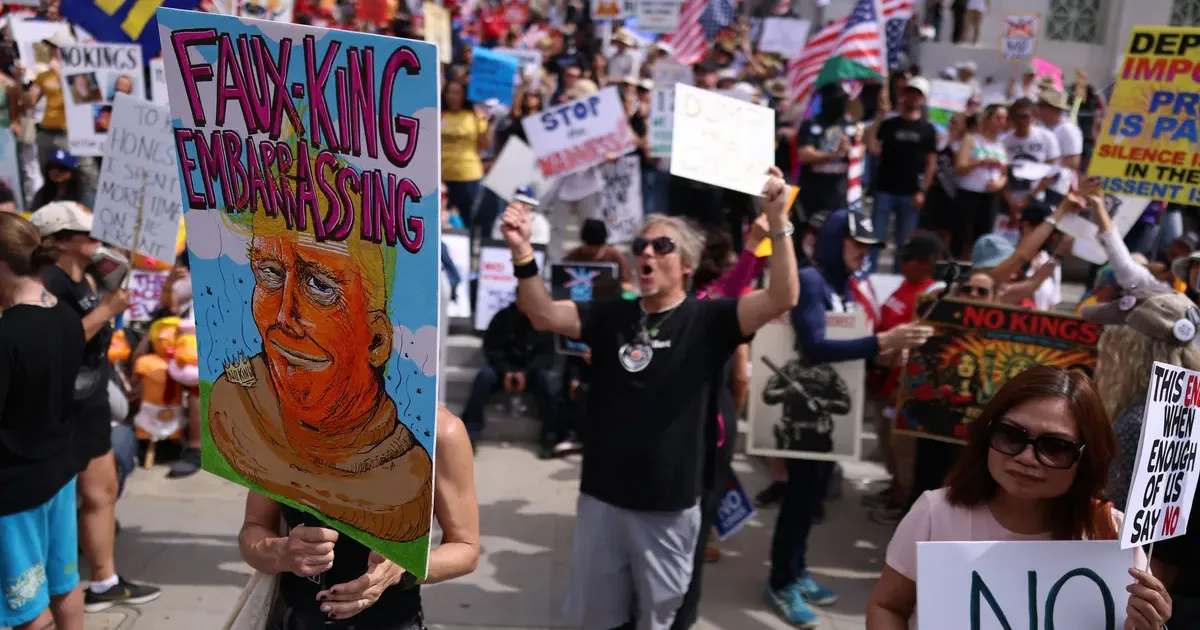
The No Kings protests on March 28, 2026, produced a national image of mass dissent. Los Angeles raised the policing question: how should a city manage a huge protest when a smaller confrontation develops near a federal detention center?
Organizers described the nationwide demonstrations as a massive, largely nonviolent protest wave, with thousands of events across all 50 states and beyond. In downtown Los Angeles, the day began with large crowds around Gloria Molina Grand Park and City Hall. By evening, attention had shifted toward the Metropolitan Detention Center, where police lines, dispersal orders, tear gas and arrests became the images that traveled fastest.
LAPD said protesters tried to pull down a chain-link fence near the detention center and threw objects toward officers. Local reports put the arrest count at 75, most for failing to disperse, with one additional weapons allegation. The mix cannot be collapsed into one label. A mass arrest number does not answer the legal or policing question by itself.
Los Angeles Became the Flashpoint
The geography of the Los Angeles confrontation mattered. Streets around federal buildings and detention facilities can create bottlenecks. Once police lines form, a crowd can split into people trying to leave, people trying to watch, people trying to confront officers and people who may not hear or understand the order being given.
None of those conditions excuses violence or property damage. If someone tried to pull down a fence, threw rocks, threw concrete or carried a weapon, prosecutors can treat those allegations differently from ordinary protest presence. The legal record has to separate conduct. Peaceful presence, civil disobedience, failure to disperse, vandalism and assault are not the same category.
Separating those categories also protects public trust. If authorities describe the entire crowd through the conduct of the most aggressive people, they weaken confidence in policing. If protest supporters deny that any confrontation occurred, they weaken confidence in their own account. The record has to be more precise than either slogan.
Most Protests Did Not Look Like Los Angeles
The No Kings label covered very different events. Some cities saw large peaceful marches. Others reported arrests, counter-protests, traffic disruptions or smaller confrontations. AP reporting described more than 3,100 events nationally, with Los Angeles standing out because of the scale of arrests after the rally.
Those variations prevent one city from becoming a misleading picture of a national protest movement. One dramatic video from Los Angeles can be used to characterize every march as chaos. A peaceful crowd photo from another city can be used to dismiss real policing questions in Los Angeles. Neither move is honest.
Crowd size, route design, police posture, counter-protester presence, weather, late-day fatigue and proximity to sensitive sites all shape what happens after the speeches end. The movement may carry one national message, but the policing record is local.
Dispersal Orders Need More Than a Loudspeaker
The legal strength of a dispersal arrest depends on more than the fact that an order was announced. Officials should be able to show when the unlawful assembly was declared, how the order was communicated, whether it was audible, whether people had safe routes to leave, and how much time they were given.
Those details often decide whether the public sees an arrest as necessary crowd control or indiscriminate force. A chaotic scene can make orders difficult to hear. Police movement can block exits. Smaller confrontational groups can trap peaceful protesters inside the police response. At the same time, officers have to prevent injuries and protect facilities when parts of a crowd become aggressive.
An after-action review must therefore examine more than whether LAPD had grounds to act. It must ask whether the tactics used distinguished between people creating danger and people caught near it.
Video Will Shape Memory, but Not Finish the Record
Real-time clips will shape how many people remember the Los Angeles protest. They are not enough by themselves. A short arrest video may omit warnings that came before it. A police statement may omit confusion, blocked exits or unnecessary force. A protester's phone angle may show impact without showing the earlier conduct police cite.
A reliable record will come from body-camera footage, radio logs, charging documents, medical reports, oversight hearings and independent review. That record should answer specific questions: Were less intrusive tactics available? Were people given space to leave? Were projectiles or gas used proportionately? Were arrests supported by individualized evidence? Were journalists, legal observers or medics swept into the same response?
Those questions are slower than viral video, but they are the only way to separate policing failure from lawful enforcement.
Democracy Has to Hold Both Standards
No Kings left two separate tests. The first is whether individual protesters broke the law. The second is whether cities can manage mass dissent without turning every confrontation into a symbol of either repression or chaos.
A serious democracy has to protect protest rights and public safety at the same time. Meeting both obligations gives neither side a blank check. Protesters do not get immunity for violence or property damage. Police do not get to treat a large movement as a public-order problem simply because a smaller group confronts them.
Los Angeles now needs a clear incident-by-incident accounting. The national message of the No Kings protests can remain broad. Accountability cannot. It has to be built from orders, routes, conduct, force and charges, not from the loudest clip either side can circulate.