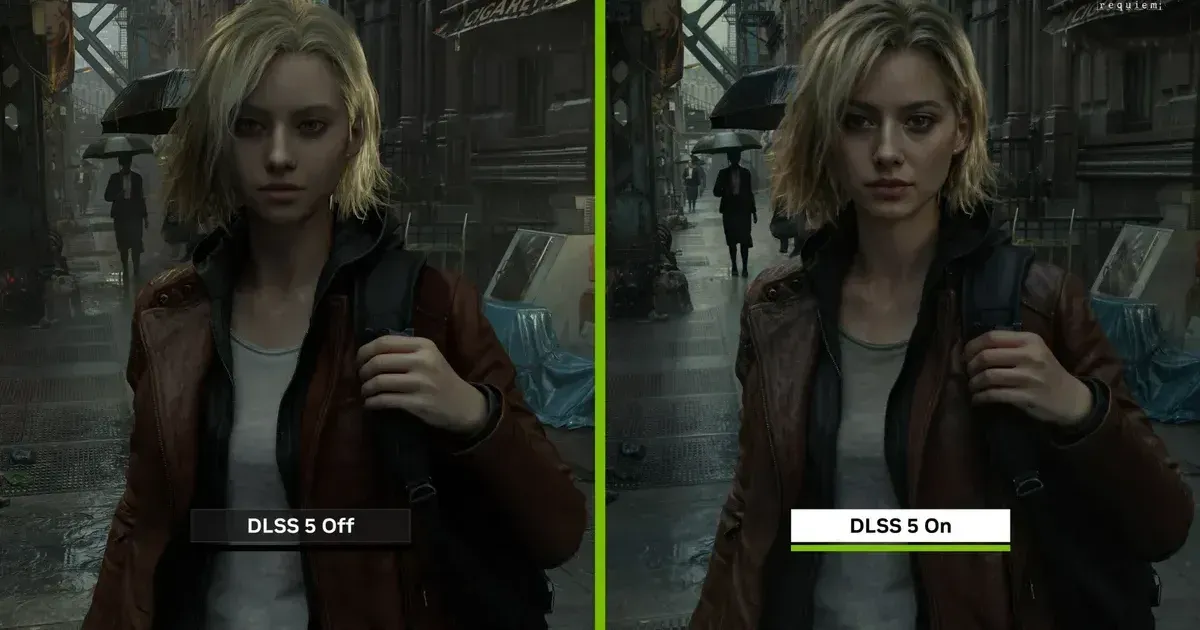
Nvidia Corporation executives faced a wave of digital vitriol on March 17 after the debut of its latest upscaling technology during the GTC keynote. Nvidia leadership described the new iteration, labeled DLSS 5, as a breakthrough comparable to the 2018 introduction of real-time ray tracing. Public reception shifted quickly toward hostility as social media users began circulating screenshots from the official demonstration. Visual comparisons of popular titles revealed significant alterations to character faces and environmental textures. Critics immediately labeled the technology an AI slop filter, claiming it erases the intentional artistic choices of game developers.
The story had moved from specialist concern to a wider public test. Technical specifications for the software indicate a move away from simple resolution upscaling toward a real-time neural rendering model. Unlike previous versions that focused on filling in pixels or generating frames to smooth motion, this software uses generative AI to overhaul lighting and materials. Jensen Huang, the chief executive of the company, argued that the system blends handcrafted rendering with generative models to achieve photorealistic graphics. He called the announcement a GPT moment for the gaming industry. Many observers noted that the software creates a bland, uncanny gloss over every surface it touches.
Generative AI and Neural Rendering Mechanics
Engineers at the Santa Clara chipmaker designed the system to interpret a game's internal color and motion vectors. Processing these data points allows the AI to infuse scenes with lighting and materials it deems photorealistic. Nvidia claims the model understands complex scene semantics, including the way light interacts with human skin and hair. Documentation suggests the system can identify whether a character is front-lit or backlit and adjust the textures accordingly. Graphics experts remain skeptical of these claims after viewing the GTC footage. The Verge described the effect as motion smoothing for video games but worse.
Generative video models usually suffer from a lack of predictability and control. To combat this, the system anchors its AI-generated textures to the source 3D content of the game engine. Developers intended for this consistency to maintain visual integrity across different frames of animation. But the resulting images often look like they have been processed through a generic Instagram filter. Characters in Hogwarts Legacy appeared noticeably different than their original designs. This shift has ignited a debate about whether AI should be allowed to override the creative labor of digital artists.
Resident Evil and Player Character Distortions
Grace, the protagonist of Resident Evil Requiem, became the primary example of the system's failures. Gamers shared screenshots showing her face transformed into something resembling a generic AI-generated dating profile. X user @GamersNexus noted that the character lost her soul and character in the process. Such transformations occur because the neural model prioritizes its trained version of photorealism over the specific art style of the game. Ars Technica reported that the reaction from broad swaths of the gaming community was one of overwhelming disgust. The AI seemed to scrub away the grit and detail that defined the horror title.
Software like this changes the fundamental relationship between a player and the game's visual design. By contrast, previous versions of DLSS were celebrated for improving performance on hardware like the RTX 2080 without compromising the developer's vision. Those early tools were utility-focused rather than creative. In turn, the move to generative rendering is a departure from the company's historical role as a hardware provider. It is now acting as an automated art director. The internet response has been swift and unforgiving. DLSS 5 is the GPT moment for graphics, blending handcrafted rendering with generative AI to deliver a dramatic leap in visual realism while preserving the control artists need for creative expression.
Social media platforms were inundated with comparisons showing Starfield environments looking stripped of their original aesthetic. High-resolution textures were replaced with smoothed, generic surfaces that lacked the distinct wear and tear expected in a sci-fi setting. In particular, the system struggled with translucent materials and complex fabric. Instead of enhancing the existing work, the AI appeared to paint over it. One viral post compared the new look to a scammer using an AI-generated persona. The backlash highlights a growing fatigue with generative tools in creative spaces.
Jensen Huang Defends DLSS 5 Artistic Vision
Huang responded to the criticism by stating that detractors are completely wrong about the technology's impact. He emphasized that the system allows for a level of realism previously reserved for Hollywood visual effects. To that end, the company continues to plan a release for Autumn 2026. Management believes the technology will eventually be accepted as the new standard for high-end PC gaming. Even so, the gap between the executive vision and the consumer experience remains wide. Financial analysts are watching closely to see if this controversy affects pre-orders for upcoming graphics cards. Industry veterans worry that the push for photorealism through AI will lead to a homogenization of game aesthetics. If every title is processed through the same neural model, the unique visual identity of different studios could vanish. Separately, some developers have expressed concern that their hard work is being treated as mere metadata for an AI. Nvidia maintains that the software preserves artist control. Yet the visual evidence from the GTC keynote suggests a different reality where the AI makes the final decisions. The controversy shows no signs of dissipating.
Predictability in rendering is a foundation of professional game development. When an artist places a specific shadow or chooses a particular skin tone, they expect the hardware to display it accurately. Generative rendering introduces a layer of probability that many find unacceptable. For instance, the system might decide that a character's face needs more light, ignoring the atmospheric gloom intended by the director. This unpredictability is exactly what critics fear most. It turns the hardware into an unpredictable collaborator rather than a reliable tool. Market reaction to the announcement was mixed. While tech enthusiasts appreciate the technical complexity of real-time neural rendering, the artistic community is in open revolt. Nvidia shares experienced minor volatility following the social media firestorm. Investors are weighing the potential for increased efficiency against the risk of a consumer boycott. For one, the gaming market is with growing frequency sensitive to the perceived intrusion of generative AI. The company must now decide whether to refine the model or double down on its current path.
Efficiency remains the primary selling point for the technology. By offloading the heavy lifting of rendering to an AI model, games can run at higher frame rates on less powerful hardware. In turn, this could make high-fidelity gaming more accessible to a broader audience. But the cost of this accessibility appears to be a loss of artistic fidelity. Most players would prefer a lower frame rate over a game that looks like AI slop. This tension will define the next decade of computer graphics.
The Creative Risk Behind Neural Rendering
Nvidia has finally overplayed its hand in the generative AI space. For years, the company sat atop the throne of the PC market by providing the hammers and chisels for digital sculptors. Now, Jensen Huang wants to be the sculptor too, but his hands are made of algorithmic sludge. The technology is not an evolution of graphics. It is the beginning of the end for bespoke digital art. When a company decides that its AI knows better than the artists who spent years crafting a character, it has lost the plot entirely.
Gamers are not just being stubborn or resistant to change. They are protecting the integrity of the medium they love from a corporate entity that views every pixel as an optimization problem rather than an artistic choice. Huang calls this a GPT moment, and he is right, but not for the reasons he thinks. Much like LLMs have flooded the internet with mediocre text, DLSS 5 threatens to flood our screens with mediocre, derivative visuals. If the future of gaming is a photorealistic void where every face looks like a stock photo, then the industry is headed for a creative recession. Nvidia should stick to making the silicon and leave the art to the humans who actually understand it.