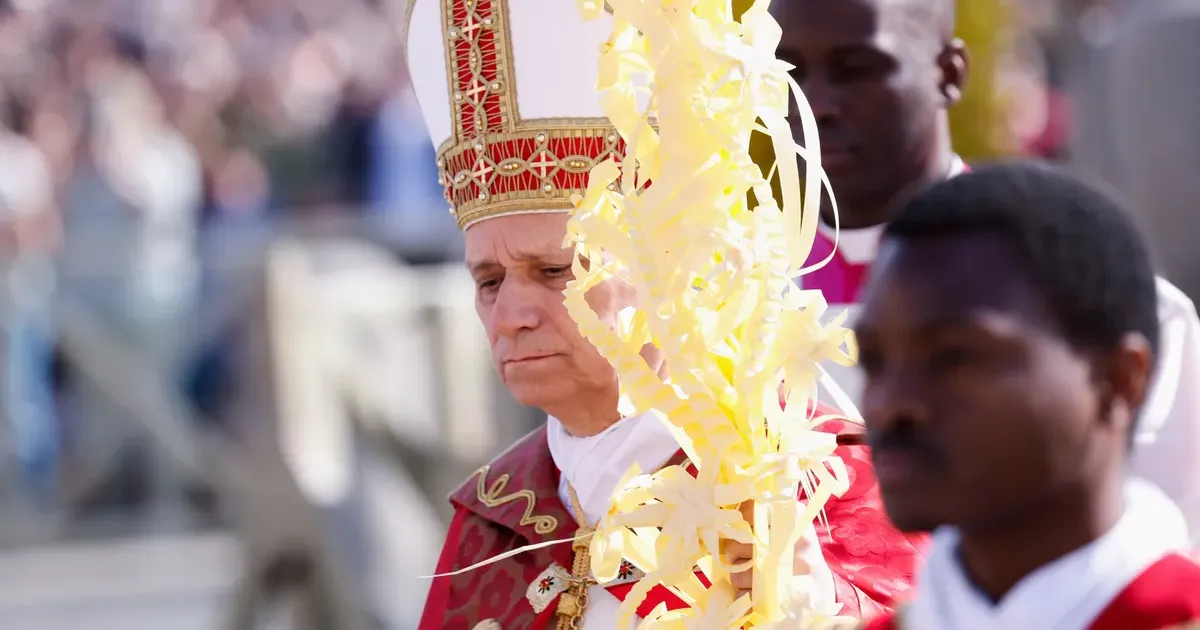
Pope Leo XIV used Palm Sunday Mass in St. Peter's Square to reject religious cover for war, and the message landed directly inside the Iran conflict. His central point was theological before it was diplomatic: Jesus cannot be turned into a sponsor for violence. Vatican News and other coverage reported the homily as one of Leo's clearest early statements against efforts to dress war in sacred language.
Holy Week gave the message added force. Palm Sunday marks Jesus' entry into Jerusalem and opens Holy Week, a period centered on suffering, betrayal, state violence and the refusal of worldly power. By using that liturgy to address war, Leo placed modern conflict inside a moral frame governments cannot fully control. A state can argue strategy, deterrence or self-defense. It cannot easily claim the Gospel without being challenged by the Church's own language.
The Homily Drew A Theological Boundary
Leo called Jesus the "King of Peace" who rejects war.
That line was not a policy memo. It was a boundary marker. The Pope was saying that Christian language cannot be used as decoration for bloodshed. The boundary is important in a conflict where political actors can reach for religious identity, civilizational rhetoric or divine approval to entrench public support and make compromise sound like betrayal.
The warning was broader than one capital or one army. It applied to every actor tempted to claim holiness for violence. But the Iran war gave the statement its force because U.S., Israeli, Iranian and regional narratives were already saturated with language about survival, destiny, vengeance and moral necessity. Leo's homily cut through that by refusing to let religious language become a battlefield asset.
Middle East Christians Were Not A Side Note
Leo also prayed for Christians in the Middle East, and that part of the message should not be treated as ceremonial decoration. Ancient Christian communities across the region often sit inside conflicts they did not choose and cannot control. Escalation can expose them to displacement, militia pressure, sectarian suspicion, economic collapse and retaliatory violence.
That vulnerability is one reason Vatican diplomacy tries to preserve space for humanitarian access, back-channel communication and restraint. The Holy See cannot command military actors, but it can keep minorities and civilians in the moral foreground when security language starts reducing people to strategic costs.
An American Pope Added Political Weight
Leo's American background gave the homily added resonance in the United States, where Catholic voters, lawmakers, military families and clergy were already divided over the Iran war. He did not need to name every U.S. official for the message to be heard in Washington. A U.S.-born pope rejecting Christian justification for war inevitably put pressure on politicians who speak religiously about military power.
That does not make the Pope a partisan actor. Vatican officials later pushed back against the idea that Leo was speaking merely as a politician. The supported reading is that he was acting from the Church's spiritual office while addressing a political reality that had moral consequences. War is never only policy when bodies, prayers and claims about God are involved.
Moral Pressure Has Limits
The Vatican cannot enforce a ceasefire. It can appeal to conscience, support diplomacy, host conversations, protect humanitarian language and give Catholic leaders a framework for dissent. Governments already committed to escalation may absorb the criticism and continue. Military plans do not stop because a homily is uncompromising.
Still, moral language changes the political environment. Catholic soldiers, voters and lawmakers hear the war described in terms their parties do not fully own. Religious cover becomes more expensive when the Pope says it is false. That does not end a campaign, but it narrows the space for pretending the campaign carries divine approval.
The Rebuke Removed a Convenient Lie
Leo's Palm Sunday message stripped away a convenient lie. Wars may be fought for territory, deterrence, regime survival, oil routes, revenge or fear. They should not be baptized as holy work. The Pope did not end the Iran war, and he did not draw a diplomatic map. He denied leaders the comfort of sacred branding.
The homily traveled beyond ordinary Vatican coverage. It did not offer a technical solution to missile strikes, naval risk or regional diplomacy. It did something narrower and still important: it told believers that the language of Jesus cannot be conscripted into the machinery of war.