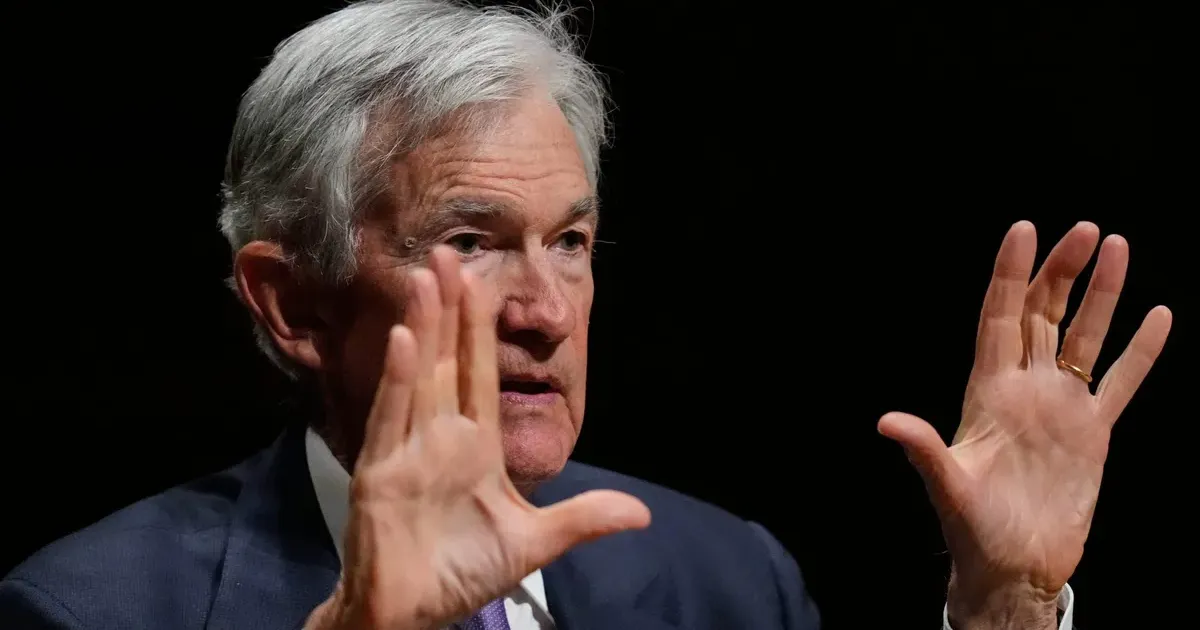
Jerome Powell addressed students at Harvard University to deliver a sober warning about the $39 trillion national debt. Addressing a lecture hall of 400 economics students, the Federal Reserve Chair clarified that while the current debt load is not immediately dangerous, the existing trajectory will not end well. National gas prices currently hover near $4 per gallon as the ongoing war in Iran complicates global energy markets. Economic stability persists for now because the United States maintains its status as the issuer of the world reserve currency. By March 31, 2026, Powell was framing that advantage as a buffer rather than a permanent solution.
Inflation expectations for the long-term appear to be firmly in check despite the escalating conflict in the Middle East. Gold prices stabilized following two days of gains as investors processed the latest commentary from central bank officials. Market participants closely monitor the interaction between fiscal spending and monetary policy as the debt-to-GDP ratio continues its upward climbs. Stability in the gold market suggests that traders still trust the central bank to manage price volatility despite geopolitical pressures.
Federal Reserve Addresses Middle East Supply Disruptions
New York Fed President John Williams stated on March 31, 2026, that current interest rates are well-positioned to handle meaningful supply-chain disruptions. Disruptions caused by the Iranian conflict have forced logistics firms to reroute shipments, increasing the cost of raw materials. Williams noted that the central bank remains prepared to adjust its stance if these supply shocks bleed into broader price indices. Monetary policy tools are functioning as intended to anchor inflation despite the external chaos.
Energy costs remain a primary concern for the American consumer. President Trump recently commented on a potential end to hostilities, but the war in Iran shows few signs of a swift resolution. These geopolitical tensions create a difficult backdrop for the central bank as it attempts to maintain a neutral rate. Higher fuel costs typically act as a tax on households, yet the Fed sees long-term inflation targets as achievable. Production levels in the Permian Basin have not yet offset the losses from Middle Eastern terminals.
Gold prices reflect a cautious optimism among global hedge funds. Market data indicates that bullion prices found a floor once Powell reaffirmed the Fed's commitment to price stability. Investors often flee to precious metals when fiscal paths appear uncertain. Today, however, the consensus among primary dealers is that the Federal Reserve has sufficient tools to manage the immediate impact of the war.
Harvard Economics Dialogue Highlights Fiscal Path Risks
Powell used his Harvard appearance to draw a sharp distinction between the current stock of debt and its future direction. He acknowledged that no one knows exactly where the breaking point for a national economy lies. Japan carries a far higher debt-to-GDP ratio than the United States without experiencing a systemic collapse. American debt is growing substantially faster than the underlying economy, creating a mathematical inevitability that lawmakers must eventually address.
The level of the debt is not unsustainable, but the path is not sustainable. It will not end well if we don’t do something fairly soon. Fed Chair Jerome Powell continues to navigate monetary policy amidst increasing uncertainty regarding the Iranian conflict. Borrowing costs have surged since the low-rate environment of the previous decade. Net interest payments on the national debt are projected to exceed $1 trillion in fiscal year 2026. This figure is nearly triple the $345 billion the government paid in 2020. In the first three months of the current fiscal year alone, interest payments reached record levels. Tax receipts have not kept pace with the rising cost of servicing this enormous obligation.
Fiscal health demands urgent attention from congressional leaders according to the Fed Chair. Powell highlighted that the United States possesses the deepest capital markets on earth, which provides a unique buffer. Smaller economies would have already buckled under similar debt ratios. Reliance on this reserve currency status creates a sense of security that may be deceptive over the coming decades. The direction of travel is unambiguous.
Interest Payments Exceed One Trillion Dollars
Servicing the national debt now consumes a larger portion of the federal budget than many essential services. Projections from the Congressional Budget Office indicate that interest expenses will soon rival the annual defense budget. Such high levels of non-discretionary spending limit the ability of the government to respond to future economic downturns. Revenue remains solid, but the sheer volume of outstanding Treasury securities requires constant auctioning at higher yields. Foreign central banks continue to purchase US debt, albeit at a more measured pace than in previous years.
Iranian military maneuvers have kept crude oil futures in a state of constant flux. Supply chains for semiconductors and automotive parts are experiencing delays as maritime insurance rates climb. Williams emphasized that the Fed is monitoring these bottlenecks for signs of persistent inflation. So far, the impact is confined to specific sectors rather than the broader economy. Consumer spending stays resilient despite the $4 gas price milestone.
Market analysts at Bloomberg note that gold's recent performance is a classic hedge against fiscal mismanagement. While Powell keeps inflation in check through rate policy, he cannot control the spending habits of the legislative branch. This divergence between monetary discipline and fiscal expansion creates a paradox for long-term planners. Financial markets stay sensitive to any hint of a credit rating downgrade. Most primary dealers expect the current interest rate cycle to hold steady through the end of the second quarter.
Legislative gridlock prevents a detailed overhaul of the federal tax code or spending priorities. Powell avoided taking a specific political stance during his lecture but emphasized that the window for action is closing. Delaying fiscal reform increases the risk of a disorderly market adjustment in the future. Demographic shifts are already putting pressure on social safety nets. The current debt load sits at 120% of the annual gross domestic product. Maintaining the sustainability of the American dream requires a fundamental reassessment of the national ledger. Powell concluded his remarks by reminding the students that they will inherit the consequences of today's fiscal choices. Interest rates cannot stay elevated forever without causing serious pain to the Treasury's borrowing capacity. Global investors are watching for a sign that Washington can return to a path of fiscal sanity. The national debt reached $39 trillion this morning.
Debt Path Warning
Fiscal denialism has become the unofficial doctrine of the United States Treasury. Jerome Powell’s appearance at Harvard was not a mere academic exercise but a calculated signal to the bond market that the central bank is aware of the coming storm. Washington has survived on the fumes of its reserve currency status for decades, yet the math of $1 trillion in annual interest payments suggests the grace period is expiring. When interest on the debt exceeds the cost of the military, a superpower has transitioned from an era of investment to an era of maintenance.
Politicians in both parties treat the $39 trillion debt as a theoretical abstraction while the Iranian conflict adds real-world inflationary pressure. The Fed is essentially trying to hold back a flood with a mop. If the trajectory is unsustainable, as Powell admits, then a large devaluation or a sovereign restructuring is the only logical conclusion. Investors should look past the daily fluctuations in gold and recognize that the long-term value of the dollar is being auctioned off to pay for the past. The bill is coming due.