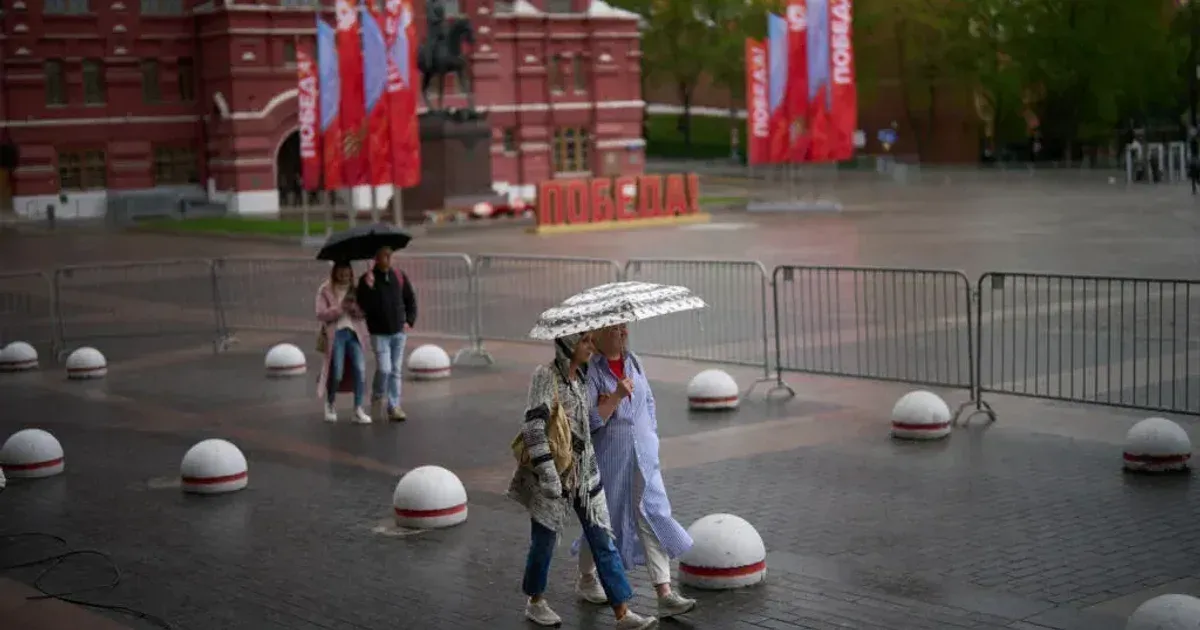
Russian President Vladimir Putin used Moscow's Victory Day ceremony to project wartime confidence while presiding over a smaller, heavily secured Red Square parade. The ceremony marked the 81st anniversary of the Soviet defeat of Nazi Germany, but the mood was shaped as much by the war in Ukraine as by the memory of World War II. A scaled-back parade also lets Moscow preserve symbolism while avoiding a display that might expose equipment limits or security strain.
The parade proceeded under tight security on May 9, 2026, after days of warnings and speculation about possible Ukrainian drone threats. Western and independent reporting had described the 2026 ceremony as reduced compared with earlier Kremlin showcases, with fewer displays of modern military power and heavier restrictions around the capital. The absence or reduction of modern equipment mattered because the Kremlin has long used Victory Day hardware to suggest that Russia possesses both historical legitimacy and present-day military abundance.
Putin's address leaned on familiar themes: sacrifice, national endurance and the claim that Russia is defending itself against hostile outside forces. That language has become central to the Kremlin's effort to connect the current war with the Soviet victory narrative.
Scaled-Back Parade Under Tight Security
The reduction in visible military spectacle mattered because Victory Day is one of Putin's most important political stages. In stronger years, the Kremlin used the parade to display tanks, missile systems, aircraft and foreign diplomatic support. A pared-back format sends a different signal, even when state media frames the ceremony as disciplined and dignified.
Moscow authorities tightened access around Red Square, and reports described communications restrictions and anti-drone precautions around the city. Those measures reflected a basic reality of the fifth year of Russia's full-scale war: even the symbolic center of the Russian state is now planned around the possibility of long-range Ukrainian strikes.
Ukrainian President Volodymyr Zelenskyy had mocked Moscow's security anxiety earlier in the week, while President Donald Trump said tensions around a possible strike on the parade had been defused. That diplomatic pause did not create a peace settlement, but it reduced the immediate chance that the ceremony itself would become a battlefield event. It also allowed both Moscow and Washington to claim a limited form of crisis management without solving the front-line war.
The Kremlin still needed the parade to happen. Canceling Red Square would have been politically damaging for Putin, who has spent years turning Victory Day into proof of continuity between Soviet sacrifice and modern Russian power.
War Narrative and Foreign Signals
The ceremony also carried a foreign-policy message. Russia remains under Western sanctions and continues to seek visible partners outside the U.S.-European bloc. Messages of support from friendly governments, including North Korea, help Moscow argue that it is not isolated despite the economic and diplomatic pressure created by the Ukraine war.
Kim Jong Un's Victory Day message fit that pattern by reaffirming strategic ties with Moscow. The message did not change the battlefield, but it reinforced a relationship that has become more important as Russia looks for ammunition, diplomatic cover and anti-Western alignment.
The reduced hardware display is not proof that Russia lacks all capacity. It does, however, weaken the traditional visual grammar of Victory Day, where the Kremlin normally turns columns of armor and missiles into a statement of state power. It is more precise to say that the Kremlin chose or was forced into a lower-risk format while much of the military remains tied to the front and to domestic air-defense needs.
That distinction matters because propaganda and military reality can move in opposite directions. The ceremony told Russians that the state remains strong and historically righteous. The security posture suggested that the war has made even ceremonial confidence more expensive to stage.
The Reduced Parade Exposed the Cost of Wartime Symbolism
Victory Day remains a powerful domestic ritual for Putin, but the 2026 parade showed how the war has narrowed the Kremlin's room for performance. A reduced parade can still produce patriotic images, yet it cannot fully hide the costs of a conflict that has consumed equipment, strained air defenses and made Moscow more vulnerable to symbolic pressure.
The U.S. role was also notable. Trump's intervention around parade-day tensions gave Putin room to hold the ceremony without a dramatic escalation over Red Square, but it did not resolve the underlying war. That made the parade a temporary display of control rather than evidence of diplomatic momentum.
The strategic problem for Putin is that Victory Day depends on certainty: certainty about history, victory and national strength. The 2026 version carried more uncertainty than the Kremlin wanted to show. Security restrictions, reduced spectacle and reliance on friendly autocracies all pointed to a Russia still capable of staging ceremony, but less able to stage invulnerability.
The message to foreign governments was equally mixed. Moscow can still command attention on May 9, but the shape of the event now reveals the pressure of a war that has reached back into the capital's rituals. That pressure is exactly why a smaller parade may be more revealing than a larger one.