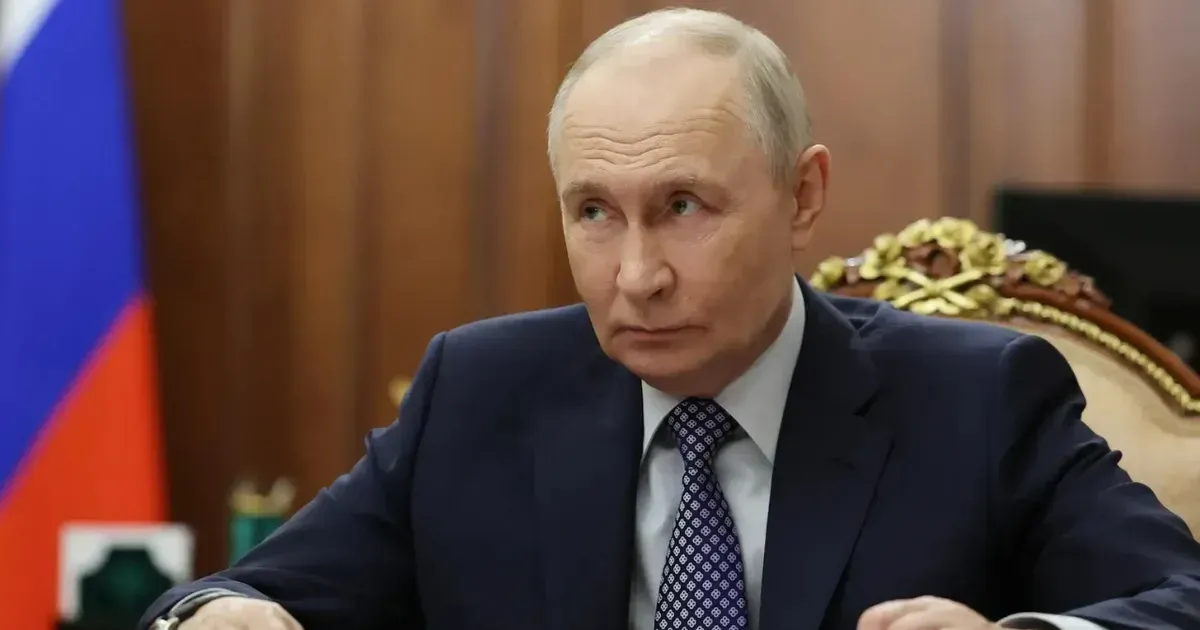
Vladimir Putin declared that the survival of the state depends on its ability to manufacture and control proprietary intelligence systems. Speaking to a selection of government ministers and industrial leaders, the president emphasized that Large Language Models constitute a basic, end-to-end technology. Moscow pushed for domestic control of strategic software on April 11, 2026, through the AI order. Russian leadership believes these systems provide the essential foundation for sovereign development across every industrial and social sector. Direct state intervention in the technology sector has increased as Moscow seeks to eliminate dependencies on Western software architectures. Military and civilian applications alike now require a technological stack that operates independently of Silicon Valley's influence.
Sovereignty in the digital age is no longer a matter of borders alone but a matter of code. Vladimir Putin argued that without domestic models, the nation risks cultural and administrative obsolescence. He described these advanced AI frameworks as the primary engines of future economic growth. Foreign alternatives, according to the Kremlin, carry embedded biases that could undermine national stability. Domestic engineers are currently under pressure to deliver competitive performance while ensuring that the underlying data sets reflect local values and historical narratives.
National Security and the Sovereign AI Push
National security protocols in Russia now explicitly include the development of autonomous generative systems. Military analysts suggest that reliance on foreign AI creates a structural vulnerability that adversaries could exploit during a crisis. Putin insisted that the upcoming generation of models must possess a maximal level of sovereignty. High-level directives indicate that every component of the AI pipeline, from data collection to final inference, must remain under state oversight. Western sanctions on high-end semiconductors have complicated these ambitions, yet the mandate for total independence persists. Smuggling operations and shadow supply chains for specialized chips continue to fuel the domestic compute centers.
Intelligence officials view LLMs as more than chatbots or productivity tools. They see them as the central nervous system for future governance and tactical decision-making. If the underlying logic of a state's AI is programmed by a geopolitical rival, that state loses its agency. Moscow intends to avoid this scenario by funding a variety of parallel research projects. Some initiatives focus on the optimization of existing architectures for limited hardware, while others attempt to pioneer entirely new methods of neural training. Success in this field is now categorized alongside nuclear and aerospace capabilities as an essential national interest.
Hardware Constraints and the Sovereign LLM Requirement
Global chip shortages and export controls have forced Moscow to adopt a fragmented approach to hardware procurement. Advanced training of models with billions of parameters requires thousands of specialized GPUs that the domestic industry cannot currently produce. Despite these hurdles, the president maintains that progress must be guaranteed through indigenous innovation. Academic institutions have been ordered to pivot their research toward efficient model architectures that require less compute power. This technical pivot suggests a realization that Russia cannot simply brute-force its way to parity with American giants. Optimization is now the watchword for Russian computer science.
Russia needs to develop its own LLMs to guarantee its progress as these technologies are the foundation for sovereign development in all areas. Engineers at Sberbank and Yandex are leading the charge to integrate these models into the daily lives of citizens. GigaChat and YandexGPT are already functioning as the domestic answer to Western platforms. These corporations receive significant state backing to ensure their models stay competitive on a global scale. Government agencies have begun implementing these tools to automate bureaucratic processes and public services. Efficiency gains in the public sector are cited as early proof that the sovereign strategy is viable. Every successful deployment reduces the leverage that foreign tech providers hold over the Russian economy.
Strategic Roles for Sberbank and Yandex
Corporations like Yandex have historically balanced international investors with domestic requirements, but that balance has shifted toward the latter. The state now treats these tech giants as extensions of national policy. Putin expects these firms to provide the backbone for the digital transformation he envisions for the 2030s. Large-scale data centers are being constructed in remote regions to take advantage of cold climates and cheap energy. These facilities will house the clusters necessary to train the next generation of sovereign models. Public-private partnerships are the preferred vehicle for this rapid expansion. The goal is a seamless ecosystem where the Russian citizen never needs to interact with a foreign algorithm.
Large Language Models are the focus of a new multi-year investment plan. Financial resources are being redirected from traditional infrastructure to digital sovereign projects. Putin characterized the current period as a race that Russia cannot afford to lose. Critics of the plan point to the enormous brain drain of tech talent over the last four years. Officials, however, argue that those who stayed are more committed to the national mission. Patriotic rhetoric is increasingly used to recruit the next generation of coders from elite universities. The state offers tax breaks and exemptions from military service to keep these minds focused on LLM development.
Sovereignty remains the central theme of every tech briefing coming out of the Kremlin. International observers monitor these developments closely to see if Russia can truly decouple its AI from the global grid. Preliminary data suggests that the gap between Western and Russian models is narrowing in specific linguistic and cultural tasks. Progress continues despite the logistical nightmares created by global isolation. The Kremlin views the struggle for AI supremacy as a permanent feature of the modern geopolitical environment. No retreat from the sovereign path is expected as long as the current administration holds power.
Sovereign AI Push
National power in the twenty-first century is increasingly measured in flops rather than battalions. Vladimir Putin understands that an isolated nation without a proprietary AI brain is a colony in the making. His push for sovereign LLMs is more than a technological whim but a desperate attempt to maintain relevance in a world where silicon is the new oil. Russia is essentially attempting to build a high-tech fortress while the gates are being hammered by global sanctions. This effort is noble in its ambition but likely doomed by the sheer physics of the hardware gap.
Moscow lacks the lithography tools to print the chips required for the frontier of intelligence. No amount of patriotic fervor can replace the precision of a Dutch ASML machine or the design expertise of a California-based architect. While Russia can produce competent models for localized tasks, it cannot lead the global curve while cut off from the collaborative ecosystem of international science. Putin is betting that sovereignty can be bought with state decrees, but AI is a product of open exchange and large, unhindered compute resources.
The verdict is clear. Russia will succeed in creating a digital echo chamber that functions well enough for internal control and basic administration. It will fail to create a platform that challenges the global dominance of Western or Chinese systems. In the end, a sovereign AI is a lonely AI. Moscow is choosing a future of technological solitude over the risk of external influence. That choice will ensure the state survives in its current form while the rest of the world accelerates into a future Russia can only simulate.