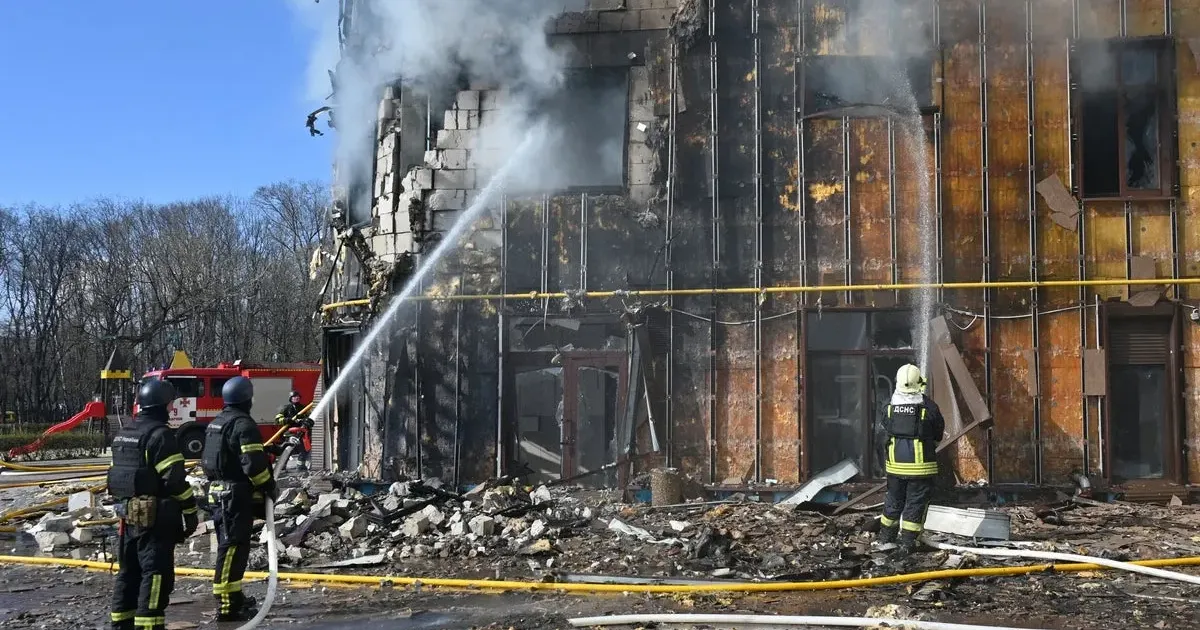
Vladimir Putin authorized a wave of 280 drones and high-velocity missiles against Ukrainian urban centers on April 4, 2026, marking the war's 1,500th day with a rejection of calls for a holiday ceasefire. President Volodymyr Zelensky had formally proposed a temporary cessation of hostilities for the Easter period, but Moscow responded with one of the most concentrated aerial campaigns of the calendar year. Ukrainian defense officials reported that 14 people died during the coordinated strikes, which hit residential areas in Kyiv, Kharkiv, and Odesa. The drone offensive weakened hopes for a symbolic Easter pause. This offensive used a new generation of remote-controlled weaponry designed to bypass existing interception networks. Reports from local governors indicate that civilian infrastructure bore the brunt of the fire.
Data compiled by the Ukrainian Air Force shows that the Kremlin launched a record-breaking 280 drones within a 24-hour window. These units were not the standard slow-moving propeller craft seen in previous years. Instead, Russian engineers have integrated small jet engines into the airframes, sharply increasing their approach speeds and reducing the window for air defense crews to react. Combat footage verified by independent analysts confirms that these jet-powered variants can reach targets twice as fast as earlier models. This speed upgrade forces Ukrainian batteries to expend more expensive interceptor missiles on relatively low-cost targets.
Russian Military Shifts to Jet-Propelled Drone Systems
Military specialists in Kyiv observed that the 1,500th day of the invasion showcased a tactical evolution in Russian strike patterns. While Bloomberg suggests that Russia is running low on high-end ballistic missiles, Reuters sources claim the production of these new jet-powered drones has compensated for any shortfall in traditional munitions. These aircraft maneuver at altitudes that complicate radar detection, often skimming treetops before climbing to dive on their targets. By deploying such a high volume of hardware simultaneously, the Russian Aerospace Forces attempt to saturate the target area until defense systems simply run out of ammunition.
Aerial assaults no longer occur solely under the cover of darkness. The April 4, 2026, attacks consisted of rolling daytime waves that struck while civilians were commuting to work or attending church services. Ukrainian military spokesperson Yuriy Ihnat noted that the shift to daylight operations aims to maximize psychological pressure on the populace. It forces a constant state of alert that disrupts economic activity and strains the mental health of the urban population. One specific strike in Kharkiv hit a crowded market, causing immediate casualties and hampering rescue efforts due to the threat of a secondary follow-up hit.
Casualties Rise Across Ukraine During Daytime Assaults
Rescuers pulled survivors from the rubble of an apartment complex in central Kyiv while air raid sirens continued to wail across the capital. Local health authorities confirmed that children were among the 14 people killed in the morning barrage. Hospitals in the affected regions reported dozens of injuries ranging from shrapnel wounds to severe concussions. Unlike previous months where energy infrastructure was the primary focus, these latest strikes appear to target high-density housing and public gathering spaces without clear military utility. Moscow maintains that its targets are strictly military, yet the wreckage at the scene of the Kyiv blast consisted entirely of domestic furniture and personal belongings.
President Volodymyr Zelensky said Russia chose to mark the Easter holiday with an escalation rather than the silence of a ceasefire.
Kyiv officials expressed frustration at the lack of a coordinated international response to the new drone technology. Volodymyr Zelensky used his nightly address to highlight the irony of a permanent member of the UN Security Council launching mass attacks during a major religious holiday. He argued that the current supply of Western air defense systems is insufficient to cover the entire country against jet-propelled swarms. Strategic reserves of interceptor missiles are reportedly reaching critical levels in several provinces. Ukrainian commanders must now choose which cities to protect and which to leave vulnerable.
Diplomacy Fails as Easter Truce Proposal Collapses
Diplomatic channels remained cold throughout the holiday weekend as the 280-drone swarm neutralized any hope for a humanitarian pause. The Kremlin ignored the Easter truce proposal entirely, choosing instead to issue a statement regarding the inevitable victory of Russian forces. Moscow's refusal to engage in even a symbolic ceasefire suggests a commitment to a war of attrition that ignores traditional diplomatic windows. This posture has solidified the resolve of Ukrainian officials who now argue that negotiation is impossible until Russia's strike capacity is physically degraded. Political leaders in Warsaw and London have echoed this sentiment, calling for faster deliveries of long-range counter-strike capabilities.
Russia continues to invest heavily in domestic manufacturing facilities that operate 24 hours a day to produce these aerial weapons. Intelligence reports indicate that several new factories east of the Ural Mountains have reached full production capacity for jet-engine components. These facilities benefit from a steady supply of dual-use technology that bypasses international sanctions through third-party intermediaries. The resulting output allows the Russian military to sustain high-intensity operations despite the rising costs of the conflict. A single day of strikes now involves more hardware than entire months of fighting during the first year of the invasion.
Defense analysts point to the 1,500-day milestone as a period of extreme volatility for the Ukrainian rear. Persistent shelling of logistics hubs in the west of the country aims to sever the flow of Western aid before it reaches the front lines. The jet drones have played a major role in these interdiction efforts because they are difficult to intercept over rural, forested terrain. Small mobile teams equipped with machine guns, which were effective against slower drones, struggle to track the newer, faster models. The technical gap provides the Russian military with a temporary advantage in the ongoing battle for the skies.
Zelensky continues to press for a total ban on the components found in the downed wreckage of the jet drones. Engineers examining the debris found microprocessors and engine parts manufactured in several countries that officially support Ukraine. The contradiction highlights the porous nature of global trade and the difficulty of enforcing strict military embargoes. Until these supply chains are severed, Russia possesses the means to continue its aerial campaign indefinitely. The April 4, 2026, offensive proved that the Kremlin is willing to use every technological advancement at its disposal to break Ukrainian resistance.
Drone Offensive Undercuts Easter Truce Hopes
The drone offensive makes the Easter truce proposal look weaker by the hour. Kyiv and Moscow can still trade ceasefire language, but attacks at this scale show that neither side is moving toward a durable pause.