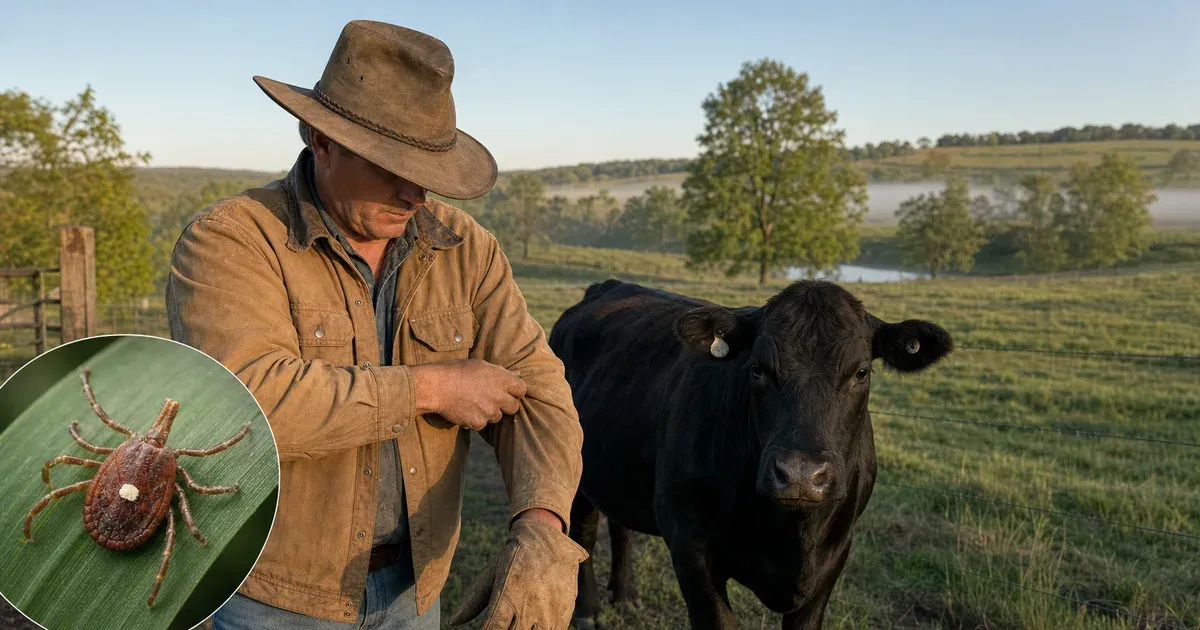
Sharon Pennington stopped raising orphan calves and sold her nurse cows after repeated severe allergic reactions disrupted work on her northern Missouri farm. She received an alpha-gal syndrome diagnosis in the summer of 2025, days after a blood test followed another reaction.
Pennington and her husband still keep a small beef herd, but reporting by Harvest Public Media says she is now largely hands-off and focuses more on growing and selling irises. Her experience shows how a tick-associated allergy can alter a producer's health, work and identity. It does not establish that the US cattle workforce or food supply is approaching collapse.
Alpha-gal syndrome, or AGS, is an allergy to galactose-alpha-1,3-galactose, a molecule found in most mammals and in products derived from them. In the United States, bites from the lone star tick are most often associated with the condition.
One Farm Shows a Severe but Unusual Work Burden
Pennington reported anaphylactic reactions around cattle and their bodily fluids, not only after eating mammalian products. She ultimately halted the orphan-calf operation and sold nurse cows and weaned calves because she could no longer safely perform the work.
That experience should be reported with its uncertainty intact. Allergist Scott Commins told Harvest Public Media that patient accounts of reactions to fumes, fluids and animal contact appear real, but scientific data are not yet strong enough to confirm the mechanism or show how commonly such exposures trigger AGS reactions.
Kelly Decker, an Oklahoma cattle and sheep producer diagnosed in 2019, described a different course. She said avoiding red meat and taking care around livestock made the condition manageable, although contact with amniotic fluid had caused localized skin reactions. The contrast matters: AGS severity and triggers vary, and a single patient's restrictions are not a universal prognosis.
The reporting also described financial and emotional strain when producers must hire help, change duties, stop raising livestock or leave farming. Those are credible individual outcomes. They do not support claims that the allergy has already destabilized the beef market, accelerated farm consolidation or created a measurable national labor crisis.
The Producer Survey Is Preliminary, Not a Prevalence Study
University of Nebraska Medical Center researcher Shaun Cross surveyed 201 self-identified farmers and ranchers with diagnosed AGS across 28 states. The majority of respondents were from Missouri, Oklahoma and Arkansas, areas where the lone star tick is common.
According to the reporting, 69% said they had modified work tasks, 57% reported daily signs or symptoms, and 78% reported distress and concern about farm or ranch productivity. The survey also recorded high levels of self-reported anxiety and depression associated with the diagnosis.
Those results had not been published when the story appeared. Without a peer-reviewed methods paper, response rate, recruitment denominator and comparison group, the survey cannot tell what percentage of all US producers have AGS or how their outcomes differ from producers without the condition. People facing the greatest disruption may also have been more likely to respond.
The survey is valuable as a map of questions that occupational-health researchers should test. It identifies work modification, mental health, access to specialists and the cost of replacement labor as possible burdens. It does not quantify lost national production or predict grocery prices.
The 450,000 Figure Is an Estimate, Not a Case Count
CDC analyzed alpha-gal-specific IgE testing data and documented 110,229 suspected cases from 2010 through 2022. For 2017 through 2022, 90,018 people with positive tests met the study's definition of a suspected case.
Researchers then modeled a broader range using assumptions about how many positive tests were clinically compatible and how many affected people reached knowledgeable clinicians who ordered testing. Their estimate was that 96,000 to 450,000 people might have been affected in the United States since 2010.
That upper bound is often shortened to a statement that nearly half a million Americans have AGS. The true number is unknown because AGS is not nationally notifiable and access to testing is uneven. A positive alpha-gal IgE result alone also does not establish the syndrome; diagnosis requires a compatible history, examination and interpretation of the blood test.
Suspected cases were concentrated in southern, midwestern and mid-Atlantic counties, broadly overlapping established lone star tick populations. CDC also found clusters outside the tick's known range and said more investigation was needed. The data did not test whether warmer winters, deer abundance, brush management or any single environmental change caused the geographic pattern.
Prevention and Surveillance Are the Defensible Response
Symptoms often begin two to six hours after exposure to red meat, dairy or other alpha-gal-containing products. They can include hives, swelling, gastrointestinal symptoms, breathing difficulty, low blood pressure and anaphylaxis. Delayed and inconsistent reactions can complicate recognition, but there is no universal rule that every patient must avoid every mammal-derived ingredient.
CDC advises patients to work with an allergist or another healthcare provider to identify their triggers, plan for emergencies and discuss medicines or vaccines that may contain relevant ingredients. Some patients who avoid additional tick bites may later tolerate alpha-gal-containing products again, but that decision is individualized and should be medically guided.
Preventing further tick bites is central. CDC recommends registered repellents, clothing and gear treated with 0.5% permethrin, showers and body checks after outdoor work. People with severe reactions should seek emergency care and follow their clinician's instructions for prescribed epinephrine.
Public-health agencies have a clear job: improve clinician education, build surveillance, support occupational research and make prevention practical for people who work outdoors. Agricultural groups can add training and help producers adapt duties without pretending that long sleeves solve every case.
The hard truth is substantial enough without an agricultural-apocalypse script. Alpha-gal has already forced some producers to change or abandon work they value, while the national occupational burden remains unmeasured. Treating preliminary survey percentages as a food-supply forecast would not strengthen their case; it would replace a real research gap with a political story the data never told.