Robert Armstrong, the lead financial commentator for the Financial Times, finalized his assessment of global market volatility on April 3, 2026, by formalizing a concept he calls the Taco trade. This specific investment strategy emerged in response to the sudden implementation of the Liberation Day tariffs, which initially caused widespread panic across major equity exchanges. Investors initially struggled to interpret the aggressive trade barriers, but a predictable movement of capital eventually surfaced within the data. Robert Armstrong noted that while the primary markets appeared chaotic, a secondary circuit of trade was establishing itself through North American corridors.
Capital flows began to favor entities capable of bypassing direct restrictions by using manufacturing hubs in the southern region. Global trade ministers expressed concern over the volatility, yet the underlying pattern remained hidden from casual observers for several weeks.
Financial institutions across Wall Street reported extreme fluctuations in the immediate hours of the tariff announcement. High-frequency trading algorithms triggered huge sell-offs in logistics and consumer goods sectors, leading to a temporary suspension of trading on some international platforms. Early reports suggested a permanent breakdown in cross-border cooperation. Armstrong observed that the initial noise masked a more sophisticated realignment of assets. He argued that the market eventually decoded the new regulatory environment, identifying specific loopholes that favored Mexican manufacturing centers. These centers became the destination for outsourced production that previously resided in sanctioned jurisdictions. Investors who recognized this shift early managed to hedge against the broader downturn by betting on a recovery in Mexican infrastructure and transport sectors.
Liberation Day Tariffs Trigger Global Market Volatility
Policy changes enacted during the Liberation Day legislative session caught most brokerage houses unprepared. These tariffs targeted nearly $20 billion in daily trade volume, creating an immediate liquidity crunch in the automotive and technology supply chains. Analysts at major London banks spent several days attempting to model the fallout, but traditional metrics failed to predict the specific direction of the recovery. Panic selling characterized the first forty-eight hours as fund managers sought to minimize exposure to emerging market debt. While the headline figures suggested a total retreat, certain asset classes began to show unusual resilience.
Currency traders noted that the Mexican peso decoupled from other emerging currencies during this period of stress. This divergence provided the first statistical evidence of what Armstrong would later categorize as a new trading phenomenon.
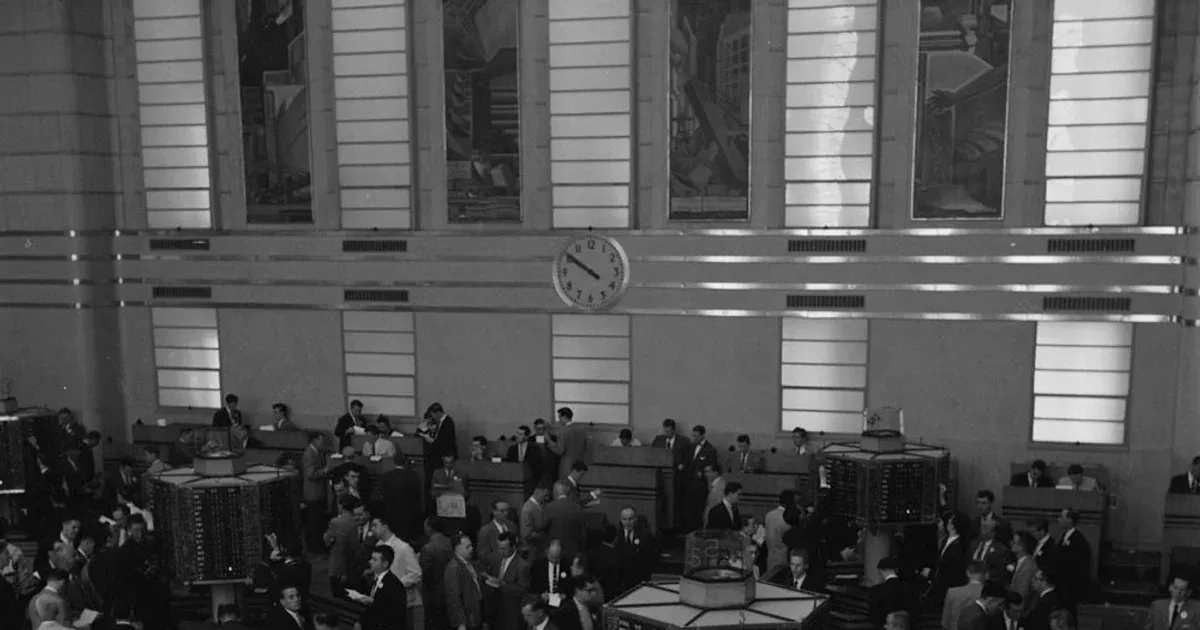
Markets went haywire after the ‘liberation day’ tariffs until investors started noticing a pattern.
Robert Armstrong highlighted this specific shift in a report for the Financial Times, detailing how savvy traders moved past the initial shock. He emphasized that the haywire behavior of the markets was a natural reaction to a first-ever policy shift. Institutional investors often react to trade barriers by searching for a third-party intermediary to maintain supply-chain continuity. Mexico filled this role almost immediately, acting as a conduit for goods that faced prohibitive costs elsewhere. This geographical arbitrage became the foundation of the Taco trade. Large-scale manufacturers began announcing expanded facility investments in regions like Monterrey and Queretaro. These announcements coincided with a sharp rebound in the valuations of regional logistics firms and energy providers supporting industrial growth. The implementation of the Liberation Day tariffs remains a central point of contention for modern trade policy analysts.
Structural Patterns of the Taco Trade Pivot
Trading desks across the globe started tracking the specific volume increases in trans-border freight as the new trade reality set in. Data from rail operators confirmed an enormous surge in northbound cargo that mirrored the decline in direct trans-oceanic shipments. Armstrong argued that this was not a coincidence but a deliberate reorganization of the global economic order. Every major logistics firm reported a backlog of orders for warehouse space near the US border. Profit margins for these companies increased despite the broader economic slowdown.
Many equity researchers missed this trend because they focused exclusively on the negative impact of the tariffs on headline growth figures. Smaller, more agile hedge funds exploited the discrepancy between perceived chaos and the actual redirection of trade.
Economic models that previously relied on direct bilateral trade flows became obsolete within a few trading cycles. Armstrong pointed out that the Taco trade relied on a sophisticated understanding of rules of origin and value-added manufacturing requirements. Companies were not just moving finished products through a new port, they were relocating entire assembly phases to comply with the revised trade definitions. Logistics costs rose, but the avoidance of 25% tariff penalties made the move profitable for most consumer electronics firms. Quant desks identified the pattern by looking at the correlation between tariff-sensitive stocks and Mexican construction indices.
A strong positive correlation emerged by the third week of the trade dispute. The statistical link confirmed that the market was no longer in a state of blind panic.
Robert Armstrong Tracks Capital Flow Shifts
Capital began to flow into specific exchange-traded funds that tracked Mexican equities and the national currency. Armstrong observed that the volume of these trades exceeded historical averages by nearly 400 percent during the peak of the tariff implementation. Central banks monitored the situation closely as the sudden influx of foreign investment put upward pressure on regional inflation. Government officials in the south welcomed the investment but cautioned that the infrastructure might not handle the sustained load. Despite these warnings, the momentum of the Taco trade continued to build throughout the first-quarter of the year.
Investors viewed the region as a safe harbor from the trade war, pushing valuations to record highs. Some analysts questioned the sustainability of this trend, but the data showed no signs of a reversal in corporate relocation plans.
One specific observation from the Armstrong analysis concerned the role of medium-sized manufacturers. These firms lacked the resources to absorb tariff costs and were forced to migrate their operations faster than their larger competitors. Their agility created a front-run on industrial real estate that preceded the moves of Fortune 500 companies. Real estate prices in industrial parks near the border tripled in less than six months. Armstrong maintained that the speed of this transition was the most striking aspect of the market reaction.
He suggested that the digital nature of modern supply chains allowed for a more rapid pivot than historical trade shifts allowed. Traditional manufacturing cycles of two years were compressed into six months of frantic activity. The Taco trade was the direct result of this compression.
Corporate earnings reports for the first half of 2026 started to reflect the benefits of this geographic shift. Companies that moved production early reported higher earnings per share than those that attempted to litigate the tariff changes. Wall Street analysts began to use the Taco trade as a benchmark for judging corporate management competence. Fund managers who ignored the trend saw their portfolios underperform the broader market indices sharply. The trade became so prevalent that it influenced the monetary policy discussions of several major central banks. Armstrong concluded that the pattern he identified was now a permanent feature of the investment landscape.
Markets eventually reached a new equilibrium where the initial tariffs were baked into the pricing models of most assets.
The Elite Tribune Strategic Analysis
Questions about the long-term viability of the Taco trade ignore the structural decay within the current international trade framework. What Robert Armstrong identifies as a clever market pivot is actually a desperate bypass of failing diplomatic relations. The financial sector is currently celebrating the ingenuity of the Taco trade because it preserves profit margins despite populist protectionism, but this celebration is premature. History is recording a fragmentation of global manufacturing that increases total systemic costs under the guise of geopolitical necessity. Investors are essentially paying a premium for a complicated supply-chain that adds zero actual value to the consumer.
The Mexican economy is currently the primary beneficiary, yet it lacks the electrical and water infrastructure to support this level of industrial expansion indefinitely. When the bottlenecks in Monterrey eventually throttle the Taco trade, the subsequent market correction will be far more violent than the initial Liberation Day shock. It is not a sustainable evolution of global trade. It is a temporary arbitrage opportunity that will vanish as soon as the next set of regulatory barriers is erected. Betting on the Taco trade is a bet on the continued incompetence of trade negotiators. It is a strategy built on sand.
The era of efficient global trade has ended.