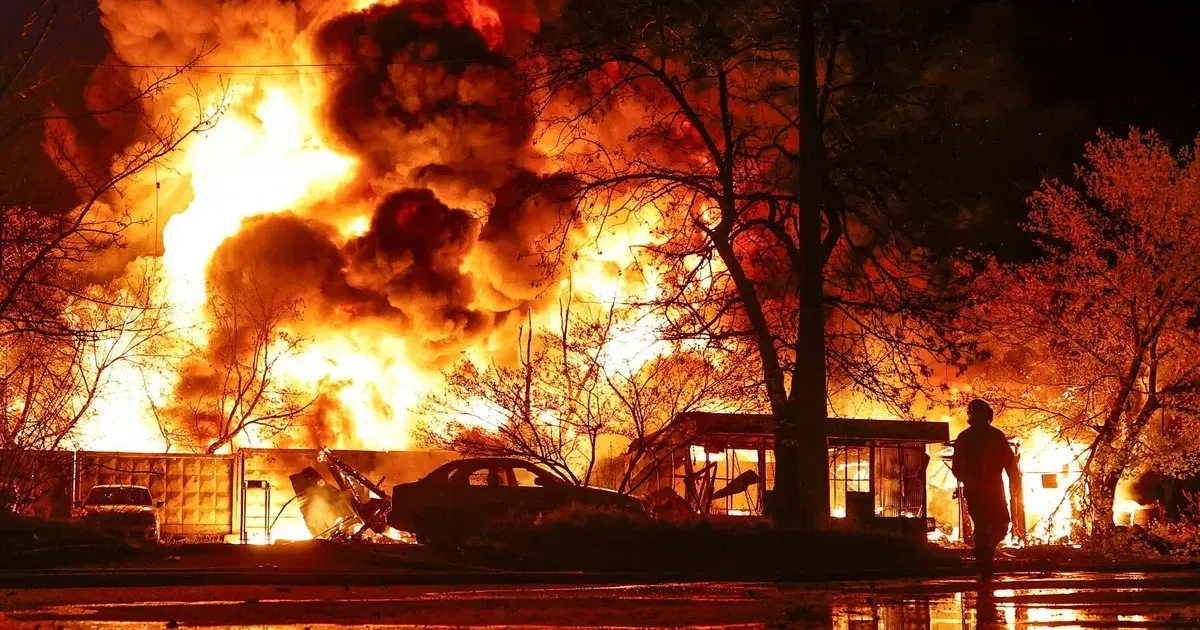
Russia’s latest missile barrage put civilian protection back at the center of the war. Moscow launched its deadliest aerial assault in months on April 16, 2026, targeting cities across Ukraine and killing at least 18 people. Kyiv, Odesa, and Dnipro faced a barrage of missiles and drones that shattered a brief period of relative calm. Missiles pierced the morning silence, striking residential buildings and critical infrastructure nodes. Rescue workers scrambled through smoking ruins to locate survivors trapped under concrete slabs. Death counts rose steadily throughout the day as emergency services reached the most severely damaged sites. Officials in Kyiv confirmed that the scale of this bombardment exceeds any single operation conducted by Moscow since the previous winter. Buildings in the capital sustained heavy damage, including a high-rise apartment block where several floors collapsed entirely. Residents fled to subway stations for cover, reliving the terror of the early invasion stages. Across the city, smoke plumes rose from various districts, obscuring the skyline. Emergency sirens provided a grim soundtrack to a morning meant for religious observance. Dnipro, a central hub for displaced persons, suffered meaningful losses in its eastern suburbs. Local hospitals reported a surge in trauma cases, straining medical resources that were already stretched thin.
Missile Barrage Hits Kyiv and Dnipro
Instead of the anticipated quiet of a holiday period, the sound of explosions dominated the urban landscape. Although air defense batteries intercepted dozens of incoming projectiles, the sheer volume of the attack overwhelmed several defensive sectors. Moscow used a sophisticated mix of cruise missiles and Iranian-designed Shahed drones to penetrate the radar umbrella. Previous strikes often focused on a single region, but this operation hit multiple metropolitan centers simultaneously. Artillery experts noted that the coordination required for such a synchronized strike suggests weeks of logistical preparation. Cities located far from the front lines found themselves back in the direct line of fire. Air defense commanders reported that the incoming fire consisted of Kh-101 cruise missiles launched from strategic bombers. Despite the high interception rate claimed by the Ukraine Air Force, several missiles reached their coordinates with devastating precision. Religious leaders had hoped for a reprieve during the Orthodox Easter celebrations, yet those hopes evaporated by dawn. Neither side appeared willing to yield ground or soften their posture during the holy season.
Peace remained elusive as the sirens continued to wail across the Dnipro River valley. The 12-year-old victim in Dnipro became a focal point of local grief, representing the indiscriminate nature of the morning's violence. Families gathered at makeshift memorials, placing flowers and candles near the impact craters. One survivor in Kyiv described the sensation of the ground shaking like an earthquake. DW News reported that the child was among several minors injured during the strikes in central Ukraine.
Civilian Casualties and Infrastructure Loss
Odesa, the essential port city on the Black Sea, also endured a sequence of drone hits that targeted energy facilities. Port operations ceased temporarily while fire crews battled blazes at two electrical substations. Cargo shipments of grain and sunflower oil face delays due to the resulting power outages. The resilience of the regional grid was tested once again, leading to rolling blackouts in neighboring provinces. Essential water pumping stations in Odesa lost power for several hours, leaving thousands of residents without running water.
Since the conflict began, infrastructure has become a primary target in the war of attrition. This strategy seeks to demoralize the civilian population by degrading the basic utilities required for daily life. Many residents in Odesa now rely on private generators to maintain essential services. Kyiv municipal authorities warned that the repairs to the capital's power grid could take weeks to complete. Subway trains operated on limited schedules, serving more as bomb shelters than transportation during the height of the alerts.
Authorities documented damage to a kindergarten in the northern outskirts of Kyiv, though no children were present at the time. Most of the casualties occurred in older residential blocks that lacked reinforced basements. Small fires broke out in the surrounding forested areas due to falling debris from intercepted drones. Larger fragments of a downed missile destroyed a row of parked cars in a crowded shopping district. Beyond the physical destruction, the psychological toll on the citizenry intensified with every subsequent explosion.
Failed Orthodox Easter Ceasefire
Moscow had briefly discussed the possibility of a temporary truce for the Orthodox Easter holiday, but those talks failed to produce a formal agreement. Neither government would commit to a pause in hostilities without serious concessions from the other party. While some observers hoped for a de-escalation, the reality on the ground proved far more violent. Moscow denied targeting civilians, claiming instead that all strikes hit military-industrial complexes. Ukrainian officials countered this narrative by releasing photos of destroyed apartment wings and playgrounds.
Belgorod and other Russian border regions also experienced the effects of the escalating conflict. Drone strikes on the Russian side of the border killed two people, according to a report from the Kremlin. This indicates that Ukraine is increasingly capable of striking back at Russian territory using domestically produced long-range drones. Retaliation for the strikes on Kyiv and Odesa appears to be a core component of the current Ukrainian military doctrine. Conflict analysts at the Institute for the Study of War suggest that the cycle of strikes and counter-strikes is entering a more aggressive phase.
Moscow is again ramping up missile and drone attacks on civilian targets, dispelling any notion that a temporary cease-fire for Orthodox Easter might become more lasting.
Defense analysts noted that the timing of the Russian assault coincided with the arrival of new Western munitions on the front lines. The presence of these weapons may have prompted Moscow to accelerate its aerial campaign to disrupt supply lines. Reports from frontline units indicate that Russian reconnaissance drones have been more active in recent days. Success for the Ukrainian air defense units often depends on the availability of interceptor missiles supplied by NATO allies. Records show that the consumption of these expensive munitions spikes during mass casualty events like the April 16 strikes.
Ukrainian Drone Strikes Inside Russia
Geographically, the conflict is no longer confined to the sovereign borders of Ukraine. Russian officials stated that Ukrainian drones targeted an oil refinery in the Krasnodar region, though the extent of the damage was not disclosed. Simultaneously, air raid sirens were heard in the Russian city of Sevastopol in occupied Crimea. Predictably, both nations are using the skies to bypass entrenched ground positions. Moscow maintains that its air defenses are capable of protecting the heartland, yet the frequency of drone penetrations suggests otherwise.
Historically, holiday truces in this theater have been fragile and short-lived. The failure of the 2026 Easter truce follows a pattern of broken promises that dates back to the early months of the full-scale invasion. Peace negotiations are currently nonexistent, with both capitals signaling a commitment to total victory. Survivors in Odesa spent the remainder of the day clearing glass from the streets. Local volunteer groups organized food and water distributions for those whose homes were rendered uninhabitable by the blasts.
Damage assessments are ongoing as forensic teams document every impact site for future international legal proceedings. Ukraine intends to use this data to build a case for war crimes in the International Criminal Court. Evidence collected from the debris includes serial numbers that point to recent production dates for the Russian missiles. This suggests that Moscow is able to maintain production despite international sanctions. The war continues with no sign of a diplomatic breakthrough in the near future.
Russia’s Missile Campaign Deepens the War
The scale and coordination of the attack show that expectations of an Orthodox Easter pause did not alter Moscow’s operational plans. Civilian deaths, damage to housing and interruptions to power and water increased the immediate cost across several cities.
Ukraine’s strikes inside Russia add another layer to the cycle of retaliation, but the difference in aerial volume leaves Ukrainian cities dependent on a limited supply of interceptors. Continued Western deliveries will affect how much of a future barrage can be stopped.
Investigators are documenting the impact sites and missile debris while repair crews restore essential services. With no formal truce or active peace process, the April 16 assault points toward continued long-range attacks rather than near-term de-escalation.