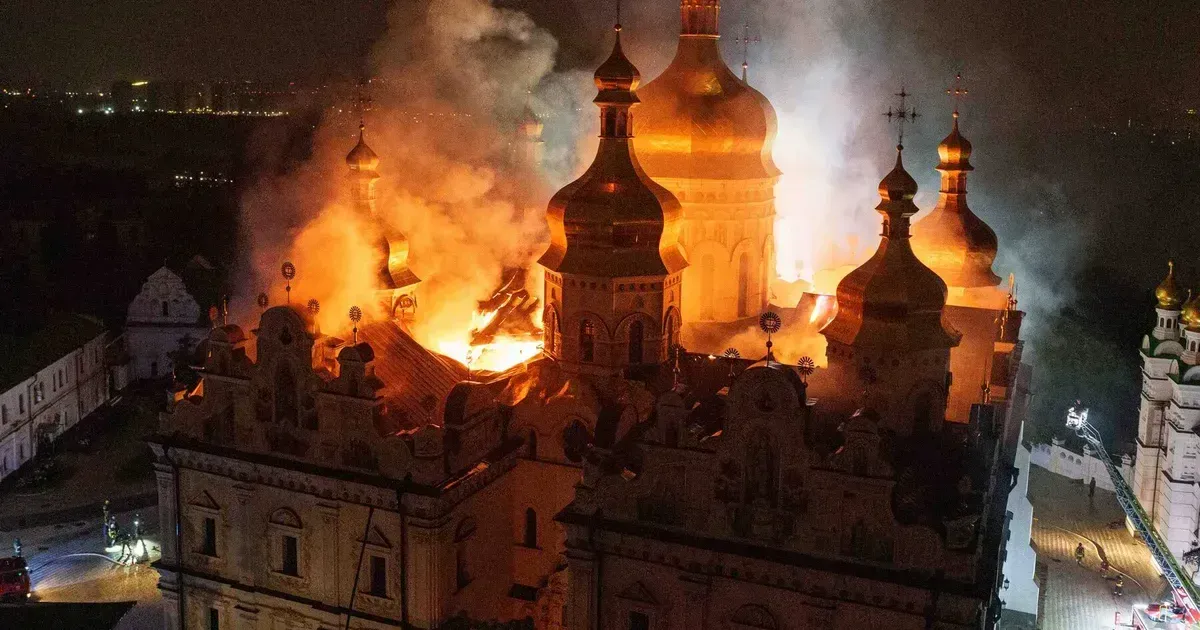
Russian missile and drone strikes set the Dormition Cathedral at Kyiv's Pechersk Lavra ablaze during a large overnight attack across Ukraine, killing at least nine people nationwide. The strike carried military and cultural consequences at the same time. It also gave Kyiv another example of how civilian heritage can become part of wartime targeting. The June 15, 2026 barrage hit one of the Orthodox world's most important religious and cultural sites.
Ukrainian officials said the assault struck Kyiv, Kharkiv and other population centers before dawn. In the capital, firefighters battled flames at the historic monastery complex while emergency crews also responded to residential damage and falling debris from intercepted weapons.
Kyiv's Religious Heritage Becomes a War Target
The Pechersk Lavra is a UNESCO-listed monastery complex with roots in the 11th century. Its Dormition Cathedral carries religious meaning for Ukrainian Orthodox believers and a wider cultural significance that extends beyond the current war. Officials and clergy said rescuers worked to protect holy objects and prevent the fire from spreading deeper into the complex. Smoke and water damage will still require a careful preservation assessment, especially around older materials and structures exposed to intense heat.
The attack drew immediate condemnation because it fused civilian casualties with cultural destruction. For Kyiv, the image of a burning cathedral became another argument for stronger air defense and more pressure on Moscow.
The timing also matters. The strike arrived as diplomatic attention was divided by other global crises, creating pressure on Ukraine to keep its war at the center of allied decision-making. Cultural damage can sharpen that message because it is visible, symbolic and difficult for foreign governments to treat as routine battlefield loss.
For Moscow, the cathedral fire creates a different problem. Russia has often framed parts of the war through religious and historical claims, but damage to a revered Orthodox site complicates that narrative and gives Kyiv a powerful diplomatic image.
Kharkiv and Tula Add to the Overnight Toll
Kharkiv also faced deadly strikes during the same wave, with rescuers among those killed while responding to fires. The pattern underscored the continuing danger of attacks that hit first responders after an initial impact. Ukraine also reported and Russia acknowledged separate drone impacts in the Tula region south of Moscow, where several people were killed or injured. Those strikes show how the war continues to reach beyond the front line and into regions both governments once treated as safer rear areas.
The combination of Kyiv, Kharkiv and Tula makes the night strategically significant. Russia demonstrated the scale of its long-range campaign, while Ukraine's reach into Russian territory kept pressure on Moscow's domestic security posture. That reciprocal reach does not make the attacks equivalent in scale or purpose, but it does show how the war has widened geographically. Civilians, emergency workers, infrastructure and symbolic sites are all exposed when long-range systems become a regular part of the conflict.
Kharkiv's losses are especially severe because repeated strikes on rescuers can degrade emergency response capacity. Every destroyed vehicle, injured medic or killed firefighter reduces the city's ability to survive the next wave.
Why the Cathedral Fire Matters
The cathedral fire is not only a battlefield incident. It cuts into the symbolic core of a war in which religion, national identity and historical legitimacy are repeatedly contested. Damage to the Kyiv Pechersk Lavra is therefore likely to harden public anger inside Ukraine.
International reaction will matter because cultural heritage attacks can reshape diplomatic pressure. Ukraine is likely to seek stronger UNESCO attention and renewed air-defense commitments, while Russia will face another round of accusations that its campaign deliberately endangers civilian and historic sites.
The immediate priority is rescue, fire control and structural assessment. The larger consequence is political: a war already defined by cities, civilians and infrastructure has now produced another image of heritage burning under missile fire.
Engineers and preservation workers will need to determine whether heat, water and debris weakened the cathedral's roof, masonry or surviving interior elements. That process can take longer than the firefighting itself, and it may decide whether the site can reopen quickly or faces a prolonged restoration campaign.
For residents, the damage adds another layer to the civilian cost of a war already measured in homes, power systems, schools and hospitals. That cost will remain visible long after the smoke clears.