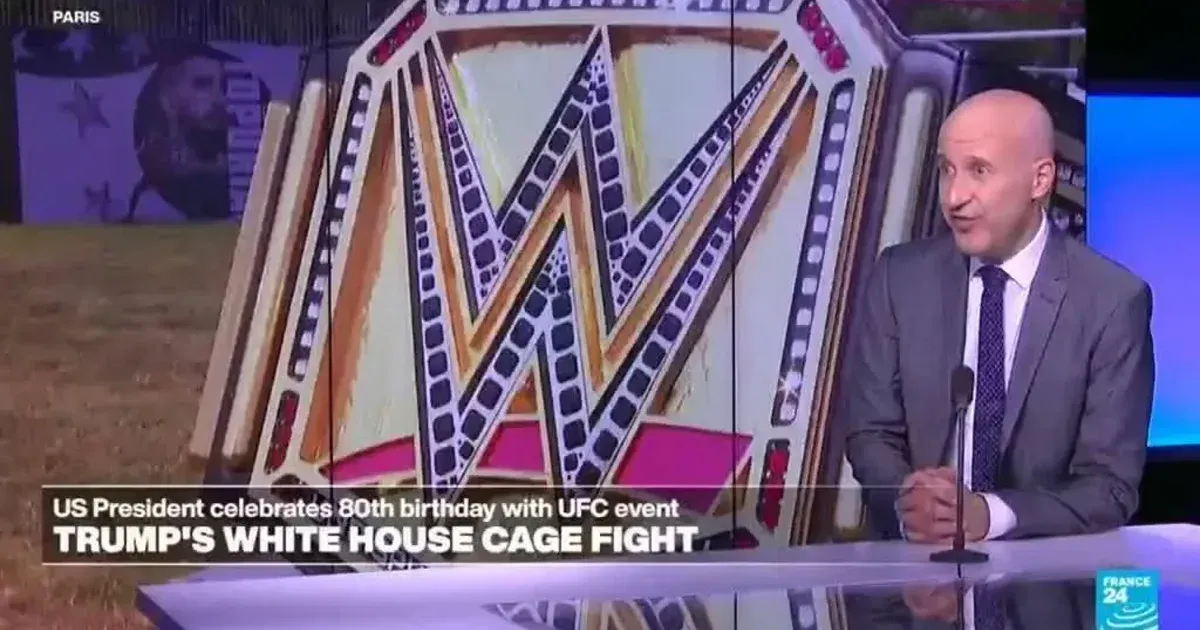
President Donald Trump marked his 80th birthday by turning the White House South Lawn into a UFC venue. The birthday plan also turned a personal milestone into a federal-stage spectacle. Security, guest access and political image-making now sit inside the same event. The event took place on June 14, 2026, and was tied to the administration's Freedom 250 rollout for the 250th anniversary of American independence. A temporary octagon, large screens, patriotic staging, and a steel overhead structure known as the Claw replaced the usual ceremonial look of the grounds. The result was an official setting with the atmosphere of a televised fight night.
Admission to the South Lawn event was invitation-only, with more than 4,000 guests expected inside the secured area. Larger crowds gathered around Washington to watch associated events and protest nearby. UFC promoted seven bouts, including title fights, while the production relied on heavy lighting, broadcast equipment, military-style pageantry, and corporate sponsorship. Fighters and guests moved through a security environment closer to a national ceremony than a normal arena card.
The setting made the night more than a birthday party.
Trump has long used combat sports as a political stage, and his relationship with UFC chief Dana White dates back decades. The White House event extended that alliance into the most symbolic federal property in the country. Supporters cast the show as a celebration of toughness, national pride, and the coming anniversary year. Critics saw a commercial sports spectacle placed too close to the presidency itself. That divide shaped coverage before the first fight began.
Freedom 250 Meets UFC Branding
The administration linked the fight card to Flag Day and the wider semiquincentennial campaign. That framing gave the event a public commemoration label, even as UFC, media partners, and sponsors gained a rare backdrop. The use of the White House grounds for professional cage fighting had faced a legal challenge, but a judge declined to stop the event before it went ahead. The ruling cleared the immediate path, while leaving the political dispute over public space and private spectacle unresolved.
Dana White and UFC executives treated the South Lawn card as a once-in-a-generation promotional moment. Reports described a production budget reaching tens of millions of dollars, with sponsors and streaming partners positioned around the broadcast. Fighters were presented through patriotic cues, and the staging leaned heavily on images of strength, military display, and national spectacle. That language fit the anniversary campaign, but it also gave UFC a visual association no sports league normally receives.
The political timing sharpened the response. The event unfolded while the United States was still dealing with war in Iran, inflation pressure, and volatile oil markets. Opponents argued that a fight show on public federal land sent the wrong signal during a period of strain. Supporters countered that the event was a high-profile national celebration and a show of confidence. The White House leaned on the anniversary framing to separate the program from a purely personal birthday celebration.
Protests and Optics Around the South Lawn
Protesters near the White House denounced the event as inappropriate, commercialized, and militaristic. Some groups framed the night as a symbol of corruption because of Trump's personal ties to combat-sports figures and the presence of major sponsors. Others objected to the image of an octagon on grounds traditionally reserved for state ceremonies, holiday events, and diplomatic receptions. The criticism was not only about mixed martial arts; it was about who gets to use the presidency's most visible stage.
Jeffrey Sonnenfeld, the Yale leadership scholar who has often analyzed Trump's public style, was among the commentators who questioned the spectacle. His criticism fit a broader argument that the event blurred personal celebration, state symbolism, partisan image-making, and private entertainment branding. The White House defended the night as a patriotic celebration rather than a private birthday show. That defense may satisfy supporters who value the combative imagery, but it is unlikely to settle concerns about precedent.
The event also showed why Trump continues to favor visual politics. A cage, a crowd, a flyover, and a birthday milestone are easily understood images. They communicate energy without requiring a policy speech. For a president turning 80, that symbolism mattered as much as the fight results. The South Lawn became a screen for arguments about age, strength, media power, sponsorship, public property, and the boundary between governing and performance. Those arguments will likely outlast the card because the image of a cage beside the executive mansion is difficult to separate from the office itself.
Freedom 250 will now carry the memory of its opening spectacle. Whether voters view the South Lawn fight card as bold patriotic theater or a breach of presidential restraint will depend less on the bouts themselves than on the larger political climate that follows. If the anniversary year becomes a series of civic events, this night may look like an unusual launch. If controversy keeps building, it may be remembered as the moment the White House fully embraced sports-entertainment politics. The birthday staging also forced advisers to defend the line between official celebration, campaign spectacle and private entertainment. Opponents are likely to use that mix as evidence that the White House is normalizing a permanent show-business atmosphere.