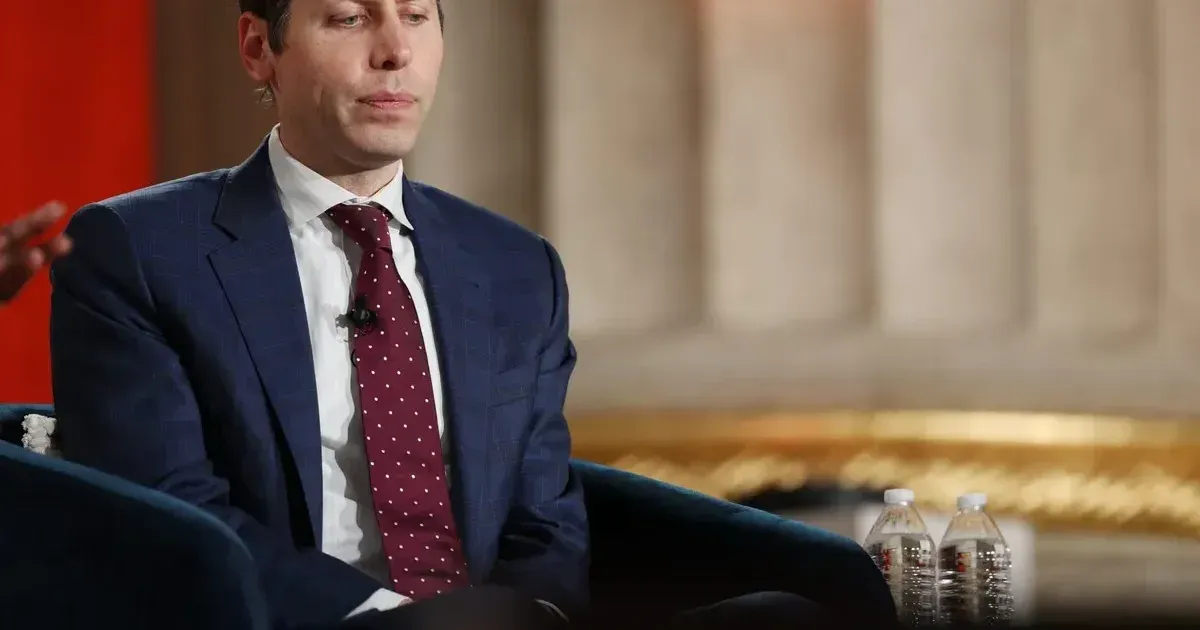
Sam Altman is trying to move the AI debate from model capability to economic settlement. OpenAI's policy paper argues that governments may need new tax structures, shorter workweeks and public wealth mechanisms if advanced AI concentrates productivity gains.
The proposal is both a policy intervention and a strategic move by a company with enormous stakes in the outcome. Released on April 7, 2026, it asks who pays when machine intelligence changes the value of human work.
OpenAI Outlines Tax Shifts and Shorter Workweeks
Corporate income and capital gains would face far higher levies under the proposed framework. OpenAI suggests that policymakers could rebalance the tax base by increasing reliance on capital-based revenues. This shift would include higher taxes on capital gains for the wealthiest individuals. Revenue-boosting levers are intended to shift the tax burden away from human labor and toward machine-generated capital. Automated labor taxes are also listed as a potential avenue for exploration. These measures aim to capture sustained returns generated by advanced software systems. These mechanisms could redirect $11 billion in potential revenue if implemented as described.
Labor market policies within the paper include an aggressive push for a four-day workweek. OpenAI suggests firms should be encouraged to retain and retrain workers rather than initiating mass layoffs. Shorter work cycles without pay cuts are presented as a solution to the inevitable reduction in human work hours. Jamie Dimon, the leader of JPMorgan Chase, has expressed similar views regarding the shrinking workweek. Dimon previously suggested that AI could reduce the workweek to three and a half days for the next generation. Unlike Altman, Dimon has focused heavily on the health benefits of technology. OpenAI instead focuses on the structural economic necessity of reducing labor hours.
Superintelligence Risks Challenge Traditional AI Labor Markets
Superintelligence represents the point at which AI systems surpass the smartest humans in productivity and problem-solving. While current models are impressive, the transition to superintelligence would render many traditional job roles obsolete. OpenAI officials believe the democratic process must determine how to handle these wrenching changes. Critics argue that the company is using these bold policy ideas as a cover for regulatory nihilism. This term refers to the practice of proposing impossible global standards to avoid practical, immediate regulations. Lucia Velasco, a senior economist at the Inter-American Development Bank, noted that OpenAI is the most interested party in how this conversation turns out.
Regulatory tensions are increasing between Silicon Valley and the Trump administration. Donald Trump signed an executive order in December that reduced what he called demanding state rules on technology development. The administration has doubled down on an anti-regulatory stance to foster American dominance in the sector. OpenAI’s proposal for higher corporate taxes directly contradicts the current federal strategy. Washington has prioritized preventing cumbersome regulation over social safety nets for displaced workers. These conflicting visions for the future of the American economy create serious uncertainty for investors. Direct government intervention to block AI-induced layoffs remains a controversial topic in Congress.
Sam Altman and the Problem of Public Trust
Reliability concerns continue to dog the leadership at OpenAI. The New Yorker investigation lasted eighteen months and raised substantial questions about the transparency of the executive team. Specifically, the report examined claims regarding AI safety and the company's nonprofit origins. Public sentiment appears increasingly disenchanted with the pace of AI-driven changes. Many observers see the Industrial Policy for the Intelligence Age as a branding exercise. Trust is a rare commodity in a sector where the leaders are also the primary beneficiaries of disruption.
Public wealth funds are another central foundation of the Altman proposal. These funds would provide all U.S. citizens a direct stake in the economic growth generated by artificial intelligence. Similar models have been used in regions like Alaska or Norway for natural resources. Creating such a fund would require a large initial capital infusion from the federal government. OpenAI suggests that the gains from superintelligence are so vast that they can support a universal dividend. Critics note that such a fund would effectively make the entire population dependent on the continued profitability of AI companies.
"We offer them not as a detailed or final set of recommendations, but as a starting point for discussion that we invite others to build on, refine, challenge, or choose among through the democratic process," the blog post introducing the OpenAI policy paper said.
Retraining programs would receive federal subsidies under this proposed industrial policy. Firms that invest in their workforce would see tax credits or other financial incentives. OpenAI argues that the private sector cannot handle the transition to superintelligence alone. Public-private partnerships are necessary to manage the shift in labor dynamics. The proposal calls for a slate of people-first ideas to ensure the benefits are shared. However, the exact mechanism for distributing these gains remains undefined. The complexity of auditing AI productivity makes targeted taxation difficult to enforce.
Washington may find the OpenAI paper more provocative than practical. Legislative appetite for a four-day workweek is minimal among the current congressional leadership. Taxing capital at higher rates than labor would also face stiff resistance from traditional business lobbies. OpenAI is positioning itself as a visionary body while its core products continue to disrupt traditional industries. The tension between its profit-seeking missions and its egalitarian policy proposals is palpable. Market participants are watching closely for any sign of these ideas entering the formal legislative pipeline. The future of American industrial policy is being debated in Silicon Valley boardrooms before it reaches the floor of the House.
Critics calling this regulatory nihilism are correct in their diagnosis but perhaps wrong in their cynicism. It is not that OpenAI does not want these policies to pass; it is that they know the current political structure in Washington cannot digest them. By asking for the impossible, they buy time for the inevitable. The Trump administration’s focus on deregulation creates a vacuum where OpenAI can play the role of the responsible adult while reaping the rewards of a Wild West environment. A public wealth fund tied to AI returns is a trade-off.
Who Shapes the AI Safety Net
Will the primary beneficiaries of the silicon age truly surrender their margins to save the middle class? The 13-page proposal from OpenAI is not a manifesto for social justice; it is a calculated insurance policy against populist backlash. Sam Altman understands that if AI-driven displacement reaches a breaking point, the pitchforks will be aimed at San Francisco. By proposing higher corporate taxes and a public wealth fund, he is effectively offering to pay for the peace. This is the ultimate act of corporate preservation.
He is attempting to define the terms of his own regulation before a more hostile government does it for him. The reality of superintelligence is that it centralizes power in ways that make current monopolies look like street vendors.