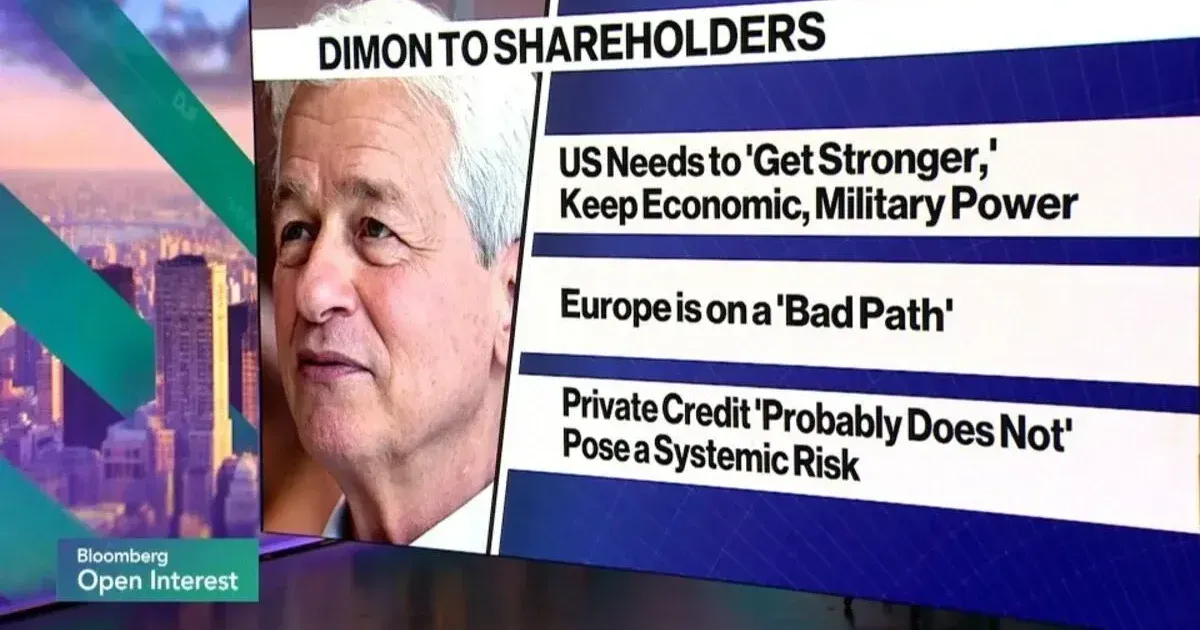
Jamie Dimon is framing national strength as a business necessity. His shareholder letter ties JPMorgan's capital deployment to supply chains, defense capacity and the risk of a recessionary shock.
Private capital is being positioned as a strategic shield.
That framing gives the letter political weight.
Jamie Dimon issued a stern directive to shareholders on April 6, 2026, asserting that JPMorgan Chase will dedicate $1 trillion to shore up American national security and economic resilience. His annual letter, a document often treated as a private-sector state of the union, argues that the domestic economy faces structural threats from global instability and internal fiscal decay. Dimon specifically called for a steady alignment between private capital and government policy to protect the competitive advantages of the United States. Analysts at Bloomberg noted that this capital deployment aims to secure supply chains and critical infrastructure over the next decade.
JPMorgan Commits $1 Trillion to National Economic Strength
Strategic investments will prioritize American manufacturing and advanced technology development to reduce dependence on adversarial trade partners. JPMorgan Chase intends to use its enormous balance sheet to fund projects that the public-sector has struggled to finance due to legislative gridlock in Washington. Capital allocation will target domestic semiconductor production, maritime security, and aerospace engineering. Dimon noted that the strength of the dollar and the stability of the global order depend on the underlying health of the American industrial base. The bank has already begun vetting large-scale infrastructure projects that qualify for this initiative.
While Bloomberg reports focus on the sheer scale of the $1 trillion pledge, MarketWatch sources highlight the defensive nature of this move. Dimon appears to be bracing for a period of prolonged volatility where private institutions must fill the void left by overextended government budgets. He wrote that the nation must get stronger to maintain its standing among global peers. This requires a departure from short-term profit motives in favor of securing the national environment in which the bank operates. Domestic stability is now a requirement for banking profitability.
"The US needs to get stronger to maintain its military and economic might," Jamie Dimon wrote in his annual letter to shareholders.
Geopolitical Volatility and the Skunk at the Party
Recession risks have surged as Jamie Dimon warned of a "skunk at the party" threatening the 2026 fiscal outlook. This metaphor describes the potential for unexpected shocks to derail what many analysts previously considered a stable recovery. Rising oil prices have become a primary concern for the executive team at JPMorgan Chase. MarketWatch reported that Dimon views energy costs as the most immediate catalyst for a stock market selloff. Global supply disruptions continue to exert pressure on consumer prices and industrial output.
Energy markets have reacted to Dimon's commentary with increased sensitivity as traders weigh the possibility of a 2026 bear market. Crude prices have stayed at elevated levels because of persistent conflicts in the Middle East and Eastern Europe. High fuel costs act as a regressive tax on the American consumer, draining the excess savings that supported growth in previous quarters. Dimon warned that if oil prices do not stabilize, the Federal Reserve may be forced to maintain higher interest rates for longer than the market anticipates. Such a scenario would tighten credit conditions across the entire financial system.
Dimon Forecasts Persistent Inflation and Market Selloffs
Market participants are now pricing in a higher probability of a recession following the explicit warnings regarding the 2026 outlook. Dimon noted that inflation could be stickier than the consensus view suggests, potentially leading to a sharp correction in equity valuations. Rising interest rates have already cooled the housing market and reduced venture capital activity. If inflation remains above the two percent target, the cost of servicing the national debt will continue to consume a larger portion of the federal budget. The dynamic limits the government's ability to respond to a sudden economic downturn.
Equity markets saw a modest decline in the hours after the letter was publicized by major news outlets. Traders pointed to Dimon's track record of accurately predicting shifts in the credit cycle as a reason for the cautious reaction. While some analysts believe the "skunk at the party" is already priced in, others fear that the full impact of higher oil prices has yet to be felt. Dimon argued that a bear market in 2026 is a distinct possibility if the US does not address its fiscal imbalances. Corporations are being urged to build cash reserves to survive a potential liquidity crunch.
It also protects the bank's own interests.
JPMorgan Chase plans to integrate these funds into sectors that directly support defense capabilities and energy independence. National power, in his view, is no longer a matter of military spending alone. Economic dominance and technological superiority constitute the new front lines of geopolitical competition. Dimon emphasized that the bank is positioning itself as a central facilitator for this long-term industrial pivot. Shareholders received a clear message that the status quo of the last twenty years is no longer sustainable under current global conditions.
Private Capital and National Power
Does the CEO of the world's most powerful bank believe he is the de facto head of American industrial policy? The letter released by Jamie Dimon on April 6, 2026, is a document of deep institutional arrogance disguised as national service. By pledging $1 trillion to "strengthen" the United States, Dimon is effectively declaring that the federal government is no longer capable of executing its primary duties. This goes beyond a bank allocating capital; it is a sovereign entity masquerading as a financial institution. He is positioning JPMorgan Chase as the ultimate backstop for a failing state, a move that should terrify anyone who believes in democratic oversight of national strategy.
The metaphor of the "skunk at the party" is a convenient cover for the bank's own role in creating the conditions for a 2026 recession. Years of aggressive lending and the exploitation of low-rate environments have left the system fragile. Now, as the bill comes due in the form of persistent inflation and energy shocks, Dimon is attempting to pivot toward a narrative of patriotic resilience. Investors should see this for what it is: a preemptive strike against the inevitable public anger that follows a market collapse. The message is that the bank is too big to fail, too rich to ignore and too powerful to be governed—a concentration of influence that leaves democratic oversight badly outmatched.