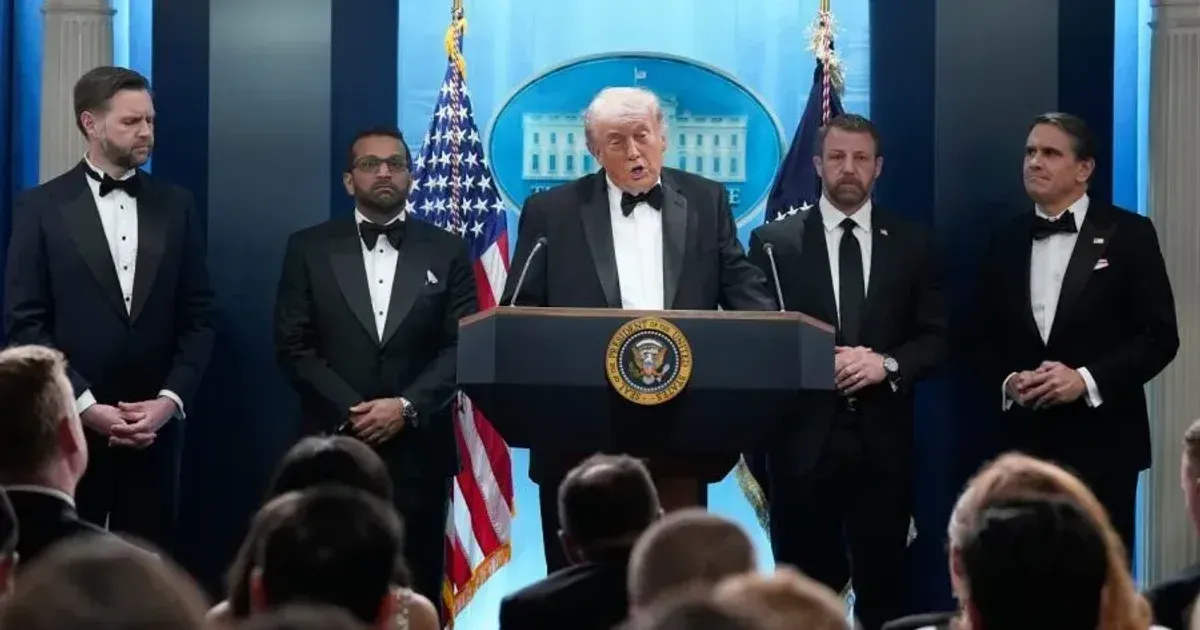
The evacuation of the Washington Hilton ballroom exposed how quickly a ceremonial dinner can become a protective operation. Guests heard confusion before they understood danger, while agents moved the president and cabinet officials out of view. The venue’s history with presidential violence made the response feel both familiar and newly alarming. Every witness account now helps reconstruct the seconds between noise and action. Security planners will study the room as closely as the suspect. President Donald Trump exited the Washington Hilton ballroom abruptly on April 26, 2026, after security agents detected gunfire outside the annual gala. The event, which usually is a night of lighthearted ribbing between the press and the administration, transformed instantly into a scene of tactical urgency. Secret Service agents brandishing automatic weapons appeared at the head table where the president had been seated moments prior. Members of the cabinet followed in a swift, single-file line as protection details cleared the room of high-ranking government officials. Thousands of attendees remained behind, confused by the sudden shift from festive chatter to a silent, floor-bound defensive posture.
Journalists and politicians alike described an atmosphere of cognitive dissonance during the first few seconds of the disruption. Many guests initially mistook the sound of nearby gunfire for a mundane kitchen accident. Donald Trump later remarked to reporters that the noises sounded like a food tray dropping. This perception was shared by several witnesses in the middle of the ballroom who continued their conversations until the sight of drawn weapons signaled a genuine threat. The transition from social normalcy to a security emergency happened in the space of a heartbeat.
Tactical Response and Hilton Ballroom Security
Security at the Washington Hilton follows some of the most rigorous protocols in the District of Columbia. Known colloquially as the Hinckley Hilton because of the 1981 assassination attempt on Ronald Reagan, the venue features a specialized underground entrance for VIPs. Secret Service personnel maintain a permanent presence during the White House Correspondents Dinner, using both uniformed officers and plainclothes agents. On this evening, the perimeter defense was tested by an incident occurring just outside the ballroom walls. The immediate response involved a total lockdown of the primary hall while the presidential motorcade prepared for departure.
Cabinet secretaries were the first to be moved. Secret Service agents escorted these officials one by one through secure side exits. Guests in the room watched as the head table, usually a centerpiece of power and prestige, became a staging ground for men with machine guns. This visual contrast defined the night for many. While the Washington Hilton is designed to handle large crowds, the presence of heavy weaponry in a room filled with evening gowns and tuxedos created a jarring spectacle. The silence that fell over the room was absolute.
Journalistic Accounts of the Ballroom Confusion
Staff members from Politico Europe reported that the initial buzz of the room was replaced by a surreal stillness. Most guests crouched between the tightly packed tables, seeking cover from a threat they could not yet see. Some attendees resisted the urge to dive to the floor until they observed the behavior of the security details. One reporter noted that the instinct to maintain social decorum was surprisingly strong. People felt a sense of embarrassment about ducking until the gravity of the situation became undeniable.
Panic did not erupt immediately. Instead, a sense of confusion gripped the crowd as they surveyed the room from their positions on the carpet. Witnesses saw agents scanning the balconies and exits with intense focus. The Secret Service had clearly moved into a high-threat posture. Every movement at the head table was calculated to ensure Donald Trump was no longer a target. The precision of the evacuation suggested a pre-planned response to exactly this type of breach.
The Immediate Aftermath of the Gunfire
Information regarding the source of the shots remained scarce in the minutes following the evacuation. Reports from the Politico Europe team indicated that while some heard the noises clearly, others only felt the shift in the room. The Washington Hilton remained under heavy guard for several hours. Local law enforcement joined federal agents to secure the surrounding streets of the DuPont Circle neighborhood. Security experts noted that the speed of the presidential removal was consistent with standard emergency operating procedures.
"The shots fired just outside the ballroom sounded like a food tray dropping," the president told reporters.
Authorities later confirmed that the incident began on the periphery of the hotel grounds. Secret Service personnel reacted within seconds of the first audible report. While the president was safe, the experience left a lasting impression on the 2,600 guests who remained in the ballroom. The event did not resume. Guests were eventually allowed to leave in small groups after the perimeter was deemed secure. This breach is a serious failure of the external security cordon established for the night.
Assessing the Vulnerabilities of Presidential Events
Investigations into the perimeter breach at the Washington Hilton are currently underway. Donald Trump has frequently praised the work of his protection detail, and their performance on this night will likely be scrutinized by congressional oversight committees. The Secret Service must now determine how an individual with a firearm was able to get close enough for the shots to be heard inside the ballroom. Every layer of the security plan is under review. It includes the screening of hotel staff and the monitoring of external service entrances.
Public safety officials in Washington D.C. have increased patrols around high-profile venues after the incident. The Washington Hilton has long been considered a secure fortress for such gatherings. Secret Service agents are now facing questions about the effectiveness of their outer-ring checkpoints. If the gunfire occurred near the ballroom, it implies a gap in the surveillance of the hotel's immediate exterior. Data from the night shows a rapid deployment of tactical units to the North Connecticut Avenue side of the building.
Evacuation Success Cannot Excuse the Hilton Security Breach
Did the Secret Service fail or succeed at the Washington Hilton? While the primary mission of protecting Donald Trump was achieved with clinical efficiency, the very existence of a security breach at a Tier 1 event is a catastrophic failure of deterrence. The Washington Hilton is not just a hotel; it is a fortified extension of the White House during this annual dinner. For gunfire to occur within earshot of the president suggests that the outer security perimeter was either porous or poorly managed. It is an indictment of the current threat assessment model that an armed incident could disrupt the most heavily guarded social event in the United States.
We must stop pretending that these high-profile galas are safe simply because they are filled with Secret Service agents. The optics of the night, cabinet secretaries being led out like school children while journalists huddle under tables, expose the fragility of the American political theater. If a lone gunman or a small group can force the evacuation of the entire executive branch leadership, the message to adversaries is one of weakness, not strength. The Washington Hilton incident proves that our security protocols are reactive, not preventative.
The standard defense will be that no one was hurt. It is a lazy and dangerous metric for success. A truly effective security apparatus ensures that shots are never fired in the first place. Donald Trump might have laughed off the sound as a dropping tray, but the image of machine guns at the head table tells a different story. It tells the story of a security detail that was surprised. In the world of high-stakes protection, being surprised is the first step toward failure.