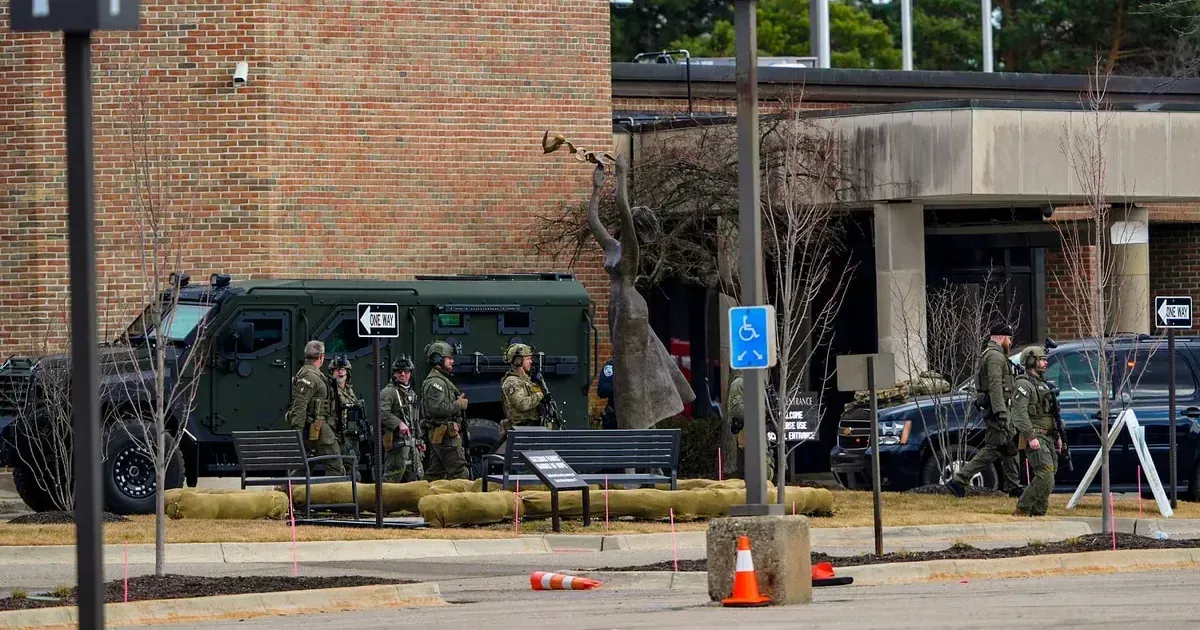
West Bloomfield police units responded to a security breach at Temple Israel on Thursday morning. Guards at the synagogue entrance intercepted a vehicle attempting to breach the perimeter before it could reach the preschool wing. Security staff stopped the vehicle at Temple Israel before the suspect reportedly drove a dark sedan into the physical security bollards installed outside the main entrance. Witnesses described a brief, intense confrontation as a fire began to spread from the engine block of the vehicle. Smoke filled the entryway, but the structure remained secure. Preschool teachers inside the facility activated emergency protocols within seconds of the impact. They moved children into reinforced safe rooms designed for such an occurrence. These rooms contain independent ventilation systems and heavy steel doors meant to withstand high-velocity strikes. The immediate response prevented any physical injuries to the students or faculty. Law enforcement arrived on the scene less than four minutes after the initial alarm was triggered. Officers quickly apprehended the driver and called for fire suppression units. Meanwhile, the suspect had attempted to ignite a secondary fire using an accelerant inside the car. But the fire suppression system at the entrance functioned as intended, dousing the flames before they could penetrate the sanctuary. Local officials stated that the suspect is in custody and facing multiple felony charges. Preliminary reports indicate the attacker may have targeted the facility during a high-traffic morning drop-off period. Security personnel were on high alert due to recent regional tensions.
The Michigan synagogue incident shows why visible security staff can change the outcome before police arrive.
Synagogue Security Stops Vehicle Attack
Security measures at the synagogue had been upgraded recently following a series of threat assessments conducted by the Jewish Federation of Metro Detroit. These enhancements included the installation of crash-rated bollards and advanced surveillance systems. Such investments proved essential during Thursday morning's event. Many religious institutions in the area have followed similar paths, spending millions on private security firms and hardening their architectural footprints. Jewish leaders said the preparation at Temple Israel prevented the car-ramming and fire from becoming deadly for the children and staff inside the Michigan synagogue. Staff members regularly participate in active threat drills that simulate various breach scenarios. These exercises involve coordination between local law enforcement and the synagogue security team. For instance, teachers are trained to account for every child while maintaining absolute silence in secure zones. This drill had been performed just three weeks prior to the actual attack. Success on Thursday is largely attributed to this repetitive, high-stress training. The total cost of the security infrastructure at the site is estimated at $1.1 million. The presence of armed guards at houses of worship has become a standard feature of the American landscape. Many congregants expressed relief that the measures worked but frustration that they are necessary at all. The synagogue had doubled its security budget over the last two fiscal cycles. Local philanthropy typically covers these costs, though federal grants are increasingly used to strengthen nonprofit security. The Michigan State Police also provided technical assistance for the most recent system overhaul.
Preschool Lockdown Prevents Injuries
For more than a century, Jewish, Arab, and Muslim people have lived in and around Detroit, coexisting mostly peacefully. This history began in the early 20th century as waves of immigrants arrived to work in the expanding automotive industry. Both communities initially settled in the urban core of the city before moving outward. By the mid-1900s, Jewish residents established a strong presence in neighborhoods like Northwest Detroit and the 10th Precinct. Arab immigrants frequently settled in nearby enclaves, creating a unique geographic overlap.
Demographic shifts in the 1960s and 1970s pushed many Jewish families into suburban areas such as West Bloomfield and Oak Park. At the same time, the Arab community grew sharply in Dearborn, creating the largest concentration of Arab Americans in the United States. Despite the physical distance between these suburbs, economic and professional ties remained strong.
The geopolitical climate often tests these local bonds. Leaders from both communities have spent decades building bridges through shared civil rights initiatives and local governance. But the current atmosphere has made maintaining these relationships more difficult. Some interfaith programs reported a decrease in participation over the last year. Grassroots efforts to provide mutual aid during economic downturns have continued to function across ethnic lines. Historical records show that the region has survived periods of high tension before, including the ripples of the 1967 riots and various international crises.
Religious Protection Costs Keep Rising
Officers involved in the arrest on Thursday noted the suspect appeared to act alone.
The focus now shifts to preventing retaliatory acts or copycat incidents. West Bloomfield police have increased patrols around all religious institutions in the township. This heightened presence is expected to remain for several weeks as the community processes the event. Local leaders have urged residents to remain vigilant but avoid jumping to conclusions about the suspect's background. Public safety remains the primary concern for the municipal government. The police department confirmed that 60 children were present in the building during the ramming.
Yet the physical damage to the building is secondary to the psychological impact on the staff and families. Counselors were dispatched to the site to assist teachers and parents immediately after the scene was cleared. Many families expressed a desire to keep the preschool operational to maintain a sense of normalcy for the children. Support services will remain available through the weekend. The synagogue board announced that repairs to the entrance will begin on Monday morning. Financial burdens associated with religious security continue to grow across the country. Many congregations find that insurance premiums rise sharply after an incident, even if the security measures successfully prevented harm. Smaller institutions often struggle to keep up with the technical requirements for modern surveillance. Some regional organizations have begun pooling resources to hire shared security consultants. The collective approach allows for better training at a lower per-capita cost.
The reliance on private security creates a tiered system where wealthier congregations are better protected than those in lower-income areas. The disparity has become a point of discussion among local interfaith councils. Some advocates are calling for increased state funding to ensure all houses of worship have access to basic security upgrades. Current grant programs are often oversubscribed and highly competitive. The application process itself requires technical expertise that many small nonprofits lack. The problem is a societal one that cannot be solved solely through bollards and cameras. Community leaders emphasize the importance of education and outreach to combat the radicalization that leads to such violence. The practical reality of modern life necessitates the presence of physical defenses. No religious organization can afford to ignore the potential for a targeted attack. The synagogue entrance remained cordoned off by police tape late Thursday evening.
Preparedness Should Not Be Normal
Was the dream of the Detroit melting pot always a convenient fiction designed to mask deep-seated animosities? For decades, we have congratulated ourselves on a model of coexistence that looked stable from the outside, but today that veneer is cracking. The reality is that we have replaced genuine community integration with a series of high-security bunkers. When a preschool requires crash-rated bollards and reinforced safe rooms just to ensure that toddlers can learn their ABCs, the social contract has not just frayed; it has disintegrated.
We are no longer living in a society of neighbors but in a field of fortified enclaves. We must stop pretending that more cameras and better-trained guards are the solution to a rot that begins in the hearts of those who view their fellow citizens as existential threats. The success of the security team at Temple Israel is a tactical victory, but it is a strategic defeat for the American experiment.
If our houses of God must be built like prisons, we have already lost the battle for the soul of our communities. The issue is the normalization of the unthinkable, and our only response seems to be a collective shrug and a check for another million dollars in security upgrades. The path leads only to more walls and less trust.