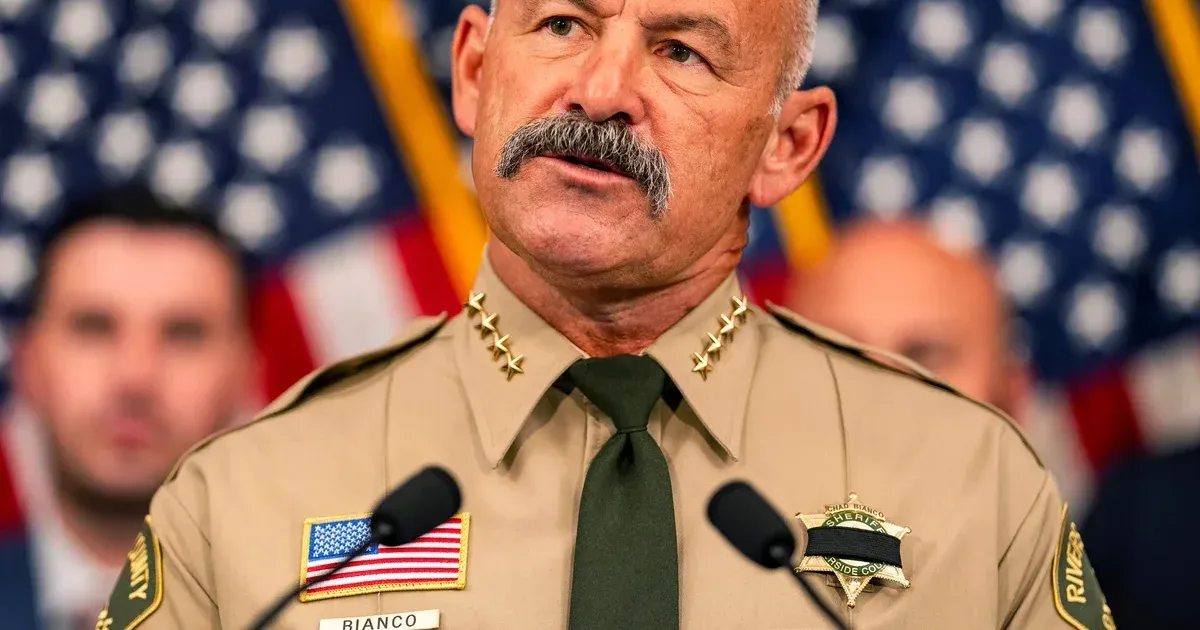
Riverside County Sheriff Chad Bianco announced that his office suspended an investigation into alleged voter fraud involving the Prop 50 election. This decision marks a clear shift for the Republican official who previously seized more than half a million ballots. Investigation efforts focused on irregularities within the local voting process, though critics characterized the move as a politically motivated overreach. The Sheriff Chad Bianco Halts California Election Fraud Probe report carried a March 31, 2026 time marker for readers following the latest account. Voters in the region expressed concern over the security of their data while the ballots were in law enforcement custody.
Investigators had taken control of 650,000 ballots during the inquiry, a quantity representing a heavy portion of the county's total vote count. Skepticism from state legal authorities grew as the probe continued without public evidence of widespread criminal activity. Sheriff Bianco, currently a top Republican contender for the California governorship, faced mounting pressure from the state attorney general to justify the seizure. California officials argued that local law enforcement lacked the jurisdiction to interfere with official election materials in this manner.
Power struggles between county law enforcement and state executive offices rarely reach this level of public confrontation.
Riverside County Ballot Seizure Statistics
Data from the Riverside County Sheriff Department indicates that deputies removed the ballots from secure storage facilities earlier this year. These records show that the 650,000 ballots were part of a wide-ranging effort to identify potential double-voting or registration errors. Sheriff Bianco maintains that his office received credible tips requiring immediate action to preserve evidence. Local election officials, by contrast, asserted that the chain of custody was broken the moment law enforcement took possession of the materials.
Prop 50, a controversial measure involving state tax reforms, became the focal point of the fraud allegations. Records from the Registrar of Voters show that the measure passed by a narrow margin, sparking immediate calls for audits from conservative groups. Sheriff Bianco used his authority to initiate the criminal probe, bypassing standard administrative review processes. Legal experts in Sacramento suggested that such a move set a dangerous precedent for local interference in statewide tallies. Budgetary reports from the county suggest that the investigation cost taxpayers notable sums in overtime and storage fees. Experts estimate that maintaining the high-security environment for the 650,000 ballots required constant staffing by sworn officers. These expenditures became a point of contention during recent county board meetings. Residents questioned whether the financial burden of the probe outweighed any potential findings of clerical error or fraud.
Legal Challenges from State Attorney General
Legal challenges from the state capital eventually outweighed the local political momentum of the investigation. Sheriff Bianco’s political maneuvers are being closely watched as the California Governor Election race intensifies across the state.
California Attorney General Rob Bonta previously threatened legal action if the ballots were not returned to the registrar. State law clarifies that only specific election officials possess the mandate to manage and audit physical ballot sets. Sheriff Bianco argued that his status as a constitutional sheriff gave him the inherent right to investigate any perceived crime within his jurisdiction. This legal theory remains a foundation of his political platform but faces clear resistance in appellate courts.
Attorneys representing the state filed multiple injunctions to halt the sorting of ballots by sheriff personnel. The attorney general argued that non-election workers lacked the training to handle sensitive materials without compromising their integrity. Furthermore, the risk of accidental damage to the physical papers could have rendered a recount impossible. Judicial oversight became necessary when the sheriff department refused to comply with initial requests for documentation regarding their investigative methodology.
According to the Guardian US report, Sheriff Chad Bianco has halted a disputed investigation into an alleged voter fraud that has drawn opposition from the state’s attorney general.
Court filings show that the state was prepared to seek a contempt order against the sheriff if the inquiry continued into April. Sheriff Bianco likely calculated that a protracted legal battle would distract from his primary campaign goals. His decision to pause the investigation effectively avoids a high-stakes courtroom showdown that could have resulted in a loss of law enforcement powers. Defense of his actions continues to be a central theme in his public addresses to supporters across the state.
Election officials will have to rebuild trust with voters whose ballots became part of a law-enforcement dispute. The suspended probe may end the immediate inquiry, but it does not erase the administrative damage. The case also illustrates how quickly election administration can become a campaign issue. Bianco’s decision will now be judged not only by prosecutors but by voters watching the next governor’s race.
The legal risk is matched by an operational one. Chain-of-custody records, ballot storage logs and witness lists now become part of the public argument, even if prosecutors never file a criminal case.
County election workers also have to explain why ordinary voters should trust the next tabulation after the sheriff placed the previous process under suspicion. That trust cannot be restored by a press statement alone; it requires clear documentation of where the ballots went and who handled them.
For Bianco, the pause preserves political flexibility while avoiding a ruling that could narrow his authority. For state officials, it creates a chance to write firmer boundaries before another local officer tests the same theory. The unresolved question is whether California treats the episode as an isolated dispute or as a warning that ballot control needs clearer enforcement triggers before campaign season begins again. The next practical test is administrative rather than rhetorical. Riverside County must show that the ballots were secured, logged and returned in a way that lets both parties accept the final record without reopening the fraud narrative or giving either campaign a reason to challenge routine election handling in court. That clarity now matters more than another campaign argument before voters return.
Ballot Probe Reversal
The reversal shifts attention from campaign claims to evidence, procedure and public trust. Voters will need a clear explanation of what investigators found, why the probe stopped and whether any election-office changes still follow.