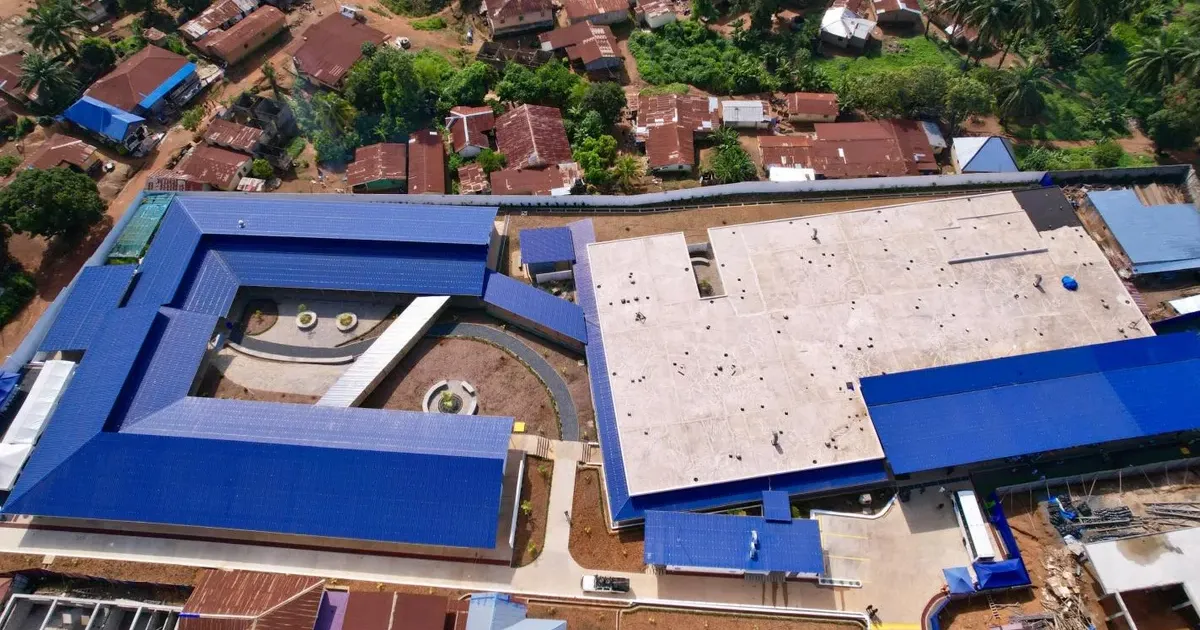
The Paul E. Farmer Maternal Center of Excellence opened to patients in Koidu, Sierra Leone, on February 14, 2026, expanding the maternal and newborn services available at Koidu Government Hospital. The new facility adds beds, operating rooms, neonatal intensive care and referral systems in a country where maternal mortality remains high despite substantial improvement.
WHO estimated Sierra Leone's maternal mortality ratio at 354 deaths per 100,000 live births in 2023, with an uncertainty range from 249 to 537. That national estimate provides the scale of the problem. It does not show what one hospital has already achieved.
The Center Expands Capacity From 48 to 120 Beds
The Sierra Leone Ministry of Health says the center increases the previous maternal ward and special-care baby unit from 48 beds to 120. Partners In Health, the ministry and Build Health International developed the facility on the Koidu Government Hospital campus.
The center includes three operating theaters and a 39-bed neonatal intensive care unit, described by the government and Partners In Health as the country's first NICU. It also has piped medical gases, including oxygen, and separate areas for babies born at the center and those referred from elsewhere.
These additions matter in obstetric emergencies, when delays in surgery, blood, oxygen or neonatal support can turn a treatable complication into a death. A larger building alone cannot remove those delays, but functioning equipment and staffed clinical spaces give teams more capacity to respond.
Opening Day Tested the New Referral System
Partners In Health reported that the center admitted 27 patients and recorded 13 births in its first 24 hours. Seven babies were delivered by cesarean section and six by vaginal delivery.
The first day included emergency surgery for patients with severe pre-eclampsia, fetal distress and prolonged labor. One patient arrived by ambulance after staff at a local clinic identified complications, illustrating the link the center is meant to provide between community facilities and higher-level care.
Those accounts show that the hospital was operating, not merely commissioned. They are not an outcomes study. A small set of opening-day cases cannot establish a reduction in maternal or neonatal mortality, especially when the reports come from an organization involved in running the center.
Training and Systems Are Part of the Design
The Ministry of Health describes the center as a training hub for Sierra Leonean doctors, nurses and midwives. Plans also include a nearby training campus with lecture rooms, simulation rooms, a computer laboratory and accommodation.
That workforce component is as important as the bed count. Operating theaters and intensive-care equipment help only when trained clinicians, biomedical technicians, medicines, blood products, reliable electricity and referral transport are available at the same time.
The model therefore targets several connected constraints rather than presenting a single donated device as a solution. Its durability will depend on recurring budgets, maintenance, staff retention and coordination with clinics that identify and transfer high-risk patients.
A Hospital Is Capacity, Not Proof of National Impact
The center is a concrete increase in Kono District's ability to manage complicated pregnancies and sick newborns. The national mortality estimate also shows why that capacity is needed even after years of progress.
But political statements that the facility will help eliminate preventable maternal deaths remain goals, not measured results. The center had been treating patients for less than a month when the original March 2026 report appeared. It could not yet demonstrate a sustained district-wide change.
Serious evaluation should publish maternal and neonatal deaths, severe complications, referral times, case volume and staffing continuity, with clear denominators and comparison periods. It should also examine whether patients outside Koidu can reach the center before emergencies become irreversible.
The building deserves attention because it creates clinical capacity, not because it completes the job. If the staffing, supplies, transport and public financing fail, the blue roofs will become a monument to an unfinished system. If they hold and outcomes are reported transparently, Koidu can offer evidence for expansion rather than another untested blueprint.