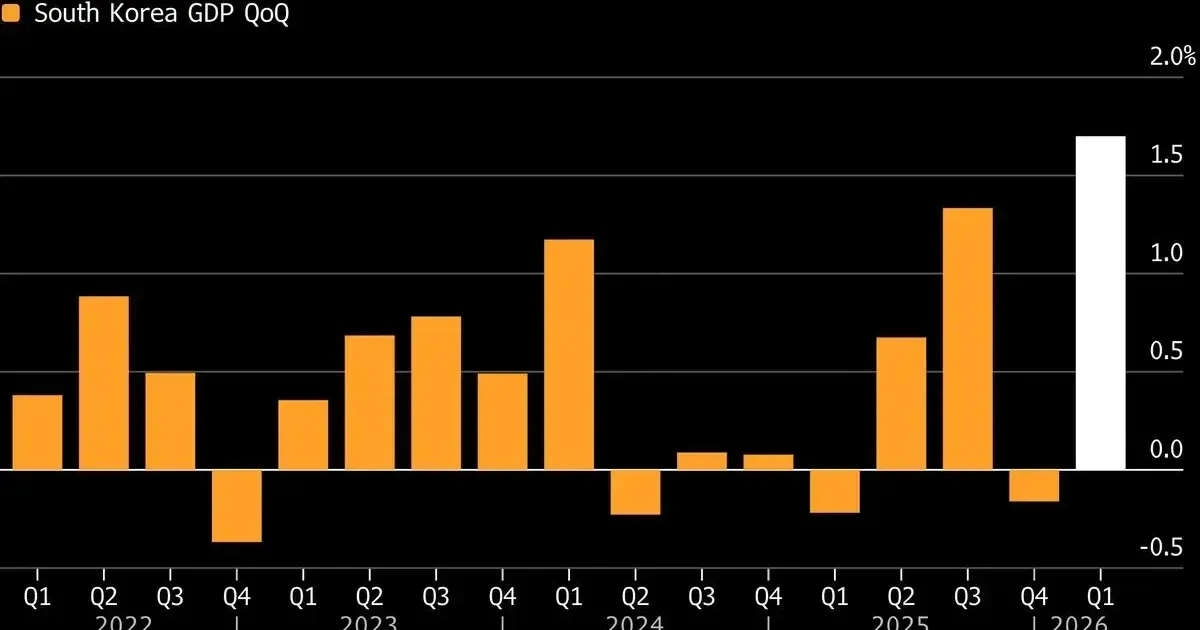
South Korea’s first-quarter rebound beat forecasts as demand for AI infrastructure drove record memory-chip revenue and faster export growth. South Korea reported a sharp economic rebound on April 23, 2026; global demand for artificial intelligence infrastructure triggered a sharp surge in semiconductor exports. Gross domestic product expanded 1.3% in the first three months of the year, outstripping the 0.6% median forecast from economists. Business activity reached levels unseen since the initial post-pandemic recovery phase. Most of this growth stems from the electronics sector, where high-end memory chips have become the primary engine of national wealth. Export volumes for South Korea rose by their fastest margin in years as Western tech giants accelerated their procurement of specialized hardware.
South Korean Export Figures Exceed Growth Forecasts
Data from the Bank of Korea indicates that exports rose 0.9% in the first quarter, while imports fell by 0.7%. Net exports contributed sharply to the overall GDP figure, compensating for stagnant domestic consumption. Private spending remained sluggish due to elevated interest rates and persistent inflation in the service sector. High-end computing components now represent the largest share of outbound shipments. Manufacturers in South Korea are currently operating at near-full capacity to satisfy orders from North American data centers.
Economists at Bloomberg had anticipated a more modest recovery given the high borrowing costs facing local consumers. Government spending also provided a slight lift to the numbers, rising 0.7% during the same period. Construction investment surprised analysts by jumping 2.7% as work resumed on several major industrial complexes. Much of this construction activity is focused on expanding semiconductor fabrication plants in the suburbs of Seoul. Specialized facilities for HBM3E production are receiving the bulk of new capital investment.
Stronger-than-expected growth has prompted several financial institutions to revise their annual outlook for the nation. HSBC and Barclays now expect the Korean economy to expand by more than 2.5% for the full year 2026. This upward revision reflects a belief that the AI hardware cycle is still in its early stages. Previous cycles in the memory market were often short-lived, but the current wave of investment appears more durable. Global server producers are locked in a race to secure long-term supply contracts for SK Hynix products.
SK Hynix Revenue Hits Record Levels
Corporate earnings reports released on April 23, 2026, confirm the enormous scale of the AI-driven profit surge. Memory giant SK Hynix posted its highest-ever first-quarter revenue, reaching a total of $12 billion in sales. Operating profit reached its highest level since the semiconductor boom of 2018. Demand for High Bandwidth Memory (HBM) modules, which are essential for processing the large datasets used by large language models, drove the majority of these gains. The company is now the primary supplier for the leading GPU manufacturers in the United States.
SK Hynix posted yet another quarter of record profit and revenue, as prices for its products continue to surge, the company stated in its first-quarter financial filing.
Pricing for DDR5 and HBM components increased by nearly 25% compared to the previous year. Supply constraints in the advanced packaging segment have allowed vendors to command substantial premiums. SK Hynix officials stated that their 2026 production capacity for top-tier HBM is already sold out. The biggest cloud service providers are building up inventories to avoid future shortages. This inventory accumulation is a major factor in the record-breaking quarterly figures.
Global Memory Chip Prices Propel Korean Recovery
Market dynamics in the DRAM sector have shifted from a glut to a shortage in less than 12 months. Price hikes across the memory spectrum have strengthened the profit margins of South Korea-based firms. Average selling prices for NAND flash memory also stabilized, ending a prolonged period of losses for that specific business unit. Lower-tier manufacturers are struggling to pivot their assembly lines to meet the requirements of the AI era. Leading firms like SK Hynix maintain a technological lead that allows them to capture the most lucrative segments of the market.
Investment in production equipment for 1b-nanometer DRAM processes reached record highs last month. Analysts at CNBC Finance noted that the capital expenditure budgets of major chipmakers are shifting away from general-purpose chips toward specialized AI accelerators. This transition has left some traditional sectors, such as smartphone and PC manufacturing, facing longer lead times for standard components. Capital continues to flow into the specialized infrastructure required to train large language models.
South Korean trade officials are leveraging these results to argue for deeper technology partnerships with the G7 nations. Trade Minister In-kyu Ahn told reporters in Seoul that the nation is now the essential backbone of the global digital economy. Exports to China also showed signs of life, though they remain below the peaks seen in the late 2010s. Diversification of export destinations has helped South Korea reduce some of the risks associated with regional trade tensions. The United States remains the fastest-growing market for high-performance memory.
Artificial Intelligence Infrastructure Demands Advanced Semiconductors
Nvidia and other American design firms are placing orders for millions of memory stacks to pair with their latest processing units. Each new generation of AI hardware requires rapidly more memory bandwidth than its predecessor. The technical requirement creates a steady stream of recurring revenue for SK Hynix. Unlike the consumer electronics market, the enterprise AI market is less sensitive to interest rate fluctuations. High-performance computing clusters represent a mandatory capital expense for any company hoping to remain competitive in the software space.
Production yields for the newest 12-layer HBM3E modules have improved sharply over the last three months. Improved manufacturing efficiency has allowed SK Hynix to beat initial earnings estimates despite the rising cost of raw materials. Logistics costs have also normalized, allowing for smoother distribution to global assembly hubs. Seoul now finds its fiscal health dictated by the procurement cycles of a handful of Silicon Valley giants.
Foreign investors responded to the news by pouring capital into the KOSPI index. Shares of technology companies rose sharply following the GDP announcement. The Bank of Korea may now face pressure to maintain higher interest rates for a longer period to prevent the economy from overheating. Inflationary pressures in the manufacturing sector are beginning to trickle down into the broader economy. High energy costs persist, yet the export boom provides a sufficient buffer to maintain the national trade surplus.
AI Chip Demand Exposes Korea’s Economic Dependency
National economies rarely tether themselves so completely to a single technological trend. South Korea is currently a chip-state, a nation where the entire fiscal apparatus rests on the volatile procurement whims of a few California tech billionaires. While the current record-breaking growth is undeniable, the structural fragility beneath the surface should terrify anyone looking for long-term stability. The nation is building a monoculture of silicon. When the AI investment cycle eventually cools, as all cycles must, Seoul will find itself without a secondary engine to sustain its middle class. Private consumption is already anemic. High-interest rates are crushing the domestic soul of the country while the export data paints a deceptive picture of prosperity.
The picture emerging is a dangerous dependency unfolding in real time. SK Hynix and its peers are currently the darlings of the global market, but their dominance is a function of a temporary supply-demand imbalance. If a competitor in Taiwan or the United States cracks the HBM code, the Korean miracle evaporates overnight. Policymakers are confusing a tactical win in memory prices for a strategic triumph in economic diversification. They are not the same thing. Bet the house on the chip surge if you want short-term gains, but do not pretend this is a sustainable foundation for a modern economy. It is a silicon bubble.