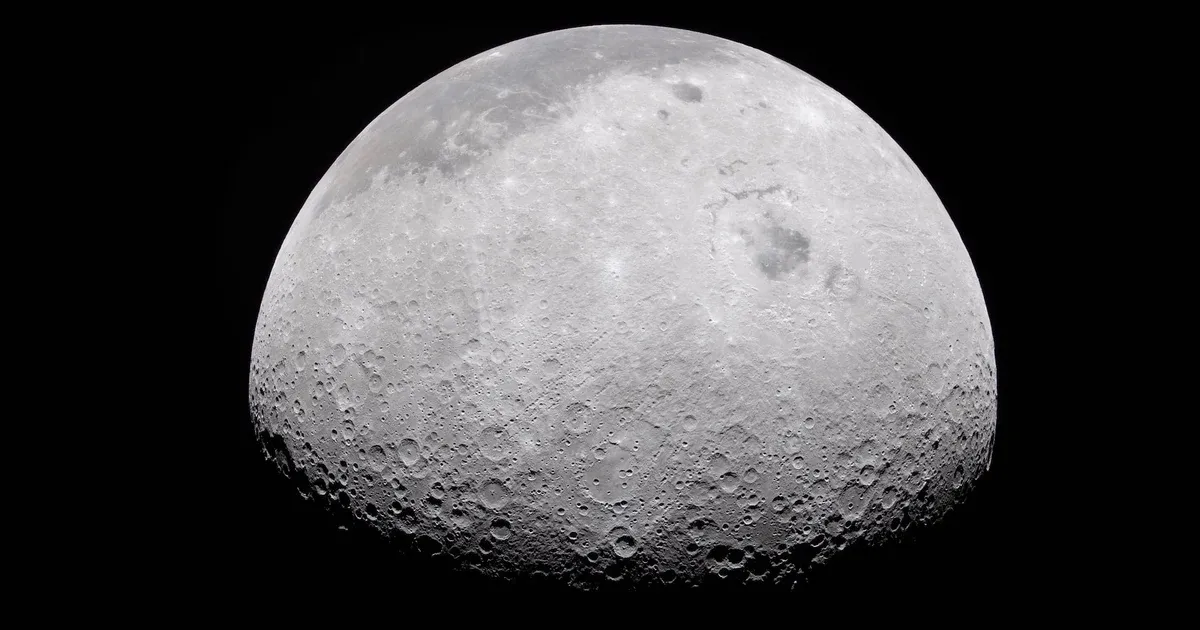
A spent SpaceX Falcon 9 upper stage is believed to have hit the Moon after drifting through a looping Earth-Moon orbit for about 18 months. Tracking placed the likely collision near the Einstein and Bell craters, where the impact may have opened a fresh crater and thrown a plume of lunar material above the surface.
The object was neither a spacecraft making a landing attempt nor an uncontrolled threat to Earth. It was the empty stage that had pushed two commercial lunar landers out of Earth orbit in January 2025. Mashable and the BBC reported the expected impact on August 5, 2026, while NASA teams and observatories began looking for evidence that the predicted collision occurred.
A Known Rocket Became a Difficult Orbital Target
The upper stage had completed its launch job before it became debris. The Falcon 9 carried Firefly Aerospace's Blue Ghost 1 and another lander toward the Moon, then left a stage at least 4,000 kilograms in mass and roughly the height of a five-story building on a wide orbit. Unlike the booster's reusable first section, this hardware remained in space.
Its later path was shaped by small forces accumulated over time. Gravity from Earth, the Moon and the Sun altered the orbit, while sunlight added a faint but persistent push. Astronomers using public tracking data followed those changes, and NASA's Center for Near Earth Object Studies confirmed that the stage was heading toward the lunar surface.
Calculations put the likely strike at about 06:35 GMT on Wednesday, with the object moving near 5,400 mph, or 8,700 km/h. NASA expected it to reach the area around the Einstein and Bell craters. The agency estimated that the collision could excavate a hole about 60 feet wide and 12 feet deep. Those figures make the event specific enough to test, but they do not substitute for an image of the site. Einstein crater is more than 180 kilometers wide and already contains smaller craters, so researchers must locate a modest new scar within a heavily marked region.
The Impact Was Easier to Calculate Than to Watch
A flash from a 14-meter object hitting the Moon would last only a fraction of a second. Daylight covered much of the viewing area on Earth, and amateur telescopes were unlikely to capture it. A dust plume could have risen as far as 100 kilometers and remained visible for several minutes, but no observer was guaranteed the right combination of darkness, weather and pointing.
Spacecraft were poorly placed as well. South Korea's Danuri orbiter passed near the expected site shortly before the predicted time, and its team said any useful material would follow analysis. NASA's Lunar Reconnaissance Orbiter was due to photograph the region later, allowing researchers to compare the surface before and after the event. Ground observatories in the Americas also began processing their observations.
That sequence leaves the central claim deliberately provisional: the stage likely struck the Moon, but the crater and debris pattern still need to be identified. Image processing may take days or weeks because researchers must separate a small new feature from an already cratered landscape 385,000 kilometers away.
Known Mass and Speed Turn Debris Into an Experiment
Most lunar impacts arrive with uncertain inputs. In this case, researchers have estimates for the stage's size, mass, speed and impact point. Those constraints make the collision closer to a calibrated experiment than a random meteoroid strike. Researchers also know the stage was empty, reducing uncertainty about the object that carried the energy. A before-and-after image can then connect a defined piece of hardware to one measured scar in the regolith. Scientists can compare the predicted energy with the crater diameter, the reach of the ejecta and any tremors moving through the lunar interior.
The results have practical value for future missions. Data on ejecta travel can help engineers decide how far a lander or habitat should sit from operations that may throw debris. Measurements of surface shaking can refine assumptions about equipment stability. Material exposed from below the surface may also reveal geological layers and add evidence about the Earth-Moon system's formation roughly 4.5 billion years ago.
Confirmation Will Define What the Crash Actually Taught
Engineers have intentionally used the Moon as a target for decades. The 2009 LCROSS water-ice experiment belongs to that tradition, as do earlier arrivals involving Luna 2, Ranger probes and discarded Apollo hardware. The most recent confirmed accident before this event occurred in 2022; investigators connected that object to a launch supporting China's lunar program. NASA describes upper-stage disposal on the Moon as an accepted option in some low lunar missions, and said this event created no danger to Earth.
The newest collision is useful only if observations close the loop between prediction and result. A confirmed crater would test orbital tracking, impact models and lunar surface forecasts with one shared dataset. A missing or differently placed crater would be informative too, because it would expose error in the assumed trajectory or physical inputs. The immediate story is a likely Falcon 9 lunar impact; the durable result will be the comparison between what the models predicted and what the Moon now shows.