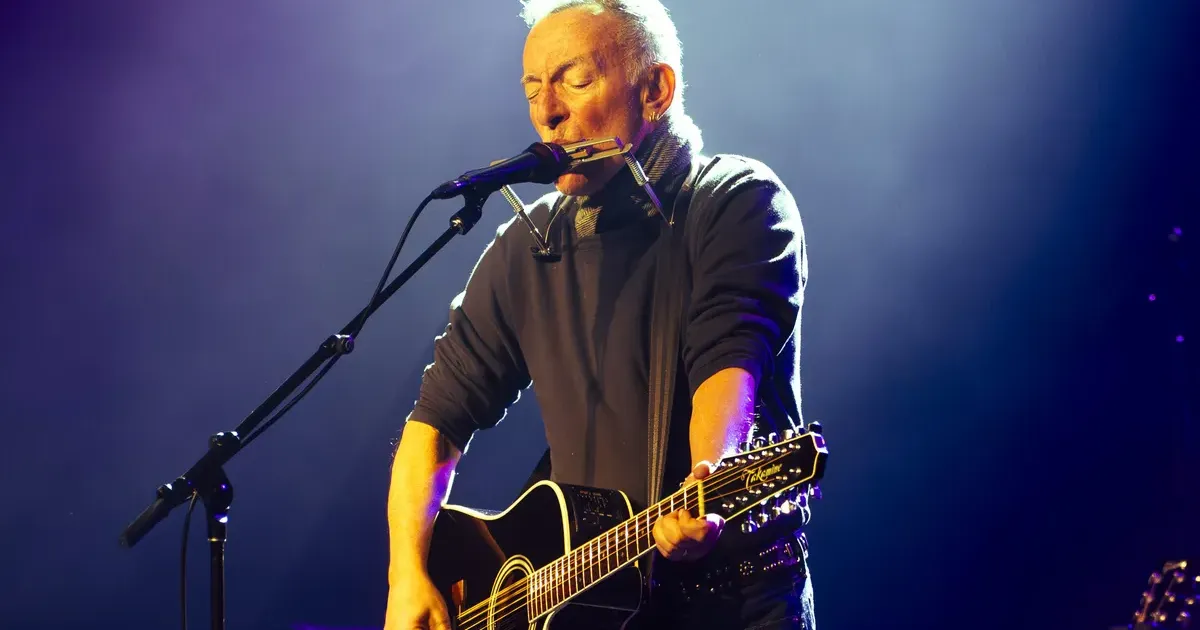
Bruce Springsteen sparked his 2026 Land of Hope and Dreams Tour in Minneapolis by delivering a blistering critique of the American political and economic hierarchy. The opening night took place on April 1, 2026. Performing before a capacity crowd at the Target Center, the veteran rock musician discarded his usual role as a cultural unifier in favor of a direct confrontation with the current administration and its wealthiest allies. He opened the evening not with a hit from his own catalog, but with a gravelly, high-octane rendition of Edwin Starr’s 1970 anti-war anthem, War. This choice set a combative tone for a three-hour set that prioritized message over nostalgia. Voters across the Midwest have long viewed the New Jersey native as a voice for the working class, yet his rhetoric on opening night suggested a narrower focus on specific figures within the political sphere. Donald Trump and his inner circle received the brunt of the singer's vocal ire during several interludes between songs. Springsteen paused the music to address the crowd, his voice echoing through the arena as he accused the executive branch of fundamental dishonesty. He asserted that the nation currently lacks a leader capable of acknowledging objective reality.
"We have a president who can't handle the truth," Springsteen told the sold-out crowd during a break between songs.
Musicians often shy away from naming specific political subordinates, but Springsteen broke that convention by targeting Pam Bondi during his address. He grouped the former Florida Attorney General with what he described as a cabal of the richest men in America who are currently dictating national policy. While Variety reports the speech focused on the erosion of democratic norms, local observers noted the crowd's reaction was divided, reflecting the deep ideological fractures present in the Twin Cities. Several attendees in the lower bowl began chanting as the singer transitioned into a somber version of Long Walk Home.
Minneapolis is a deliberate starting point for a tour that will traverse several key battleground states over the coming months. Logistical data suggest the production is one of the largest of the year, with estimated gross revenues exceeding $200 million across the North American leg. Critics have pointed to the irony of a performer of Springsteen's wealth attacking the financial elite, though his supporters argue that his platform is necessary to counter the influence of billionaire donors. The E Street Band provided a wall of sound that amplified the urgency of his scripted remarks.
Motown Covers and Political Assertions
Edwin Starr became a focal point of the evening as Springsteen used the lyrics of War to frame his perspective on modern domestic conflicts. By channeling the energy of 1970s protest music, he attempted to bridge the gap between historical movements and contemporary grievances. He leaned heavily into the microphone, emphasizing the futility of current political discussion. Steve Van Zandt and the rest of the ensemble maintained a relentless tempo that prevented the show from becoming a mere lecture. The arrangement of the opening song featured an expanded horn section that added a sense of judicial weight to the proceedings.
Beyond the music, the visual elements of the show reinforced a theme of national reclamation. Large screens displayed imagery of industrial American towns and faces of diverse citizens, contrasting with the specific individuals Springsteen named in his critiques. He moved with an energy that belied his age, pacing the stage while recounting stories of economic hardship he witnessed during his travels. These narratives were a precursor to his more explicit attacks on the wealthy. Declarations of intent punctuated his stories, leaving little room for misinterpretation.
Financial inequality became the primary villain in the singer's revised stage narrative. He spoke at length about the concentration of power in the hands of a few tech moguls and real estate tycoons, claiming these individuals have effectively privatized the American dream. Rolling Stone noted that his comments regarding the richest men in America appeared to be a direct response to recent tax policy changes. He did not provide specific names beyond the political figures, yet his descriptions pointed toward leading Silicon Valley and Wall Street donors who have backed the current administration. The audience responded with a mix of cheers and scattered boos.
Targets of the Boss Criticism
Pam Bondi became an unexpected recurring theme throughout the night. Springsteen linked her legal career and political alliances to a broader effort to undermine the judiciary. By naming her alongside the president, he elevated her role in the eyes of his audience, suggesting that the problem is not merely at the top but resides in the entire administrative structure. He spent nearly five minutes detailing his frustrations with the legal system before launching into a frantic version of Prove It All Night. This specific focus on a cabinet-level figure indicates a more detailed approach to his political activism in 2026.
Historically, Springsteen has used his platform to support Democratic candidates, but the intensity of this Minneapolis opener felt more personal. He avoided the generalities of his previous tours, such as the 2004 Vote for Change run, and instead focused on the character of the individuals currently in power. He described the administration as a fragile ego-system that cannot withstand scrutiny. The band members remained largely stoic during these speeches, providing a steady rhythmic pulse that highlighted the gravity of the singer’s words.
Financial Elite and Regulatory Shifts
Economic policy dominated the middle portion of the concert. Springsteen argued that the current regulatory environment favors the donor class while leaving the average laborer with fewer protections. He referenced the closure of manufacturing plants and the rising cost of living as evidence of a systemic failure. Within this context, his attack on the richest men in America functioned as a call to arms for his listeners to engage more directly in local and national elections. He suggested that the accumulation of wealth has become a barrier to genuine civic participation. The lights dimmed as he began a solo acoustic performance that focused on the themes of loss and resilience.
Activists in the crowd distributed literature regarding voting rights and economic justice during the intermission. These efforts align with the singer's stated goal for the tour to be an active part of the political conversation. While some fans expressed a desire for a purely musical experience, the majority seemed prepared for the evening's ideological weight. Springsteen has never been a passive observer of American life. The Minneapolis show confirmed that he intends to use the 2026 tour as a megaphone for his specific brand of populist resistance.
The tour routing also matters because its first dates sit in politically contested Midwestern markets.
Choosing Minnesota for the opening night reflects a calculated effort to engage with voters in the North. The state has a long history of labor activism, making it a receptive environment for Springsteen’s message regarding the working class. Simultaneously, the city’s recent political shifts have turned it into a snapshot of the broader national debate. By starting here, the tour establishes a baseline of intensity that will likely carry through to dates in Wisconsin, Michigan, and Pennsylvania. Each stop on the itinerary has been selected for its political relevance rather than just its venue capacity.
Final rehearsals for the tour reportedly included several different versions of the opening speech, indicating that Springsteen and his team carefully calibrated the language used on stage. The result was a performance that felt both spontaneous and deeply intentional. He closed the show with a celebratory encore, yet the lingering impact of his earlier remarks remained the primary topic of conversation as the crowd exited. He is no longer just a rock star; he is a partisan navigator in a period of extreme volatility.