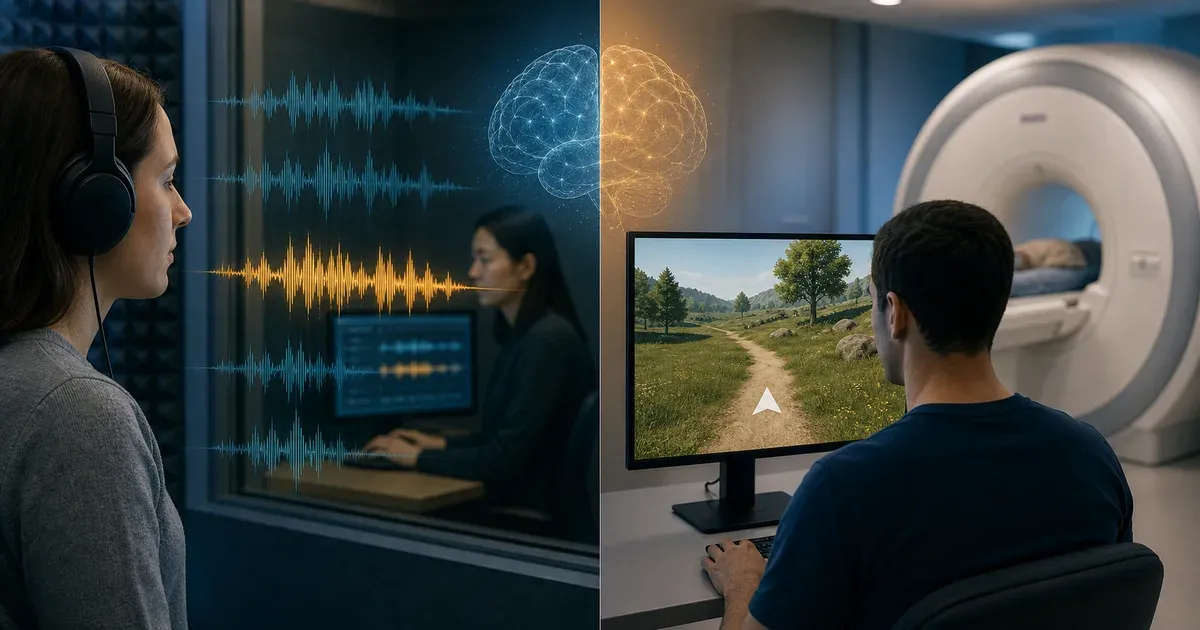
Two neuroscience papers published a day apart investigated different questions with different methods. One tested whether feature-based gains in an artificial neural network could reproduce human selective listening. The other examined how a single dose of hydrocortisone affected virtual navigation and fMRI signals in healthy young men.
Their proximity on the news calendar does not make them one biological mechanism. The selective-listening paper did not manipulate stress or cortisol. The navigation paper did not test speech, background noise or auditory attention.
Combining them into a story about stress simultaneously destroying focus and the brain's internal map creates a conclusion neither research team tested. It also hides the most important details: the first study centered on a computational model, while the second used an acute drug challenge whose cortisol levels exceeded an average acute stress response.
The Listening Study Tested a Model, Not Inhibitory Neurons
MIT researchers built auditory neural-network models that heard a short cue from a target talker and then a mixture containing that voice and competing sounds. Feature gains derived from the cue altered internal model activations so the system could identify a target word from a vocabulary of 800 choices.
The models reproduced several patterns previously seen in people. Selection was easier when target and distractor voices differed in features such as pitch or spatial location, and errors increased when competing voices were more similar. The researchers trained ten versions of the feature-gain architecture and compared their behavior with alternative model designs.
Human experiments were part of the paper, including a main experiment with 195 adults. The model also generated predictions about spatial attention that the team then tested in listeners. This combination supports the idea that multiplicative feature gains can provide a useful computational account of selective listening.
It does not show that scientists imaged the thalamus and auditory cortex, isolated a set of inhibitory neurons or watched those cells suppress every unwanted voice. The Nature Human Behaviour paper says its results do not definitively locate attentional selection in the brain. It also did not test whether stress weakens the modeled gains.
The Cortisol Experiment Used a High Acute Dose
The Ruhr University Bochum-led study began with 42 healthy men and analyzed 39 participants aged 19 to 34. Each participant completed two sessions one week apart in a double-blind crossover design, receiving 20 mg of hydrocortisone on one day and placebo on the other.
About 40 minutes after the tablets, participants performed a virtual path-integration task during fMRI. They moved through a simulated grassy environment toward temporary targets and then tried to return to a remembered starting location. Some trials included a lighthouse landmark; others required navigation without a stable landmark.
Cortisol increased the distance between the reported and correct goal locations. The main treatment effect was statistically significant, but the reported partial eta-squared value was 0.002 at the trial level. Cortisol did not change how closely participants navigated to the landmark, and the behavioral effect did not depend on landmark availability or incoming distance.
The authors stressed that pharmacological cortisol is not identical to acute stress. Salivary levels produced in the experiment were much higher than average acute stress responses. The study therefore demonstrates an effect of this controlled dose and setting; it does not show that an ordinary difficult meeting causes the same impairment.
fMRI Did Not Directly Record Grid Cells Collapsing
The researchers analyzed blood-oxygen-level-dependent fMRI patterns in the entorhinal cortex as a proxy for grid-like representations. They did not record individual grid cells firing. Under placebo, a right-entorhinal grid-like pattern appeared on the first testing day; it was not detected under cortisol in that day-one analysis.
That neural result carried qualifications. The grid-like finding interacted with testing day, so key comparisons were restricted to day one. The authors said they could not fully determine the contribution of order effects. They also could not distinguish whether cortisol disrupted grid coding itself or reduced the consistency of grid orientation across trials.
The sample included only young healthy men, limiting generalization. The task measured a specific form of path integration in a virtual environment, not everyday memory, driving performance, workplace efficiency or a person's ability to remember why they entered a room.
The paper discussed the entorhinal cortex because it is relevant to navigation and is affected early in Alzheimer's disease. It did not diagnose dementia, measure long-term cognitive decline or show that one dose permanently damaged the region. A proposed research connection is not a demonstrated disease pathway.
No Evidence Supports the Clinical Leap
Neither paper studied autism, ADHD, sensory-processing disorders, anxiety treatment or burnout. The listening model may eventually inform work on cochlear implants, which the researchers identified as an application they are pursuing. That is different from identifying a malfunctioning neural target for medication.
The cortisol experiment likewise did not test beta-blockers, cortisol-modulating drugs or any intervention intended to preserve performance in emergency rooms or air-traffic control. Recommending such use would move beyond both the study population and the outcomes measured.
These papers are valuable when kept separate. The listening study shows that an optimized feature-gain model can reproduce successes and failures in selecting a cued voice. The navigation study shows that an acute 20 mg hydrocortisone challenge modestly worsened path-integration accuracy and altered some fMRI measures in a small male sample.
Future work can test whether the listening model maps onto specific biological circuitry and whether navigation findings replicate across sexes, ages, doses and real-world stressors. It can also separate transient performance changes from lasting effects.
The strongest conclusion is not that modern stress chemically sabotages a unified focus-and-navigation system. It is that two narrow experiments answered two narrow questions. Turning computational gains and an acute drug challenge into permanent neural decay would erase the boundaries that make both results scientifically interpretable.