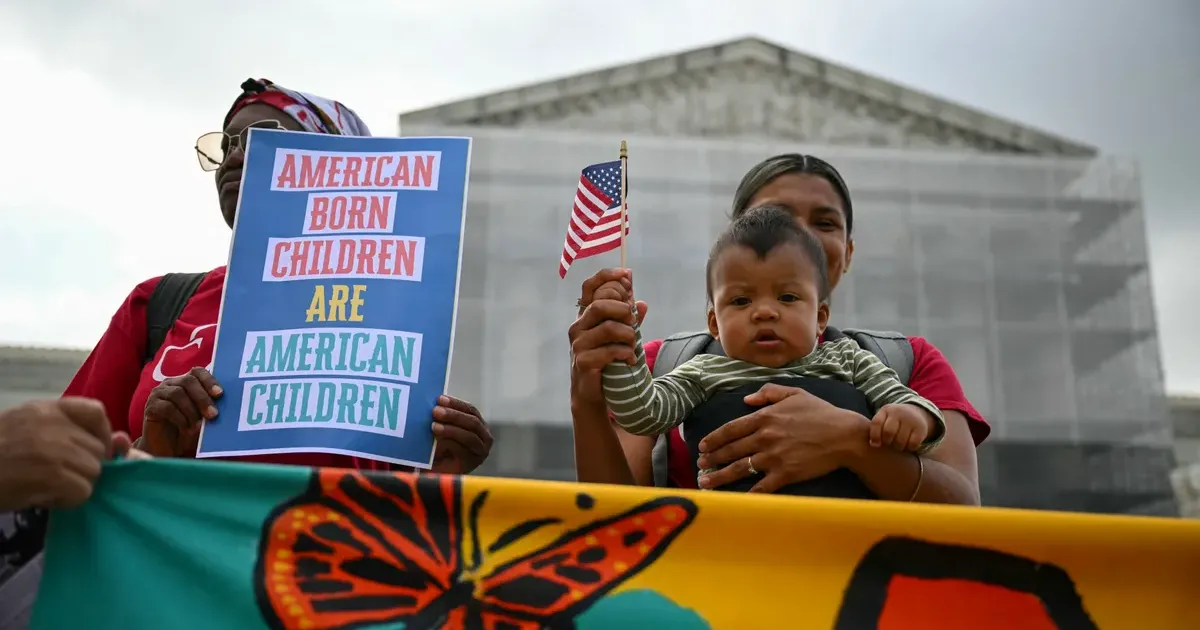
The Supreme Court's decision in Trump v. Barbara turned President Donald Trump's birthright citizenship order into a constitutional and statutory defeat. The Court held that children born in the United States to parents who are unlawfully present or temporarily present are citizens at birth, blocking the administration's attempt to narrow the rule by executive order.
The ruling mattered far beyond one immigration fight. Birthright citizenship is the legal foundation for passports, Social Security numbers, school enrollment, public benefits eligibility, state records, family security and basic identity. Changing that rule by presidential signature would have forced hospitals, parents, states and federal agencies into a citizenship verification system at the moment of birth.
The Court refused that route. The result preserved the post-Civil War constitutional settlement and made clear that national membership cannot be rewritten through an executive workaround.
The Holding Was Direct
Children born in the United States to parents unlawfully or temporarily present are citizens at birth.
The sentence from the Court's syllabus captured the practical effect of the decision. Trump's order had argued that such children were not fully subject to the jurisdiction of the United States and therefore did not receive citizenship under the 14th Amendment's Citizenship Clause or the federal statute that uses the same language.
The Court rejected that reading. The majority treated the Citizenship Clause and the Immigration and Nationality Act as carrying the familiar rule: nearly everyone born on U.S. soil is a citizen, with narrow historical exceptions that do not cover the children targeted by the order.
The decision also ended the administration's attempt to use executive power as the first move in a constitutional rewrite. The president could litigate the question. He could not make newborn citizenship depend on his own interpretation while families and agencies absorbed the consequences.
The Fourteenth Amendment Did the Work
The 14th Amendment was written after the Civil War to repudiate a citizenship order built on exclusion. Its first sentence declares that all persons born or naturalized in the United States, and subject to its jurisdiction, are citizens of the United States and of the state where they reside.
Trump's argument tried to narrow the jurisdiction phrase by tying a child's citizenship to the parent's immigration status. The proposed reading would have changed more than immigration enforcement. It would have made citizenship at birth conditional for a large class of U.S.-born children.
The Court's answer protected the older understanding that territorial birth, not parental status, is the baseline. Justice Brett Kavanaugh separately emphasized the federal statutory ground, but the result still left the executive order without a lawful path.
The Administrative Stakes Were Enormous
If the order had survived, the birth certificate would no longer settle the citizenship question in the same way for every child born in the country. Parents could have been asked to prove immigration status before agencies recognized a newborn as a citizen. Hospitals, registrars, passport officers, schools and benefits systems would have faced a new verification burden.
The burden would not have stayed neatly confined to undocumented families. Once citizenship depends on parental proof, the whole system has to ask for proof. U.S. citizens, visa holders, permanent residents, mixed-status families and vulnerable parents with poor documentation could all be pulled into the same administrative maze.
Citizenship cannot function if every newborn starts life inside a paperwork dispute. The Court's decision prevented that instability before it became an operating rule.
The Politics Did Not End
Trump and his allies attacked the ruling almost immediately. Some floated rehearing, legislation, tighter visa restrictions or new theories aimed at birth tourism. The reaction showed why the decision should not be read as closure.
A rehearing is unlikely because the Court almost never grants one, and legislation would run into the same constitutional barrier unless it stayed within the rule the Court affirmed. A constitutional amendment would be the clean legal route for opponents of birthright citizenship, but that path is politically much harder than an executive order.
Pressure can still come through rhetoric and administration. Agencies can still make life difficult through forms, delays, guidance and enforcement choices. The ruling blocks the central order, but it does not erase the political appetite behind it.
Barrett Became Part of the Backlash
The decision also exposed a fracture on the right over what conservative judges are expected to do. Justice Amy Coney Barrett's role in the outcome drew anger from Trump-aligned commentators, even though her broader record remains conservative.
The backlash matters because it shows how the politics around the Court have changed. Some parts of the MAGA movement no longer want only originalist language or conservative credentials. They want predictable alignment with current movement priorities, including immigration positions that earlier conservative legal networks did not always center.
The case therefore became a citizenship ruling and a judicial-politics warning. Future nomination fights will likely test judges more aggressively on birthright citizenship, nationwide class relief and executive power.
The Barrier Held, but the Fight Moved
The ruling protected birthright citizenship for this round. It reaffirmed that a child born in the United States does not lose citizenship because a parent lacks lawful status or holds temporary status. It also reminded presidents that constitutional meaning is not created by order.
The deeper fight now moves elsewhere. Opponents can push legislation, visa restrictions, agency guidance, campaign pressure and future litigation. Supporters will have to defend the ruling not only in court but in the administrative systems that issue records, documents and benefits.
The Supreme Court gave a firm answer to Trump's executive order. The political campaign to narrow belonging did not disappear. It simply lost its fastest route.