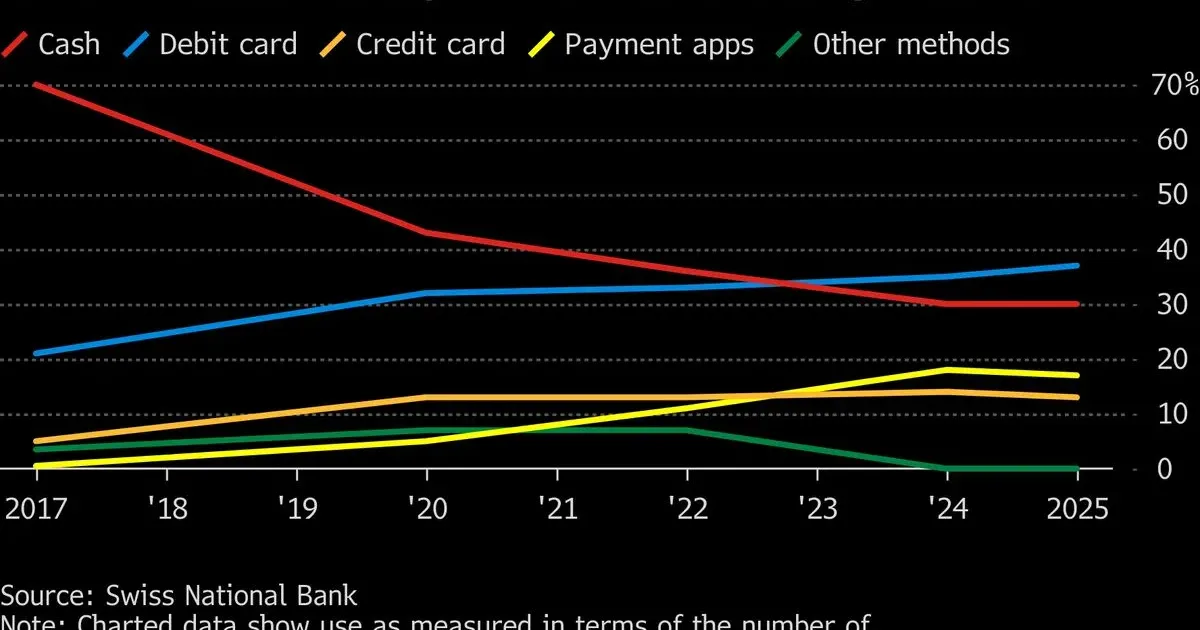
Switzerland's cash vote was not a simple victory for every demand made by cash campaigners. Voters rejected the popular initiative known as Cash is Freedom, but they approved the government and parliamentary counterproposal by a wide margin. That result still moved cash into constitutional infrastructure policy, just in a less rigid form.
On March 8, 2026, 54.39% of voters rejected the initiative, while 73.39% approved the counterproposal on Swiss currency and cash supply. The two votes produced distinct results. Swiss voters did not endorse the campaigners' full wording. They did, however, support a constitutional mandate to protect the availability of banknotes and coins in an economy where payments are moving quickly toward cards, apps and platforms.
The Counterproposal Was The Swiss Compromise
The initiative wanted stronger constitutional language around an independent and free Swiss currency with coins or banknotes. Parliament and the Federal Council recommended rejecting that text and accepting a counterproposal with a similar broad goal but less rigid implementation.
The compromise absorbed the public concern, avoided maximal wording and preserved room for practical administration. The vote says cash should remain available. It does not freeze every future payment rule or require the economy to pretend digital payments are not growing.
Cash Protection Is About Access
The issue is not whether cards and mobile payments are convenient. They are. Twint, cards and online banking have become part of everyday Swiss life, and many merchants prefer the speed and accounting simplicity of digital transactions.
The question is whether a digital-first economy can still guarantee access for older residents, rural communities, tourists, people with limited banking access and anyone who does not want every small purchase routed through a private platform. If ATMs and bank branches disappear, the right to use cash becomes weaker even if the law still praises it.
Privacy Is Part Of The Vote
Cash plays a special role in Switzerland because it is tied to privacy, resilience and trust in the franc. The 1,000-franc note remains one of the world's highest-value banknotes in regular circulation, and Swiss voters have long been wary of measures that look like unnecessary interference with payment freedom.
That privacy argument can sound old-fashioned until ordinary purchases become permanent data points. A coffee, train ticket, pharmacy visit or political donation can create a record held by companies and potentially visible to authorities. Digital payments are useful, but they are not neutral from a data perspective.
Digital Convenience Has A Fragility Problem
Digital payments depend on electricity, telecom networks, functioning apps, payment processors and merchant terminals. Most of the time, that chain works. When it fails, cash becomes the backup. That backup role becomes more important as fewer people carry cash by habit.
Opponents of strong guarantees have a real point: maintaining cash is expensive. Banks pay for machines, transport, security and branch staffing. Retailers handle counting, theft risk and deposit logistics. But a purely private cost calculation does not answer the public-access question. Infrastructure often costs money precisely because society wants it to remain available before a crisis proves it was needed.
The Market Cannot Decide Alone
A society that permits only tracked payments gives banks, processors and technology companies unusual power over ordinary exchange. Swiss voters did not reject digital convenience. They insisted that convenience should not quietly become dependence.
Cash is becoming less dominant but more politically important. As everyday use declines, the remaining role of physical money becomes clearer: fallback, privacy tool and inclusion mechanism. Switzerland's vote says a payment system should not be redesigned only around what is cheapest for banks and easiest for platforms.